
Ben Youssef Madrasa, Marrakech: History & Visitor Guide
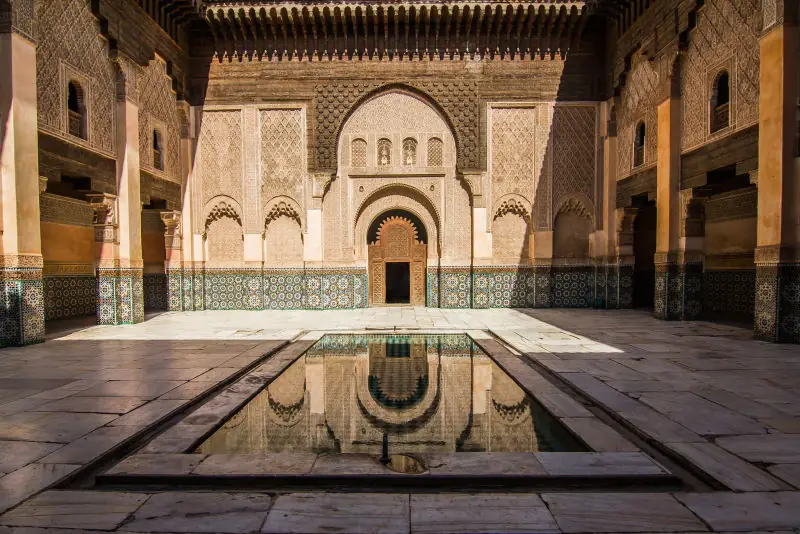
The Ben Youssef Madrasa is one of the finest historic sights in Marrakech. Once the largest Islamic college in the Maghreb, it has a magnificent courtyard decorated with carved cedar, stucco and zellige tiles. It stands in the heart of the medina, close to the souks and the Marrakech Museum.
At a glance
- Location
- Marrakech medina
- Built
- 14th century (Marinid), rebuilt 1564 to 1565 (Saadian)
- Style
- Hispano-Moorish
- Allow
- 45 to 60 minutes
- Open to visitors
- Yes, ticketed
In this guide
History
The site belongs to the old religious quarter around the Ben Youssef Mosque, founded in the 12th century by the Almoravid Sultan Ali ibn Yusuf, after whom the district is named. The madrasa itself was founded by the Marinid Sultan Abu al-Hassan in the 14th century and rebuilt by the Saadian Sultan Abdallah al-Ghalib in the 1560s, who made it the largest in Morocco. For centuries it trained students in Islamic law, theology and the sciences, and it closed as a college in the 1960s.
What to see
- The central courtyard: a rectangular pool reflects walls decorated with zellige, intricate stucco and carved cedar.
- The prayer hall: an exquisite room with carved plasterwork and a mihrab.
- The student cells: around 130 small rooms on two floors, arranged around patios, which give a sense of student life.
- Craftsmanship: look for muqarnas (honeycomb vaulting) and calligraphic bands. See our architecture guide.
Visiting tips
- Arrive early or late in the day to avoid tour groups and to enjoy the light in the courtyard.
- Check opening hours and ticket details locally, as they can change; combined tickets may cover nearby sights.
- Dress modestly, and keep voices low in the prayer hall.
- Allow about an hour, and combine with the nearby Marrakech Museum and Almoravid Koubba.
Getting there
The madrasa is in the north of the medina, about 15 to 20 minutes' walk from Jemaa el-Fna. Follow the signs from the souks, and use a map app or ask for directions. Taxis cannot enter the medina.
Nearby
Pair it with the Bahia Palace, the Jardin Majorelle and the rest of Marrakech. For a comparison, see the Al Attarine Madrasa in Fes.
Photography tips
The courtyard is at its best in the first hour after opening, when sunlight enters from above and the pool is still calm. Use a wide-angle lens for the courtyard and look for details such as carved cedar eaves, zellige patterns and the intricate stucco around the doors. Avoid using flash or tripods, which are often restricted.
How it compares with other madrasas
Ben Youssef is the largest madrasa in Morocco and a more spacious experience than the Marinid madrasas of Fes, such as Al Attarine. Both are worth seeing: Ben Youssef shows Saadian-era grandeur, while Fes highlights earlier Marinid craftsmanship. See our architecture guide for how these styles differ.
What else is nearby
- The Marrakech Museum, in a former palace with a central atrium.
- The Almoravid Koubba, a small 12th-century dome that is among the oldest surviving monuments in the city.
- The Ben Youssef Mosque, which is not open to non-Muslims.
- Leather and craft workshops in the surrounding souks.
A half-day route
Start at the madrasa, walk to the Marrakech Museum and the Koubba, then continue through the souks towards Jemaa el-Fna for lunch. In the afternoon, take a taxi to the Bahia Palace or the Jardin Majorelle.
Frequently asked questions
Who built the Ben Youssef Madrasa?
It was founded by the Marinid Sultan Abu al-Hassan in the 14th century and rebuilt by the Saadian Sultan Abdallah al-Ghalib in the 1560s.
How long does a visit to Ben Youssef Madrasa take?
About 45 to 60 minutes.
Can non-Muslims enter the Ben Youssef Madrasa?
Yes. It is open to visitors as a historic monument.