
Al Attarine Madrasa, Fes: History & Visitor Guide
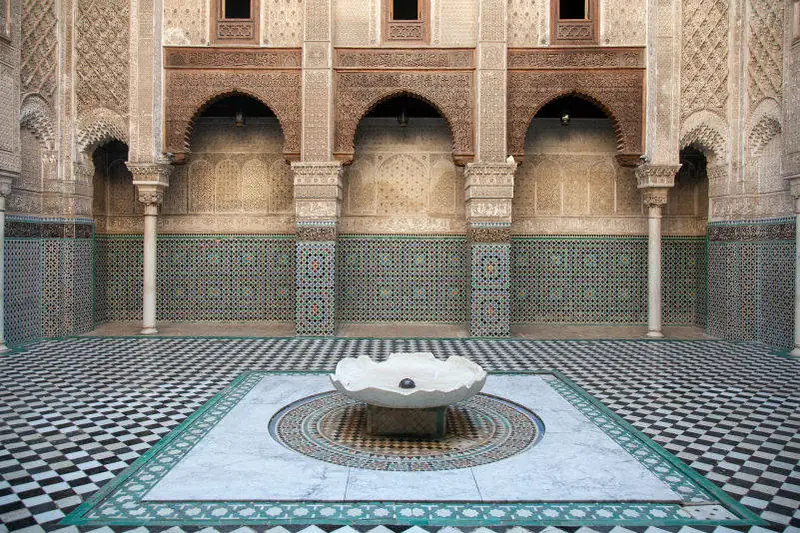
Al Attarine is a small Marinid madrasa in the heart of the Fes medina, named after the nearby spice and perfume sellers. Built in the 14th century, it is compact but exquisite, with a courtyard that many visitors consider more perfectly proportioned than larger madrasas.
At a glance
- Built
- 1323 to 1325 (Marinid)
- Builder
- Sultan Abu Said Uthman II
- Style
- Hispano-Moorish
- Allow
- 30 minutes
- Location
- Next to Al-Qarawiyyin, Fes el-Bali
In this guide
History
The madrasa was built between 1323 and 1325 by the Marinid Sultan Abu Said Uthman II, and was used as a student residence and teaching centre linked to the Al-Qarawiyyin University. It is one of the finest examples of Marinid art, and was restored in recent decades. See our history of Morocco.
What to see
- The courtyard: a central fountain, zellige tiles on the lower walls, carved plaster above and a carved cedar lintel.
- The prayer room: a small hall with a mihrab and beautifully carved details.
- Student cells and roof: small rooms on the upper floor, with a roof terrace that gives views over the medina rooftops and the Al-Qarawiyyin minaret.
Comparing the madrasas
Al Attarine is smaller than the Bou Inania Madrasa, but quieter and often easier to photograph. Both are good examples of the craft traditions described in our architecture guide. In Marrakech, see the Ben Youssef Madrasa.
Visiting tips
- Visit early, before tour groups arrive.
- There is a small entrance fee; check current hours and prices.
- Dress modestly, and speak softly.
- Combine it with the spice market and the Nejjarine Museum.
Getting there
It is in the central medina near Al-Qarawiyyin, about a 15 to 20 minute walk from Bab Boujloud. Use an official guide or a map app, as the alleys are confusing. See our Fes guide.
Details worth noticing
Look closely at the cedar doors and window screens, which are carved with floral and geometric patterns. The stucco bands carry Arabic inscriptions and the tile mosaics follow strict geometric rules. Look up to see the carved wooden lintels and the green tiled roofs visible from the courtyard.
The role of the madrasa
Students lived in small cells and studied at the neighbouring Al-Qarawiyyin. Daily life revolved around prayer, memorising texts and lessons in law, grammar and astronomy. The madrasa also had a small mosque for the students.
The spice market outside
The madrasa is named after the attarine, the sellers of spices, perfumes and herbal remedies whose souk surrounds it. A stroll through the market gives you the scents of cumin, saffron, cinnamon and dried rose petals. See our souk shopping guide.
A short medina walking route
From Bab Boujloud, walk down Talaa Kebira to the Bou Inania Madrasa, continue to Al Attarine and Al-Qarawiyyin, then to the Chouara Tannery. This route takes about half a day with stops. Our Fes guide has more.
Frequently asked questions
Who built Al Attarine Madrasa?
The Marinid Sultan Abu Said Uthman II, between 1323 and 1325.
How long does it take to visit?
About 30 minutes.
Can non-Muslims visit Al Attarine?
Yes. It is open to visitors as a historic monument.