
Bahia Palace, Marrakech: Visitor Guide & History
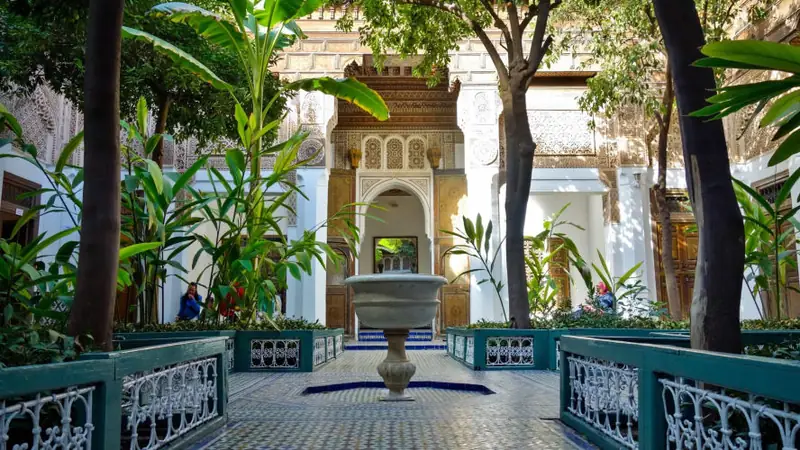
The Bahia Palace is a grand 19th-century residence in Marrakech, built to be the finest palace of its time. Its name means brilliance, and it is still impressive today, with painted cedar ceilings, zellige tilework and tranquil courtyards that show the height of Moroccan decorative art.
At a glance
- Built
- Late 19th century
- Builders
- Si Moussa and his son Ba Ahmed
- Style
- Moroccan and Andalusian
- Allow
- About 1 hour
- Location
- Marrakech medina, near the Mellah
In this guide
History
The palace was begun around 1866 by Si Moussa, grand vizier to the Sultan, and expanded in the 1890s by his son Ba Ahmed ibn Moussa, who served as regent and chamberlain. Craftsmen from Fes and across Morocco worked on it for years. After the French protectorate began in 1912, it was used as a residence by officials, and today parts remain used by the royal family while the rest is open to the public.
What to see
- The Grand Courtyard: a huge marble-paved court surrounded by painted doors and galleries.
- The Small Court and apartments: richly decorated rooms with carved and painted cedar ceilings.
- Gardens and fountains: shady orange trees and tiled paths offer relief from the sun.
- Craft details: look at the geometric zellige and stucco. See Moroccan architecture.
Visiting tips
- Go as soon as it opens, when it is quieter and the light is best for photographs.
- Only part of the palace is open, and rooms are mostly empty of furniture, so the decoration is the attraction.
- Check current opening hours and ticket price locally.
- Combine with the nearby El Badi Palace, Saadian Tombs and the Jemaa el-Fna.
Getting there
The palace is in the south of the medina, around 15 minutes' walk from the main square, or a short taxi ride to the entrance. See our Marrakech guide for how to plan the day.
Understanding the decoration
The Bahia Palace brings together the best Moroccan craftsmen of the late 19th century. The ceilings are painted cedar in geometric and floral patterns, the walls are covered in carved plaster, and the floors are laid with zellige and marble. Look at the doors, which are often decorated with elaborate floral motifs and metal fittings.
What the palace was like to live in
Ba Ahmed built the palace as a residence for his family, including his four wives and many concubines, and it had its own hammam, gardens and courtyards. It was intended to be the grandest palace in Morocco at the time, and it was also a statement of political power. Few furnishings survive, but the plan shows how a wealthy household was organised.
Tips for a good visit
- Visit early, since it can get very crowded with tour groups by late morning.
- Do not rely on guides at the gate; guided tours can be arranged officially, and signs explain the main rooms.
- Bring a hat and water in summer, since many courtyards are open to the sun.
Combine with
The nearby Saadian Tombs, El Badi Palace and the Mellah (old Jewish quarter) make a good morning in the south of the medina. See our Marrakech guide and Ben Youssef Madrasa guide.
Frequently asked questions
Who built the Bahia Palace?
Si Moussa, grand vizier to the sultan, began it around 1866, and his son Ba Ahmed expanded it in the 1890s.
How long do you need at the Bahia Palace?
About an hour is enough.
Is the Bahia Palace worth visiting?
Yes. It is one of the best places in Marrakech to see traditional Moroccan decoration.