Casablanca Travel Guide: The Mosque, Art Deco Streets and the Corniche
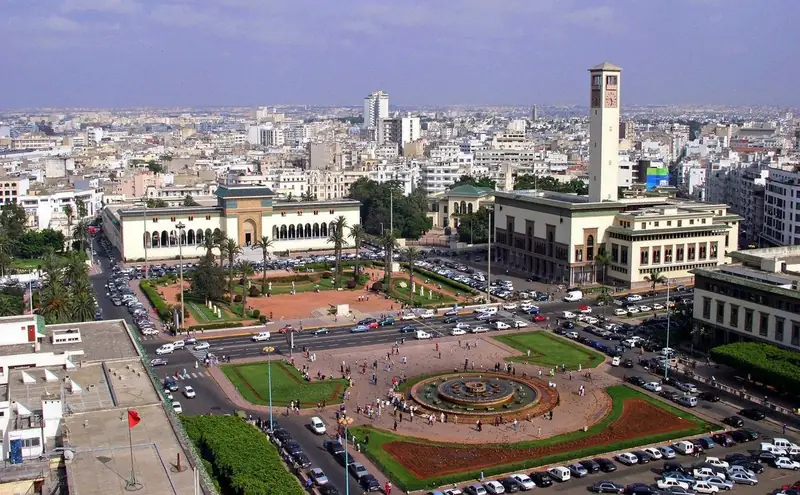
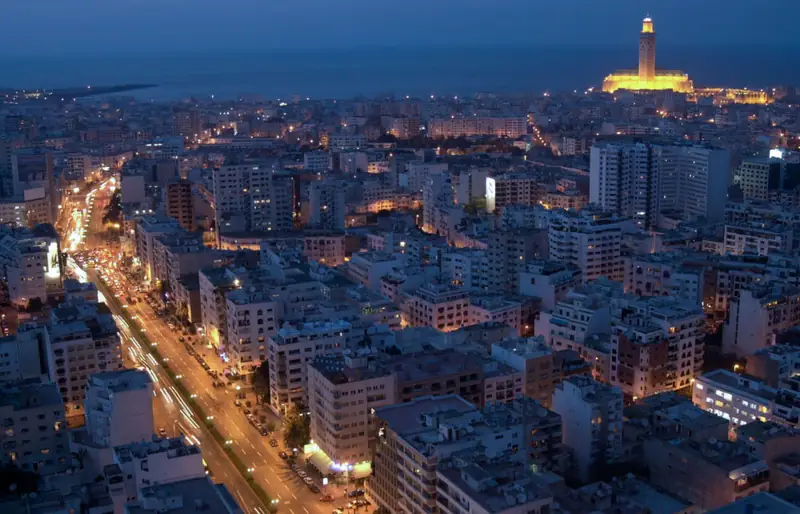
This Casablanca travel guide starts with the short answer: give the city one full day, or two if your flight lands or leaves here. Morocco’s largest city and main air hub is a sprawling Atlantic port without a postcard medina, but it has the Hassan II Mosque, one of the few mosques in the country that non-Muslims can enter, a remarkable Art Deco centre and a long seafront Corniche. Trains link the airport, the centre, Rabat, Tangier and Marrakech.
Expect traffic, long distances between sights and a workaday mood, balanced by excellent seafood, good coffee and Atlantic sunsets. Below you will find the sights, current prices, a two-day plan, where to stay, food, transport, seasons and etiquette.
Plan the day around the mosque tour. Non-Muslims can enter the Hassan II Mosque only on a guided tour at set times, with fewer tours on Fridays and during Ramadan. Buy tickets at the office beside the mosque and aim for the first tour.
At a glance
- Population
- About 3.2 million (2024 census)
- Highlight
- Hassan II Mosque
- Allow
- 1–2 days
- By train
- Rabat about 1 h, Tangier 2 h 10
- Airport
- Mohammed V (CMN), about 30 km south
- Best time
- March–May and September–November
In this guide
- Is Casablanca Worth Visiting?
- Best Things to Do in Casablanca
- Casablanca Prices: Sights, Food and Transport
- A 2-Day Casablanca Itinerary
- Where to Stay in Casablanca
- What to Eat in Casablanca
- Getting to Casablanca and Getting Around
- Best Time to Visit Casablanca
- Day Trips from Casablanca
- Safety and Etiquette in Casablanca
- Money, SIM Cards and Tipping
Is Casablanca Worth Visiting?
Yes, for a night or two, ideally at the start or end of a trip. The Hassan II Mosque alone justifies the stop, though heavy traffic and a gritty, workaday feel can disappoint after Fes or Marrakech. Calmer Rabat, an hour away by train, makes an easy pairing.
- Flying in or out: a night here breaks up the journey, and the mosque is about an hour from the airport.
- Architecture fans: two days leave time for the Art Deco centre, the Habous quarter and a museum.
- Short on time: the mosque, the old medina and the Corniche fit into one long day.
Best Things to Do in Casablanca
Casablanca is spread out, so think in areas: the mosque and the old medina by the port, the Art Deco centre and the Habous quarter inland, and the Corniche to the west.
The Hassan II Mosque
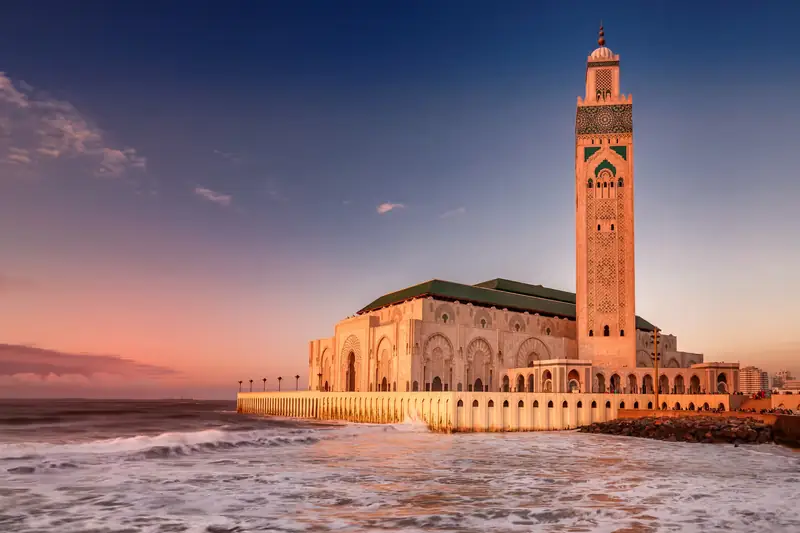
Completed in 1993 partly over the Atlantic, the mosque was designed by the French architect Michel Pinseau and finished by thousands of Moroccan craftsmen in marble, carved cedar and zellige. Its 210-metre minaret is the world’s second tallest, and the prayer hall holds 25,000 worshippers, with room for 80,000 more outside. The hour-long guided tour covers the prayer hall and the ablutions hall below; see our Hassan II Mosque guide.
The Art Deco city centre
Between the 1910s and the 1950s, French architects made Casablanca a laboratory of modern design. Boulevard Mohammed V and the streets around the Central Market are lined with Art Deco and neo-Moorish facades, wrought-iron balconies and carved stucco, best in the soft morning light. Place Mohammed V groups the clock-towered prefecture, the law courts and the post office around a fountain; nearby, the white 1930 Sacré-Cœur, a former church, hosts cultural events, so check whether it is open.
The Habous quarter and the old medina
The Habous, or New Medina, was built in the 1920s and 1930s as a planned take on a traditional town, with arcaded lanes, bookshops, olive stalls and old-fashioned pastry shops. The old medina by the port is smaller and more everyday than those of Fes or Marrakech. Its lanes lead to the Sqala, an 18th-century cannon bastion, and to Rick’s Café, a 2004 homage to the 1942 film, shot entirely in Hollywood.
The Corniche and Ain Diab
West of the mosque, the coast road passes the El Hank lighthouse on its way to Ain Diab, where beach clubs, restaurants and cafés line a promenade that fills with families and joggers at sunset. Tram T2 runs there. Currents are strong, so swim only where lifeguards are on duty.
The Museum of Moroccan Judaism
In the leafy Oasis district, a 1948 villa that once housed a Jewish orphanage holds the Museum of Moroccan Judaism, opened in 1997 and often called the only Jewish museum in the Arab world. Torah scrolls, costumes and jewellery recall a community that once numbered tens of thousands here. It opens on weekdays only; check hours and fees before you go.
Buy mosque tickets on site. Standard tour tickets are sold at the official office beside the mosque. Agency “skip-the-line” tickets cost more, so compare prices before you pay.
Casablanca Prices: Sights, Food and Transport
Walking the Corniche, the Art Deco centre and the old medina is free. These are typical 2026 prices for foreign visitors; the mosque’s museum charges a separate 30 MAD (≈ €3 / $3).
| Item | Cost | Tip |
|---|---|---|
| Hassan II Mosque tour | 140 MAD (≈ €13 / $14) | Cover shoulders and knees |
| Tram ticket | 8 MAD (≈ €0.70 / $0.80) | Buy at stop machines |
| Petit taxi in town | Most rides 10–25 MAD (≈ €1–2 / $1–3) | Meter; 50% more after 8pm |
| Central Market seafood | 60–150 MAD (≈ €6–14 / $6–15) per person | Check prices first |
| Airport train | 43–50 MAD (≈ €4–5 / $4–5) | Roughly hourly |
| Airport grand taxi | 250–350 MAD (≈ €23–32 / $25–35) | Agree the fare first |
Prices may vary; always check them on site.
A 2-Day Casablanca Itinerary
Take the mosque tour on the first morning and save the Art Deco walk for the second.
- Day 1 · MorningJoin the first mosque tour, then walk the esplanade and the seafront.
- Day 1 · AfternoonHave grilled fish at the Central Market, then wander the old medina to the Sqala bastion.
- Day 1 · EveningCatch the sunset on the Corniche at Ain Diab and dine by the sea.
- Day 2 · MorningWalk Boulevard Mohammed V to Place Mohammed V and the Sacré-Cœur.
- Day 2 · AfternoonBrowse pastries, books and olives in the Habous, or see the Museum of Moroccan Judaism (weekdays).
- Day 2 · EveningHave dinner in Gauthier or Maarif, the liveliest restaurant districts.
With a third day, take the train to Rabat or El Jadida.
Where to Stay in Casablanca
Choose the area by your plans: the centre for sights and trains, the Corniche for the sea.
| Area | Best for | Trade-off |
|---|---|---|
| City centre | Art Deco streets, Casa-Port, old medina on foot | Noisy; some streets feel rough after dark |
| Gauthier and Maarif | Restaurants, cafés, nightlife | Taxi ride to the mosque and medina |
| Corniche and Ain Diab | Sea views, pools, tram T2 to the centre | Far from the main stations |
| Near the airport | Late arrivals and early flights | About 30 km from the city |
Business hotels often cut prices at weekends; book ahead for Jazzablanca in early July and big football matches.
What to Eat in Casablanca
Seafood is the city’s strength. At the Central Market on Boulevard Mohammed V, small stalls grill the day’s catch to order amid fishmongers and flower sellers; ask the price by weight or check the menu before you sit down. The port and the Corniche have smarter fish restaurants for a seafront dinner.
Casablanca also has Morocco’s widest choice of international cooking and specialty coffee, especially in Maarif and Gauthier. For local flavours, try harira, bissara and fried fish in the old medina and almond pastries in the Habous. Licensed restaurants, hotels and bars serve alcohol.
Getting to Casablanca and Getting Around
- By air: Mohammed V Airport (CMN), about 30 km south, is Morocco’s main hub. Trains leave from below Terminal 1 roughly hourly and take about 45–50 minutes to Casa-Voyageurs, continuing to Casa-Port.
- By train: from Casa-Voyageurs, Al Boraq high-speed trains reach Rabat in about an hour and Tangier in 2 h 10; Al Atlas trains take 2 h 40–3 h 20 to Marrakech and 3.5–4 hours to Fes. See our train times.
- By bus: CTM and Supratours coaches serve most cities, including Essaouira, Agadir and Chefchaouen.
- By tram: four tram lines and two busway lines share one 8 MAD ticket and run until about 22:30; T1 serves Casa-Voyageurs and the centre, T2 runs to Ain Diab and T3 ends at Casa-Port.
- By taxi: red petit taxis run on the meter, carry up to three passengers and may pick up others; they cannot leave the city, so take a white grand taxi to the airport.
Since September 2026, high-speed line works have brought revised timetables and occasional replacement buses on the airport line, so check ONCF before travelling. On a layover, leave the airport only with seven hours or more.
Best Time to Visit Casablanca
| Season | Weather | Verdict |
|---|---|---|
| Mar–May | About 20–23 °C by day; showers ease by May | Ideal for walking |
| Jun–Aug | About 24–27 °C, humid; morning sea mist | Beach season; busy in July |
| Sep–Nov | About 21–26 °C; warm sea; rain returns in November | Excellent, especially Sep–Oct |
| Dec–Feb | About 17–19 °C by day, 9–10 °C at night; rainiest season | Quiet; pack a rain jacket |
The ocean keeps Casablanca far cooler in summer than Marrakech or Fes. Jazzablanca fills early July with concerts (2–11 July in 2026), and Ramadan, expected from about 8 February to 9 March 2027, changes mosque tour times and restaurant hours.
Day Trips from Casablanca
Frequent trains make the coast on either side of the city easy to explore.
- Rabat: the calm capital, with the Kasbah of the Udayas, the Hassan Tower and a UNESCO-listed centre.
- El Jadida: the UNESCO-listed Portuguese City of Mazagan hides a vaulted cistern where Orson Welles filmed Othello.
- Azemmour: a quiet walled medina above the Oum Er-Rbia river, easily combined with El Jadida.
- Marrakech: at 2 h 40 or more each way by train, it deserves a night or two.
| Destination | Distance | Best for |
|---|---|---|
| Rabat | About 90 km | Kasbah, Hassan Tower, gardens |
| El Jadida | About 100 km | Portuguese cistern, ramparts |
| Azemmour | About 80 km | Quiet walled medina |
| Marrakech | About 240 km | Better with a night |
Rabat takes about an hour by train and El Jadida about 1.5 hours, so both work as day trips.
Safety and Etiquette in Casablanca
- Phones and bags: watch for pickpockets on trams, in the medina and at stations, and keep your phone away from the kerb, where scooter thieves operate.
- Taxis: insist on the meter in petit taxis, agree grand-taxi fares first and ask your hotel to call a cab late at night.
- Photos: ask before photographing people, especially in the medina and at the market.
- After dark: stick to busy, well-lit streets, especially around the port and the old medina.
- Mosque visits: cover shoulders and knees, carry your shoes in a bag inside and keep your voice low.
Money, SIM Cards and Tipping
- Cash and cards: hotels, malls and many restaurants take cards, but taxis, markets and small cafés want cash; ATMs are plentiful in the centre.
- SIM cards: a Maroc Telecom or Orange SIM costs around 30 MAD with your passport, from the airport or operators’ shops.
- Tipping: 1–2 MAD in cafés, 5–10 MAD in casual restaurants and 50–100 MAD a day for a driver or guide; round up taxi fares.
- Phrases: “Salam alaikum” (hello), “shukran” (thank you) and “la, shukran” (no, thank you) are always appreciated, even where French is spoken.
- Ramadan: out of respect, avoid eating, drinking or smoking in public during daylight hours.
Prices may vary. Euro and dollar figures use November 2026 rates (€1 ≈ 10.9 MAD, $1 ≈ 9.9 MAD). Tour fees, taxi fares and train tickets change, so check them on site before you pay.
Frequently asked questions
How many days do you need in Casablanca?
One full day covers the Hassan II Mosque, the old medina and the Corniche. Two days let you add the Art Deco centre, the Habous quarter and a museum.
Can non-Muslims visit the Hassan II Mosque?
Yes, on a guided tour of about an hour, which costs 140 MAD for foreign adults. Tours run several times a day outside prayer times, with fewer on Fridays and during Ramadan.
How do you get from Casablanca airport to the city?
Trains leave from below Terminal 1 roughly every hour and take about 45–50 minutes to Casa-Voyageurs. Grand taxis charge about 250–350 MAD by day; agree the fare before you set off.
How long is the train from Casablanca to Marrakech?
About 2 hours 40 minutes to 3 hours 20 minutes from Casa-Voyageurs, with departures throughout the day. High-speed rail works can lengthen journeys, so check ONCF times before you travel.
Is Casablanca safe for tourists?
Generally yes, with big-city precautions. Watch your bag and phone in crowds, use metered petit taxis and avoid empty streets late at night.