Al Attarine Madrasa: A Small Courtyard Worth Your Time
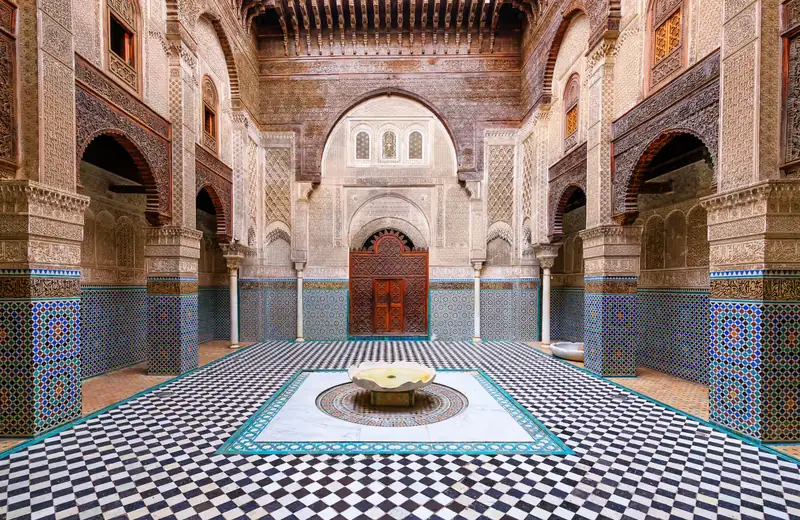
Al Attarine Madrasa in Fes is a fourteenth-century college beside Al-Qarawiyyin, and one of the city’s most rewarding short architectural visits. Come for the courtyard: a fountain, geometric tilework, carved plaster and cedar fitted into a remarkably small space. Allow thirty to forty-five minutes rather than treating it as a doorway photograph. Non-Muslims can visit the monument, but that permission does not extend to the working mosque next door.
Bring cash, confirm the day’s admission and hours locally, and do not buy a promise of rooftop access. Upper rooms and terraces depend on current arrangements. This guide covers the secure historical facts, the craft details worth slowing down for, and a walking plan that leaves time for the neighbourhood.
Confirm what is open before paying. The courtyard is the main reason to visit. Ask about upper rooms and any terrace separately; a photograph online is not a guarantee that the same area is open today.
At a glance
- Built
- 1323–1325
- Patron
- Marinid sultan Abu Said Uthman II
- Location
- Fes el-Bali, beside Al-Qarawiyyin
- Allow
- 30–45 minutes
- Admission
- Ticketed; confirm locally
- Best approach
- On foot through the medina
In this guide
- Is Al Attarine Madrasa Worth Visiting?
- Who Built It, and Why Here?
- Admission, Hours and What to Confirm
- What to See: Courtyard, Prayer Hall and Rooms
- Reading the Walls from Floor to Cedar
- What Student Life Adds to the Visit
- Best Time, Photographs and Accessibility
- Getting There from Bab Boujloud
- A Realistic Day Around the Madrasa
- Comparisons, Shopping and Everyday Etiquette
Is Al Attarine Madrasa Worth Visiting?
Yes, particularly if you prefer a close look at a few excellent surfaces to a long checklist of rooms. You can understand the courtyard’s arrangement almost immediately, then spend the rest of the visit finding how tile, plaster and timber change at corners and doorways. Its smallness is the attraction, not a defect to compensate for.
Do not expect guaranteed solitude. A single guided group can fill much of the court, and the same doorway attracts repeated photographs. Wait to one side, let people move through, and look above the camera line. It is a strong stop within a medina day, not a reason to cross the city repeatedly.
- Architecture: ideal for a focused half-hour or longer of looking closely.
- Short stay: pair it with the surrounding quarter instead of adding another cross-city transfer.
- Repeat visitors: notice repaired surfaces and details at the corners rather than chasing an empty courtyard.
Who Built It, and Why Here?
The Marinid sultan Abu Said Uthman II commissioned the madrasa in 1323; it was completed in 1325. It takes its name from the nearby spice and perfume market, the Souk al-Attarine. The secure date matters: the college belongs to the fourteenth-century Marinid expansion of scholarly institutions, not to the much later Saadian building programme in Marrakech.
Its position near Al-Qarawiyyin connected accommodation, study and the wider religious quarter. Patronage had a public face as well as a practical purpose: the richly decorated courtyard presented the founder’s generosity, while simpler residential areas served students. A madrasa was an institution supported by resources and people, not merely a beautiful prayer room.
Admission, Hours and What to Confirm
Published prices conflict, with many accounts still quoting 20 MAD and others giving higher figures. Rather than call any one of them a confirmed current tariff, check at the entrance and bring small dirham notes. Ask about reduced admission if relevant; there is no need to buy an expensive tour simply to gain entry.
Opening listings also disagree, and religious occasions or local arrangements can affect access. Confirm the day’s hours through your accommodation or the ticket desk, aim for a daytime visit and leave room to return later if the door is closed. Neither a search listing nor an old review establishes a reliable last-admission time.
| Item | Planning advice | Check |
|---|---|---|
| Admission | Confirm in MAD | At the desk |
| Reduced rates | Ask locally | Bring ID |
| Guide | Agree beforehand | Entry included? |
Prices may vary; always check them on site.
What to See: Courtyard, Prayer Hall and Rooms
Pause at the transition from the market lane to the court. The building turns a constrained plot into a coherent sequence: entry, fountain, decorated walls and the prayer-hall opening. Rather than rushing to the middle, first look from near the entrance so you can see how the proportions work together.
The upper student quarters, when open, provide a different view of the court and an important contrast in scale. Ask staff which areas are included before taking a staircase. A roof is not an automatic part of the visit, and an open-looking door is not permission to enter a restricted room or climb beyond a barrier.
- Fountain: look at its relation to the court’s geometry, without sitting on or climbing the stonework.
- Prayer hall: identify the mihrab, the niche indicating prayer direction, and follow the current viewing limits.
- Residential rooms: enter only open, permitted areas and leave thresholds clear for people passing.
Reading the Walls from Floor to Cedar
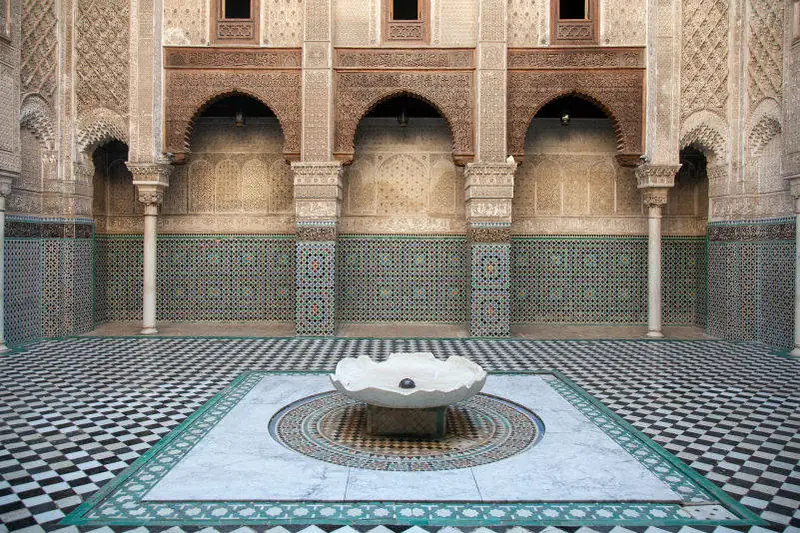
Begin with zellige, the mosaic made from separately cut glazed pieces. Follow one band around an angle to see how the geometry continues rather than thinking of the wall as a flat printed pattern. The pale fountain and paving provide a visual rest against the dense wall decoration; take in that balance as well as the individual motifs.
Above are carved plaster, calligraphic bands and cedarwork. Notice the change in depth: a tile surface catches light differently from a cut recess or a projecting wooden eave. Our Moroccan architecture guide explains the vocabulary, but recognising the material and its position is already enough to make the visit more legible.
What Student Life Adds to the Visit
The decorative court tells you about patronage; the modest rooms tell you about the institution’s everyday purpose. Students needed somewhere to sleep and keep their belongings while studying within the religious and scholarly world around Al-Qarawiyyin. Do not read the residence as a modern university campus with one classroom for every subject or identical private bedrooms.
Compare the light, size and openings of any rooms staff allow you to see. If upstairs is closed, the contrast between public ornament and practical accommodation still helps explain the plan. It is better to understand that relationship than repeat an unverified room count, a supposed student capacity or a precise daily timetable.
Best Time, Photographs and Accessibility
Try a confirmed opening period before the main tour flow, while accepting that light and crowding vary. The court is narrow, so the best photograph is not always a wide-angle view from its centre. A section of tile meeting plaster, or a doorway seen without distortion, can say more than a frame that tries to contain everything.
The approach involves uneven medina paving and the upper areas require stairs. Ask directly about thresholds, the ground-floor route and any assistance you need; this page does not promise full wheelchair access. For children, keep the fountain edge and narrow stairs in mind, and avoid making other visitors step around a pushchair in a small passage.
- Photography: ask about tripods or professional equipment, avoid flash on delicate surfaces and keep the main doorway clear.
- Dress: covered shoulders and knees are a respectful choice in a former religious college; follow any instructions about footwear.
- Conservation: do not touch carved plaster or lean bags against fragile walls. Restoration is part of a working heritage site, not an invitation to test the material.
Getting There from Bab Boujloud
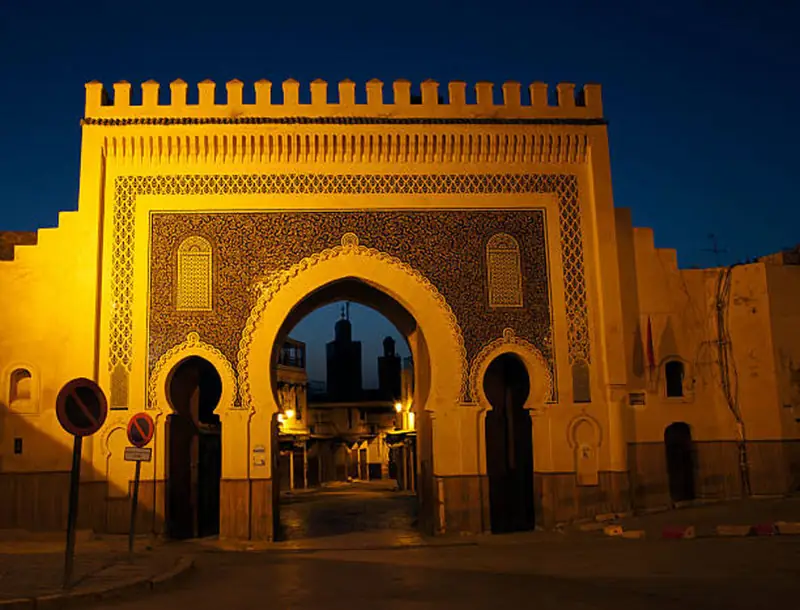
The madrasa is deep in Fes el-Bali near Al-Qarawiyyin. From Bab Boujloud, follow the principal medina routes towards the religious quarter, allowing roughly twenty to thirty minutes or more with pauses and wrong turns. The return is uphill in places; walking time is not simply distance divided by a fast city pace.
Save the madrasa’s own map pin and a nearby landmark, not only the name of the mosque. A taxi brings you to an appropriate medina access point, not to the courtyard door. If someone announces that the monument is closed and offers a shop instead, verify at the entrance rather than accepting an unsolicited detour.
A Realistic Day Around the Madrasa
The surrounding quarter makes more sense on foot than as a sequence of taxi transfers. Al-Qarawiyyin is a working religious complex: non-Muslims should respect its entry restrictions and view only from permitted public positions. Never step through a mosque doorway for a clearer photograph or assume the madrasa ticket covers neighbouring religious buildings.
Nejjarine’s square and museum, the metalworking area around Seffarine and the Attarine market can fit around the visit, with museum admission checked separately. They are workplaces and public streets, not staged demonstrations available on demand. Choose a few, take a proper break and leave a buffer rather than attaching every famous Fes sight to one morning.
- MorningStart at Bab Boujloud, walk down into the medina and visit Al Attarine during confirmed opening hours. Keep time for the approach and the court.
- AfternoonChoose Nejjarine or Seffarine, take lunch and rest, and browse the market without compulsory shop stops. Do not promise a roof visit.
- EveningReturn towards your accommodation before becoming tired or disorientated. Save your route and arrange any gate-side taxi separately.
| Stop | Why go | Allow |
|---|---|---|
| Al Attarine | Craft and court | 30–45 min |
| Mosque area | Public exterior | Brief stop |
| Nejjarine | Square or museum | At your pace |
| Seffarine | Metal workshops | Brief stop |
Comparisons, Shopping and Everyday Etiquette
Bou Inania offers another Marinid comparison in Fes, though it has its own entry arrangements; visiting both is useful if you enjoy architecture, not compulsory. In Marrakech, Ben Youssef Madrasa gives a larger, later Saadian contrast. Do not rank them solely by size: Al Attarine rewards concentration and the relation between a small court and dense craft.
The spice-and-perfume market explains the name, but a monument visit does not oblige a purchase. Confirm quantities, units and the total before buying spices or oils; claims of rarity or therapeutic effects are not proof of quality. Our Fes guide helps place this quarter within a longer stay rather than one shopping-led circuit.
- Polite words: Salam alaikum is a greeting, Shukran means thank you, and La shukran declines an offer. A calm refusal is enough.
- Money: use cash for small admissions and purchases. Agree a guide’s fee and duration first; any extra tip is voluntary, while a small dirham tip in a café is appreciated.
- Phone: download an offline map before leaving. Buy a Maroc Telecom or Orange SIM at an authorised shop with your passport; thick walls can still interrupt reception.
- People: ask before photographing residents or craftspeople, step aside for deliveries and keep your bag closed in narrow crowded lanes.
Prices may vary. Admission, guide fees and nearby museum charges can change. Where no consistent current tariff could be established, check locally in MAD rather than treating a converted euro or dollar amount as verified.
Frequently asked questions
Can non-Muslims enter Al Attarine Madrasa?
Yes, the madrasa can be visited as a ticketed historic monument. That does not permit entry to the neighbouring Al-Qarawiyyin Mosque, which follows different rules.
What does admission cost?
Published fees conflict, so check the current amount locally in MAD instead of relying on an old 20 MAD listing. Bring cash and ask what parts of the building are open before paying.
How long should I allow?
Thirty to forty-five minutes is a useful allowance for a careful courtyard visit and any open rooms. Add the walking approach separately, and allow longer if you want detailed photographs or architectural interpretation.
Is the roof always open?
No, upper rooms and terraces depend on current access arrangements. Ask staff and respect barriers; the courtyard remains the principal reason to visit.
Do I need a guide or advance booking?
An independent visit is feasible with a saved map and admission arranged at the entrance. A licensed guide can add context, but agree the service and whether entry is included before starting.