Chefchaouen Travel Guide: How to See the Blue City and the Rif
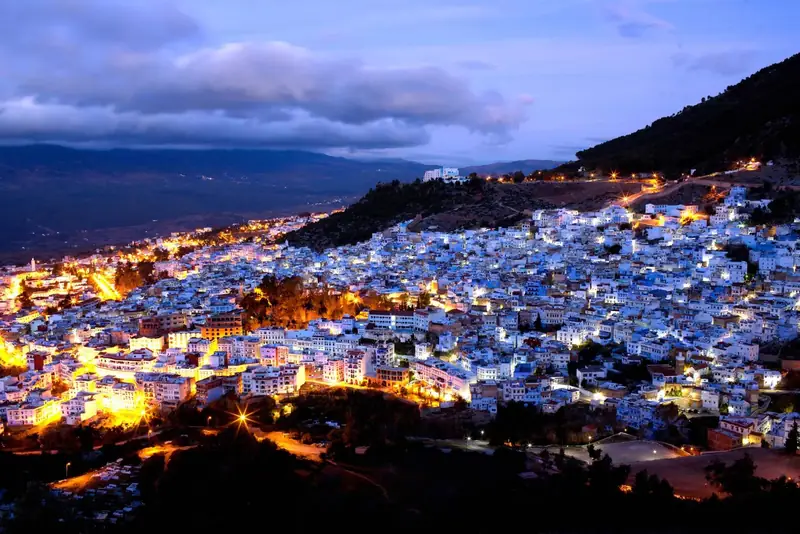
This Chefchaouen travel guide starts with the answer most people need: give the town two nights, not a rushed day trip. Arrive by bus from Tangier or Fes, sleep in the medina, walk its blue lanes before the tour groups arrive, and keep a day for the Akchour gorge and God’s Bridge. Founded in 1471 as a mountain fortress, Chefchaouen sits at about 600 metres in the Rif Mountains, and its blue-washed medina is small enough to cross in 20 minutes.
It is calmer and cheaper than the big cities, with few monuments and plenty of mountain air. Below: what to see, current prices, a two-day plan, hikes, where to stay, food, transport and etiquette.
Book your bus seat early. CTM buses on the Fes and Tangier routes fill up in summer and at weekends, so buy tickets a day or two ahead. Pack light: the medina is all steps, and taxis stop at the gates.
At a glance
- Founded
- 1471
- Altitude
- About 600 m, Rif Mountains
- Allow
- 2 nights
- Nearest airport
- Tangier (TNG), about 2 h 15 by road
- Train
- None: buses and grand taxis
- Best time
- April–June and September–October
In this guide
- Is Chefchaouen Worth Visiting?
- Best Things to Do in Chefchaouen
- Chefchaouen Prices: Sights, Hikes and Transport
- A 2-Day Chefchaouen Itinerary
- Where to Stay in Chefchaouen
- What to Eat in Chefchaouen
- Getting to Chefchaouen and Getting Around
- Best Time to Visit Chefchaouen
- Akchour, Hikes and Day Trips from Chefchaouen
- Safety, Cannabis and Etiquette
- Money, SIM Cards and Tipping
Is Chefchaouen Worth Visiting?
Yes, if you want a slower stop between the big medinas: blue lanes, mountain air, cheap guesthouses and some of the best hiking in northern Morocco. The trade-offs are crowds at midday, when day-trippers arrive, and a long road in. Most travellers pair it with Fes or Tangier.
- Short on time: one night lets you see the medina at dusk and dawn, when it is at its best.
- Hikers: two or three nights leave time for Akchour and the peak above town.
- Day trip only: possible from Tangier, but tiring from Fes, with eight or nine hours on the road.
Best Things to Do in Chefchaouen
The medina climbs the hillside from its main gate, Bab el-Ain, towards the spring at Ras el-Maa. There are no grand monuments; the pleasure lies in wandering, sitting on terraces and walking up into the hills.
Why is Chefchaouen blue?
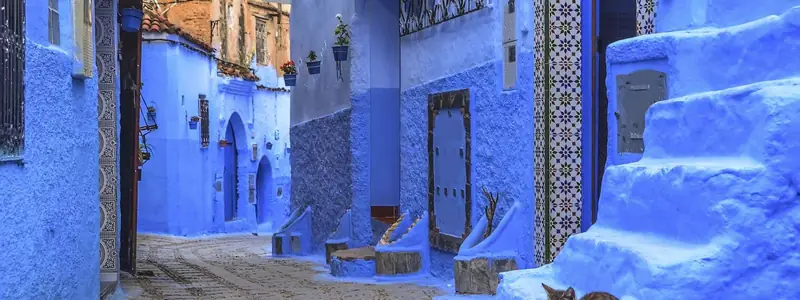
Nobody knows for certain. A popular story credits Jewish refugees who settled here in the 1930s with painting walls blue as a symbol of the sky. Others point to practical reasons, since blue lime wash is said to keep houses cool and deter mosquitoes. Today residents repaint regularly, and the shades run from pale sky to deep indigo.
The medina’s blue lanes
Go out before 9am, when the stepped lanes are empty, the light is soft and shopkeepers are only starting to set out their blankets. The medina is small, so you will not stay lost for long.
Plaza Uta el-Hammam, the kasbah and Plaza el-Haouta
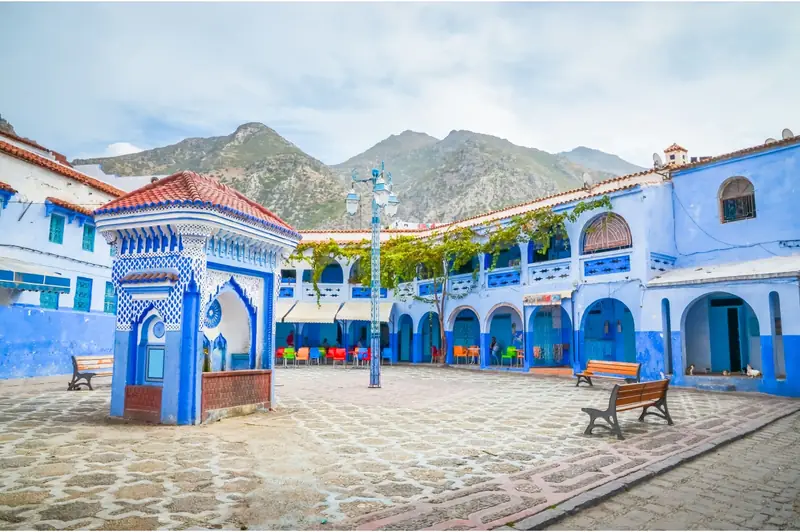
The main square is lined with cafés and overlooked by the red-walled kasbah, a 15th-century fortress with a small ethnographic museum, a garden and a tower with views over the rooftops. Beside it stands the Great Mosque with its octagonal minaret, which non-Muslims cannot enter. A few lanes away, the smaller Plaza el-Haouta has a tiled fountain and quieter cafés.
Ras el-Maa and the Spanish Mosque
At the eastern edge of the medina, the spring of Ras el-Maa tumbles over a small waterfall, and women still wash laundry in the stream. From here a path climbs for 20–40 minutes to the Spanish Mosque, built in the 1920s and never used for prayer, which has the classic panorama of the blue town. Arrive 45 minutes before sunset, or go at sunrise for the same view without the crowd.
Crafts and shopping
Look for woven wool blankets, jellabas and leather bags. Prices are lower than in Marrakech or Fes, but bargaining is still expected, so start at about half the first price.
Skip the self-appointed guides. You do not need a guide in the medina, which is easy to explore alone. Ignore anyone who offers to show you the way out for a tip or to take you to a ‘special’ viewpoint.
Chefchaouen Prices: Sights, Hikes and Transport
Most of what you come for is free. These are typical 2026 prices for foreign visitors; small fees at the kasbah and the Akchour trailhead change often, so carry small notes.
| Item | Cost | Tip |
|---|---|---|
| Kasbah and museum | 60–70 MAD (≈ €6 / $6–7) | Climb the tower for views |
| Spanish Mosque viewpoint | Free | Go 45 minutes before sunset |
| Ras el-Maa spring | Free | Quietest in the morning |
| Akchour trails | Free; an informal fee of 10–20 MAD is sometimes collected | Start before 9am |
| Shared taxi to Akchour | 20–35 MAD (≈ €2–3 / $2–4) per seat | Return taxis thin out after 5pm |
| Petit taxi, bus station to medina | 10–20 MAD (≈ €1–2 / $1–2) | Or a 20–30 minute uphill walk |
Prices may vary; always check them on site.
A 2-Day Chefchaouen Itinerary
This plan keeps the medina for the quiet hours and gives the second day to the mountains.
- Day 1 · MorningWalk the upper medina before 9am, then have breakfast on Plaza Uta el-Hammam and visit the kasbah and its garden.
- Day 1 · AfternoonBrowse blanket and leather workshops, sit in Plaza el-Haouta, then follow the stream to Ras el-Maa.
- Day 1 · EveningClimb to the Spanish Mosque for sunset, then have dinner on a rooftop terrace.
- Day 2 · MorningTake a shared taxi to Akchour by 9am and hike along the river to God’s Bridge.
- Day 2 · AfternoonHave lunch at the riverside cafés, add the upper waterfall if you are fit, and head back before 5pm.
- Day 2 · EveningBook a hammam, or try bissara and goat cheese at a simple café in the medina.
Not a hiker? Spend the second morning on the lanes around Bab el-Ain and the afternoon on a day trip to Tetouan.
Where to Stay in Chefchaouen
Pick the area first, then the guesthouse; many have roof terraces with mountain views.
| Area | Best for | Trade-off |
|---|---|---|
| Around Uta el-Hammam | Cafés, kasbah, easy orientation | Busy by day; noisier |
| Upper medina, Ras el-Maa | Quiet lanes, views, hiking paths | Many steps with luggage |
| Medina edge, Bab el-Ain | Taxi access, shops, shorter walks | Less atmosphere |
| Hotels outside the walls | Parking, pools, families by car | Uphill walk or taxi |
Book ahead for summer weekends and Moroccan holidays, when domestic visitors fill the town and the best roof terraces go first.
What to Eat in Chefchaouen
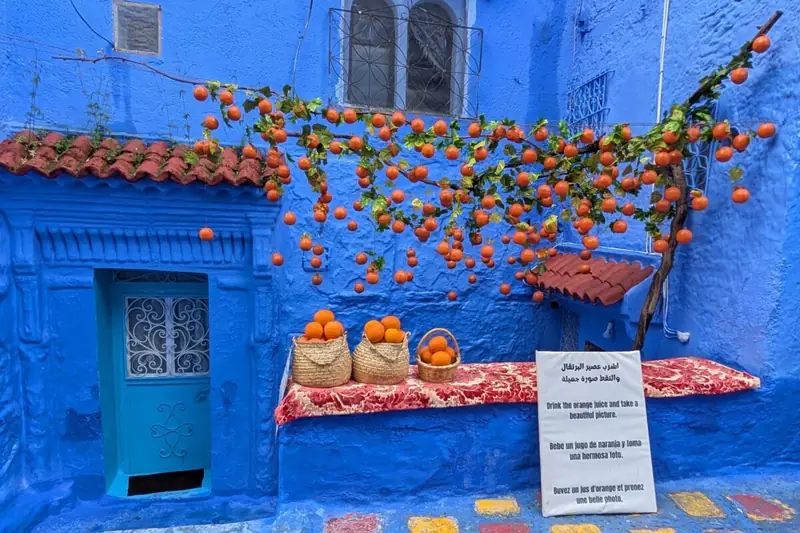
The Rif is goat country, so look for fresh goat cheese (jben), often served in salads or with honey and bread at breakfast. Bissara, a thick fava bean soup with olive oil and cumin, is the classic cheap breakfast, and tagines here often feature goat or lamb with local herbs.
Terrace restaurants on the main square trade on their views; simpler places in the lanes are cheaper, so check menu prices before you sit down.
Getting to Chefchaouen and Getting Around
- By bus: CTM and Supratours run from Tangier (2 h 15–3 h), Tetouan (about 1.5 h), Fes (4–4.5 h) and Casablanca (about 6 h). Check our bus times and book a day or two ahead.
- By grand taxi: shared taxis from Tetouan take about 1–1.5 hours and leave when full; from Fes you usually change in Ouazzane.
- By air: the nearest airports are Tangier (TNG), about 2 h 15 by road, and Tetouan (TTU), about an hour away with few flights.
- On arrival: buses stop at the bus station about 2 km below the medina; a petit taxi costs 10–20 MAD, or it is a 20–30 minute uphill walk.
- On foot: the medina is car-free and steep, so wear shoes with grip and pack light.
There is no train. Rail travellers usually ride to Tangier or Fes and continue by bus.
Best Time to Visit Chefchaouen
| Season | Weather | Verdict |
|---|---|---|
| Apr–Jun | Warm days, green hills, full rivers | Best for hiking |
| Jul–Aug | Around 33 °C by day, busy | Book ahead; hike early |
| Sep–Oct | Warm and settled, fewer crowds | Excellent all round |
| Nov–Mar | About 14 °C by day, near 5 °C at night; wettest season | Pack layers; trails can be muddy |
Winter brings snow to the surrounding peaks and chilly guesthouses, so ask whether rooms are heated. Ramadan is expected from about 8 February to 9 March 2027, when cafés open later and evenings come alive after sunset.
Akchour, Hikes and Day Trips from Chefchaouen
The Rif around Chefchaouen is the town’s other great attraction, and Akchour, in Talassemtane National Park, is the classic outing.
- God’s Bridge: from Akchour village, a riverside trail reaches this natural rock arch in about 1.5 hours each way, past turquoise pools that are popular for swimming in summer.
- Akchour waterfall: the upper trail to the main waterfall adds 2–3 hours each way; combining both makes a demanding 7–8 hour day.
- Jebel el-Kelaa: the peak above town is a steep 5–6 hour loop of about 15 km with roughly 1,000 metres of climbing; the upper path is poorly marked, so consider a guide.
Hike safely. Start early, carry plenty of water and wear shoes with good grip, because the river paths are rocky and slippery. Ask about water levels after rain, and agree a pickup time if you hire a taxi.
| Destination | Time | Best for |
|---|---|---|
| Akchour | About 45 min | God’s Bridge and river pools |
| Tetouan | About 1–1.5 h | Andalusian medina and museums |
| Tangier | 2 h 15–3 h | Kasbah, sea views, onward trains |
| Fes | 4–4.5 h | Better as an overnight stop |
Travel times are one way by road. Tetouan works as a day trip, but Tangier and Fes are better as the next stop on your route.
Safety, Cannabis and Etiquette
- Cannabis: you will probably be offered hashish. Morocco’s 2021 law allows only licensed medical and industrial cannabis, and buying or using it is a crime that can mean prison, so decline firmly.
- Photos: ask before photographing people or the inside of homes, and expect requests for a small tip at popular doorways.
- Touts: you do not need help finding your way; a polite “la, shukran” (no, thank you) is enough.
- Hiking: paths can be slippery and remote, so do not hike alone at dusk and tell your guesthouse where you are going.
- Dress: this is a conservative mountain town; cover shoulders and knees, especially away from the main square.
Money, SIM Cards and Tipping
- Cash: most guesthouses, taxis and shops want cash, and there are only a few ATMs just outside the medina, so carry enough for hikes and weekends.
- SIM cards: a Maroc Telecom or Orange SIM costs around 30 MAD with your passport; buy one in Tangier, Fes or Tetouan if you arrive late.
- Tipping: 1–2 MAD in cafés, 5–10 MAD in casual restaurants and 50–100 MAD a day for a driver or hiking guide.
- Phrases: “Salam alaikum” (hello), “shukran” (thank you) and “la, shukran” (no, thank you) go a long way.
- Ramadan: avoid eating, drinking or smoking in public during daylight hours out of respect.
Prices may vary. Euro and dollar figures use November 2026 rates (€1 ≈ 10.9 MAD, $1 ≈ 9.9 MAD). Fees, taxi fares and guide rates change, so check them on site before you pay.
Frequently asked questions
How many days do you need in Chefchaouen?
Two nights are ideal: one day for the medina and the Spanish Mosque, and one for the Akchour hike. One night is enough if you only want to see the town at its quietest.
Can you visit Chefchaouen as a day trip from Fes?
It is possible but tiring, because the bus takes 4–4.5 hours each way and leaves only a few hours in town. Stay at least one night, or visit from Tangier, which is closer.
How do you get from Chefchaouen to Akchour?
Shared grand taxis leave from town when full, take about 45 minutes and cost 20–35 MAD per seat. Head back before about 5pm, when return taxis become scarce, or hire a taxi for the day.
Why is Chefchaouen painted blue?
Nobody knows for certain. One story credits Jewish refugees in the 1930s, while others cite cooler houses and fewer mosquitoes; today residents repaint regularly.
Is Chefchaouen safe for tourists?
Generally yes; it is one of Morocco’s most relaxed towns. The main issues are persistent offers of hashish, which is illegal to buy, and slippery hiking trails, so decline firmly and hike in daylight.