Rabat Travel Guide: The Kasbah, the Hassan Tower and Chellah
This Rabat travel guide starts with the short answer: Morocco’s capital deserves one full day, or two if you add Salé and the museums, and it is the calmest big city in the country. Set where the Bou Regreg river meets the Atlantic, Rabat hides a 12th-century kasbah, an unfinished Almohad minaret and a Marinid necropolis full of storks behind wide, tidy avenues; UNESCO listed it in 2012 as a modern capital and historic city. Al Boraq trains reach Tangier in about 1 hour 20 minutes.
Expect fewer touts and less spectacle than in Marrakech or Fes, which is exactly the appeal. Below you will find the sights, 2026 prices, a two-day plan, where to stay, food, transport, seasons and etiquette.
Avoid Tuesdays for museums. The national museums, including the Kasbah’s jewellery museum, close on Tuesdays. Al Boraq high-speed trains use Rabat-Agdal, not the central Rabat-Ville station, so check your ticket before you set off.
At a glance
- Status
- Capital since 1912
- Population
- Just over 500,000 (2024 census)
- Allow
- 1–2 days
- By train
- Casablanca about 1 h, Tangier 1 h 20
- Airport
- Rabat–Salé (RBA), about 10 km
- Best time
- March–May and September–October
In this guide
Is Rabat Worth Visiting?
Yes, especially if the bigger cities have worn you out. Rabat’s monuments are first-rate and mostly free, and the medina is flat and calm. The trade-off is less drama: the medina is small and nightlife is quiet, so many travellers pair it with Casablanca, about an hour away by train.
- Culture lovers: two days cover the Kasbah, Chellah, the national museums and Salé’s Marinid madrasa.
- Short on time: the Kasbah, the Hassan Tower and Chellah fit into one well-planned day.
- Rail travellers: Rabat breaks the journey between Tangier and Casablanca or Fes.
Best Things to Do in Rabat
Most sights line the south bank of the Bou Regreg, from the Kasbah at the river mouth to Chellah just outside the city walls, with Salé facing them across the water.
The Kasbah of the Udayas
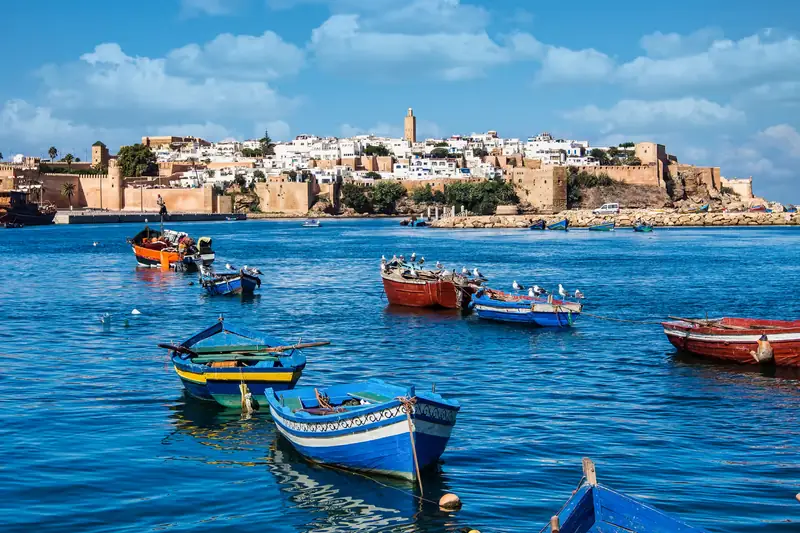
Begin at the Kasbah of the Udayas, a 12th-century Almohad fortress on the cliff above the river mouth. Enter through the carved Bab Oudaia gate and wander the whitewashed, blue-trimmed lanes up to a platform overlooking the Atlantic surf. Inside the walls, the terraced Andalusian Garden is free, a terrace café serves mint tea above the estuary, and the National Museum of Jewellery fills a 17th-century pavilion.
The Hassan Tower and the Mausoleum of Mohammed V
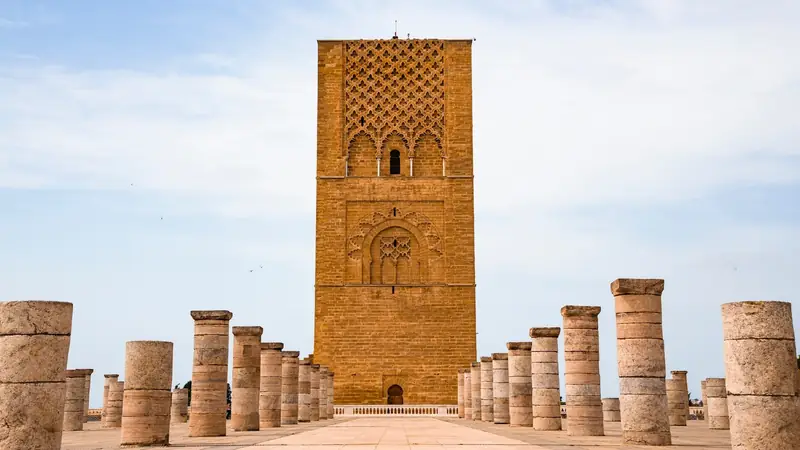
On a terrace above the river stands the Hassan Tower, the minaret of a vast mosque begun in the 1190s by the Almohad sultan Yaqub al-Mansur and abandoned at his death in 1199. The tower stopped at about 44 metres, and rows of column stumps trace the prayer hall that never rose. Facing it, the white Mausoleum of Mohammed V (1971), under a green-tiled roof, holds the tombs of the king who led Morocco to independence and of his son Hassan II. Both are free; mounted royal guards stand at the gates, and modest dress is expected inside. For context, see our history of Morocco.
Chellah
Just outside the city walls, Chellah layers the Roman town of Sala Colonia beneath a 14th-century Marinid royal necropolis of tombs, a ruined mosque and overgrown gardens. White storks nest on the minaret and walls, most busily in spring, and their bill-clattering is the soundtrack of the site. Entry costs 70 MAD, or 120 MAD with an audioguide, and the ticket office closes at 18:00; allow one and a half to two hours.
The medina and the new town
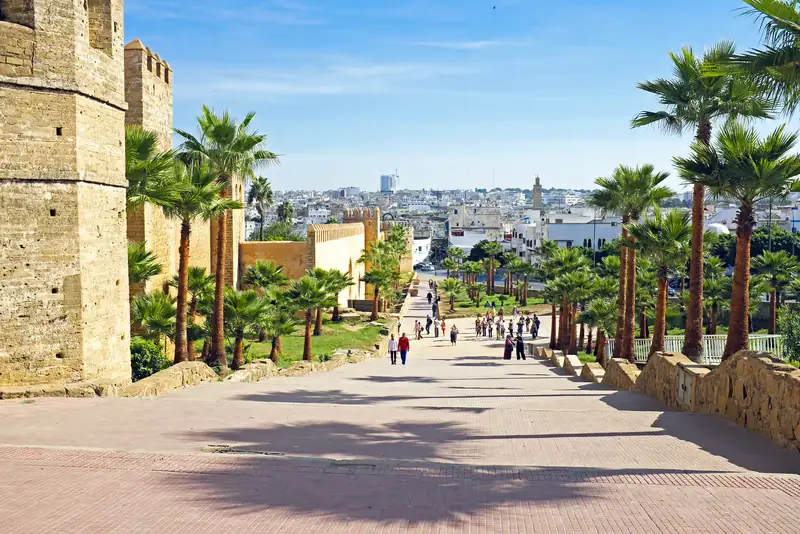
Rabat’s medina is small, flat and refreshingly calm. Rue des Consuls, where European consuls lived until 1912, is lined with rug, leather and craft shops, and the 17th-century Andalusian wall separates the old town from the French-built Ville Nouvelle. Along Avenue Mohammed V you pass the Parliament, Rabat-Ville station and Art Deco facades, with the Almohad gate of Bab er-Rouah a short walk away.
Museums, the Royal Theatre and Salé
The Mohammed VI Museum of Modern and Contemporary Art shows Moroccan art from the 20th century to today, and the Museum of History and Civilizations (20 MAD) displays the Roman bronzes from Volubilis; both close on Tuesdays. Upriver, Zaha Hadid’s Royal Theatre opened to the public on 22 April 2026. Across the river, Salé’s quiet medina hides a 14th-century Marinid madrasa of carved cedar and zellige.
Cross the river by boat. Wooden rowing boats leave from the jetty below the Kasbah and cost a few dirhams in cash; the tram over the Hassan II bridge is quicker.
Rabat Prices: Sights, Museums and Transport
The Kasbah, the medina, the Hassan Tower and the mausoleum cost nothing. These are typical 2026 prices for foreign visitors; Moroccans and residents often pay less.
| Item | Cost | Tip |
|---|---|---|
| Chellah | 70 MAD (≈ €6 / $7) | 120 MAD with audioguide |
| Jewellery museum (Kasbah) | 60 MAD (≈ €6 / $6) | Closed Tuesdays |
| Mohammed VI Museum | 40 MAD (≈ €4 / $4) | Closed Tuesdays |
| Salé Marinid madrasa | 80 MAD (≈ €7 / $8) | Check hours locally |
| Tram ticket | 7 MAD (≈ €0.65 / $0.70) | Valid for one hour |
| Petit taxi in town | Most rides 15–30 MAD (≈ €1–3 / $2–3) | Meter; 50% more after 8pm |
Prices may vary; always check them on site.
A 2-Day Rabat Itinerary
Follow the river on day one and keep the museums and Salé for day two, as long as it isn’t a Tuesday.
- Day 1 · MorningExplore the Kasbah of the Udayas and the Andalusian Garden, then take mint tea above the estuary.
- Day 1 · AfternoonLunch in the medina, then walk to the Hassan Tower and the mausoleum and on to Chellah.
- Day 1 · EveningWatch the sunset over the river mouth, then dine at the marina or in the new town.
- Day 2 · MorningVisit the Mohammed VI Museum, then walk Avenue Mohammed V to Bab er-Rouah.
- Day 2 · AfternoonCross to Salé by rowing boat for the Marinid madrasa, then ride the tram back.
- Day 2 · EveningSee a show at the Royal Theatre, or have dinner in Agdal.
With a third day, take the train to Meknes for Volubilis, or go north to Tangier.
Where to Stay in Rabat
Choose by your plans: the medina for atmosphere, the centre or Agdal for trains and trams.
| Area | Best for | Trade-off |
|---|---|---|
| Medina and Kasbah | Riads with roof terraces, sights on foot | Stairs with luggage; taxis stop at the gates |
| City centre and Hassan | Rabat-Ville station, the tram, cafés | Traffic and business hotels |
| Agdal | Rabat-Agdal station for Al Boraq, restaurants | A tram or taxi ride from the sights |
| Souissi | Leafy embassy district, garden hotels | Far from the medina; taxis needed |
Rabat has fewer riads than Fes or Marrakech, so book ahead for Mawazine in June and during big conferences.
What to Eat in Rabat
Rabat eats well without the tourist trappings of bigger cities. In the medina, look for bissara (fava bean soup) at breakfast, msemen flatbreads and grilled sardines, and try tagines or international cooking in the new town and Agdal.
For seafood, head to the restaurants around the marina and the river mouth, or cross to Salé. Licensed restaurants and hotel bars serve alcohol, and mint tea with almond pastries on the Kasbah terrace is the classic afternoon break.
Getting to Rabat and Getting Around
- By train: Al Boraq high-speed trains stop at Rabat-Agdal and reach Tangier in about 1 h 20 and Casablanca in under an hour. Al Atlas trains from Rabat-Agdal and the central Rabat-Ville run to Meknes (about 2 h 15), Fes (about 3 h) and Marrakech (about 4 h); see our train times.
- By air: Rabat–Salé Airport (RBA), about 10 km northeast, has mostly European flights; a grand taxi costs about 100–200 MAD, and a shuttle bus runs to Rabat-Agdal station. Long-haul travellers often fly into Casablanca (CMN), two hours away by train.
- By bus: CTM and Supratours coaches link Rabat with Chefchaouen and most other cities.
- By tram: two lines link Rabat and Salé, with a 7 MAD ticket valid for an hour, including one change; both stop at the Hassan Tower before crossing the river.
- By taxi: blue petit taxis use the meter, carry up to three passengers and add 50% after 8pm; they generally stay within Rabat, so cross to Salé by tram or boat.
Since September 2026, works on the Kenitra–Marrakech high-speed line have brought revised timetables and some longer journeys, so check ONCF before you travel; the new line is due in 2029.
Best Time to Visit Rabat
| Season | Weather | Verdict |
|---|---|---|
| Mar–May | About 20–24 °C by day; storks nest at Chellah | Ideal for walking |
| Jun–Aug | About 25–28 °C, breezy; morning sea mist | Beach season; Mawazine in June |
| Sep–Nov | About 21–27 °C; warm sea; rain returns in November | Excellent, especially Sep–Oct |
| Dec–Feb | About 17–19 °C by day, 8–9 °C at night; wettest months | Quiet; pack a rain jacket |
The ocean keeps Rabat far milder in summer than Fes or Marrakech. Mawazine brings mostly free concerts in late June (19–27 June in 2026), Rabat is UNESCO World Book Capital until 22 April 2027, and Ramadan, expected from about 8 February to 9 March 2027, shortens museum and restaurant hours.
Day Trips from Rabat
Rabat sits at the heart of Morocco’s rail network, so day trips are easy.
- Casablanca: about an hour by train, for the Hassan II Mosque tour, Art Deco streets and the Corniche.
- Meknes and Volubilis: Moulay Ismail’s imperial city is a little over two hours by train, and the Roman ruins of Volubilis are 30 km further by taxi, so start early.
- Tangier: about 1 h 20 by Al Boraq; possible as a long day trip, better with a night.
- Plage des Nations: a wide Atlantic beach about 20 km north of Rabat, beyond Salé, with strong currents.
| Destination | Distance | Best for |
|---|---|---|
| Casablanca | About 90 km | Hassan II Mosque, Art Deco |
| Meknes | About 140 km | Imperial city, Volubilis |
| Tangier | About 250 km | Medina, kasbah, the Strait |
| Plage des Nations | About 20 km | A beach day |
For Volubilis, a grand taxi or a tour from Meknes saves time.
Safety and Etiquette in Rabat
- Guides: decline unofficial guides at the Kasbah gate and around Chellah, politely but firmly.
- Taxis: insist on the meter in blue petit taxis, and agree grand-taxi fares before you set off.
- Photos: ask before photographing residents in the Kasbah and the medina.
- Swimming: the town beach and Plage des Nations have strong currents, so swim only where lifeguards are on duty.
- Dress: cover shoulders and knees for the mausoleum; non-Muslims cannot enter working mosques.
Money, SIM Cards and Tipping
- Cash and cards: hotels and many restaurants take cards, but taxis, boats and small cafés want cash; ATMs line Avenue Mohammed V.
- SIM cards: a Maroc Telecom or Orange SIM costs around 30 MAD with your passport, from the operators’ shops.
- Tipping: 1–2 MAD in cafés, 5–10 MAD in casual restaurants and 50–100 MAD a day for a driver or guide; round up taxi fares.
- Phrases: “Salam alaikum” (hello), “shukran” (thank you) and “la, shukran” (no, thank you) are always appreciated, even where French is widely spoken.
- Ramadan: out of respect, avoid eating, drinking or smoking in public during daylight hours.
Prices may vary. Euro and dollar figures use November 2026 rates (€1 ≈ 10.9 MAD, $1 ≈ 9.9 MAD). Entry fees, tram fares and taxi rates change, so check them on site before you pay.
Frequently asked questions
How many days do you need in Rabat?
One full day covers the Kasbah of the Udayas, the Hassan Tower and Chellah. With two days you can add the museums, the medina and a boat trip across to Salé.
Is Rabat worth visiting?
Yes. It has major Almohad and Marinid monuments, a calm medina and easy train links, with far less hassle than Marrakech or Fes.
Why is Rabat the capital and not Casablanca?
The French protectorate made Rabat the seat of government in 1912, and it stayed the royal and administrative capital after independence in 1956. Casablanca grew into the economic centre instead.
Which Rabat train station should I use?
Al Boraq trains to Tangier and Casablanca stop at Rabat-Agdal. Rabat-Ville is more central, and many regular trains call at both, so check your ticket.
Is Rabat safe for tourists?
Yes, it is one of Morocco’s calmest cities. Take the usual precautions: watch your bag in crowds and on the tram, use metered taxis and avoid empty streets late at night.