Bahia Palace: Marrakech’s Palace of Painted Cedar
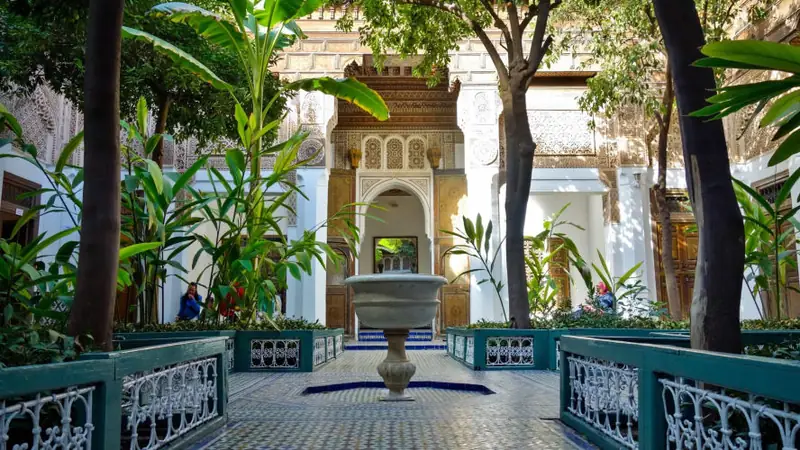
The Bahia Palace is a late-19th-century vizier’s residence in the south of the Marrakech medina, and the best place in Morocco to see what a private fortune could buy in zellige, carved plaster and painted cedar. The ticket is 100 MAD for foreign adults, the palace is open daily from 09:00 to 17:00, and an hour to ninety minutes covers it. It is also, in 2026, a building site in places: parts of it are behind scaffolding after the 2023 earthquake, and the price does not drop.
This guide covers the ticket and the hours, what is actually worth looking at inside, the two men who built it, how to dodge the coach groups, and what sits within a ten-minute walk.
Ask what is open before you pay. Restoration after the September 2023 earthquake is still running. If large sections are fenced off on the day, the ticket window will tell you there is no discount for it, so decide at the gate whether the price is still worth it to you.
At a glance
- Built
- 1866–1900, in two phases
- Entry
- 100 MAD (≈ €9 / $10)
- Hours
- Daily 09:00–17:00
- Allow
- 1–1.5 hours
- Where
- Rue Riad Zitoun el Jdid, south medina
- Best time
- 09:00, or after 15:30
In this guide
Is the Bahia Palace Worth Visiting?
Yes, with one caveat in 2026: you pay full price for a building that is partly under repair. What you get for it is the finest surviving example of late-19th-century Moroccan palace decoration ceilings that took craftsmen years, courtyards of Italian marble, and a floor plan that shows how a household of wives, concubines, servants and petitioners was arranged. Almost no furniture survives and there is very little labelling, so the visit is about surfaces and space rather than objects.
If you have seen the Alhambra or the Alcázar in Seville, the vocabulary will be familiar. What is different here is the ambition: a vizier, not a sultan, built this, and he built it to be noticed.
- First-time visitors: yes, and pair it with El Badi Palace, ten minutes away.
- Short trips: go at opening, give it 60–75 minutes, then walk to the Saadian Tombs.
- Architecture lovers: read the decoration notes below first; the labels will not help you.
What You Actually See Inside
The route runs through a sequence of courtyards rather than along one grand axis, because Ba Ahmed expanded the palace by buying up neighbouring houses and knocking them together. That is why the plan feels domestic and slightly irrational, and why one courtyard never prepares you for the next.
The Grand Courtyard
The Cour d’Honneur measures roughly 50 by 30 metres, paved in Carrara marble and ringed by a painted wooden gallery. Stand at the southern end and look up: the gallery ceiling is the largest single painted surface in the palace, and it is the shot almost everyone takes first.
The Painted Ceilings
Zouak painted cedar is the real treasure here. The best are in the Salle d’Honneur at the east end of the great courtyard, a hall about 20 by 8 metres, and in the small reception rooms off the Petit Riad. Blue, green, red and gold bands frame floral centres. Look at the borders rather than the middle: that is where the craftsmen competed.
The Grand Riad and the Gardens
The oldest part, Dar Si Moussa, is where the route ends. Trees planted in the 1860s still shade beds of roses, jasmine and orange, and the two chambers flanking the garden carry an inscription dated 1866–67 the firmest evidence of when the whole story began.
Bahia Palace Tickets and Hours
Tickets are sold at the gate, and the price has risen well above the 70 MAD that many older guides still print. One ticket buys one entry; there is no combined pass with El Badi or the Saadian Tombs, so budget for each separately.
| Ticket | Price | Who pays |
|---|---|---|
| Foreign adult | 100 MAD (≈ €9 / $10) | Visitors without a Moroccan ID |
| Reduced rates | Check locally | Bring ID |
| Licensed guide outside | 100–150 MAD (≈ €9–14 / $10–15) | About 45 minutes |
Prices may vary; always check them on site.
Hours are 09:00–17:00 every day, with last entry around 16:30, and a shorter day in Ramadan, usually 10:00–16:00 confirm on the morning you go. Bring cash: the gate has long been cash-only, and a dead card reader at 16:20 is a wasted afternoon. There is no audio guide and almost no signage, which is why the licensed guides waiting outside earn their 100–150 MAD if you want names and gossip. Check for a Ministry of Tourism badge before you agree a price.
Who Built It, and Why It Is Empty
Two men built the Bahia, father and son, and neither was a sultan. Si Moussa came from a family of servants in the makhzen and rose to become chamberlain, then grand vizier under Sultan Muhammad IV and Hassan I; he built the first house on the site in 1866–67. His son Ba Ahmed, born in 1841, was chamberlain to Hassan I, and when the teenage Abdelaziz took the throne in 1894, Ba Ahmed became grand vizier and regent the man who governed Morocco in all but name for six years.
He spent those years absorbing about sixty neighbouring houses and sixteen gardens and rebuilding them as one palace, with the architect Muhammad ibn Makki al-Misfiwi of Safi, tiles cut by men from Fes, plaster carved by men from Tetouan, marble brought from Meknes and cedar from the Middle Atlas. The grounds once ran to eight hectares. The palace is often described as having around 150 rooms, but only part of the complex is open to visitors; other parts are reserved for state use.
Ba Ahmed died on 17 May 1900. Within hours, by most accounts, Sultan Abdelaziz had the palace stripped of everything movable furniture, carpets, jewellery and the household, four wives and 24 concubines among them, was dispersed. That is why the rooms are bare and why the decoration has to carry the visit. Madani el-Glaoui took control in 1908 and added an upper floor; from 1912 the palace was the Marrakech residence of the French resident-general Hubert Lyautey; the medina, palace included, became a UNESCO World Heritage site in 1985.
How to Read the Decoration
Four crafts are stacked on every wall. Once you can name them, the palace stops being a blur of pattern. Our Moroccan architecture guide goes further into each craft.
- Zellige: hand-cut glazed tiles on the lower walls and floors. Different rooms use different palettes, so a change of colour usually marks a change of builder or function.
- Carved plaster: the lacework above the tiles. Look for the depth of the cutting and whether the pattern is geometric or floral the two styles come from different workshops.
- Zouak: painted cedar ceilings and lintels, the palace’s signature. The pigments have faded unevenly, which is why some ceilings glow and others look grey.
- Marble: Carrara in the great courtyard, local stone in the small patios, some of it reused from earlier Saadian buildings.
The Best Time to Go
Coach groups land between about 10:30 and 13:30, exactly when the courtyards are hottest and most crowded. The two good windows are the first half hour after opening and the last hour before closing, when low sun reaches the painted ceilings.
- 09:00Doors open. The great courtyard stays nearly empty for about 45 minutes; go straight there, then work backwards through the route.
- 10:30–13:30Peak groups. The small rooms and ceilings still work; the courtyards do not.
- 13:30–15:00Quietest stretch in summer, and the hottest. Shaded galleries and the gardens are the sensible places.
- 15:30–16:30Best light for zouak, and most coaches have gone.
- 17:00Closing. Last entry is around 16:30 and staff start moving people out firmly.
- RamadanUsually 10:00–16:00. Confirm the shorter hours locally; the palace may close well before iftar.
Getting There
The entrance is on Rue Riad Zitoun el Jdid in the south of the medina, five minutes on foot from Place des Ferblantiers and about 14 minutes from Jemaa el-Fna straight down the Riad Zitoun road, follow signs or an offline map; a guide is not necessary. If you are planning the rest of the day, our Marrakech guide covers the souks and the timing.
Petits taxis can drop you at Place des Ferblantiers but not at the door, because the lanes are too narrow. From Gueliz or the train station, count on 20–30 minutes and 30–50 MAD. The lane in is lined with lantern and leather shops, which is pleasant on the way in and tedious at 17:00 when everyone leaves at once.
What to See Nearby
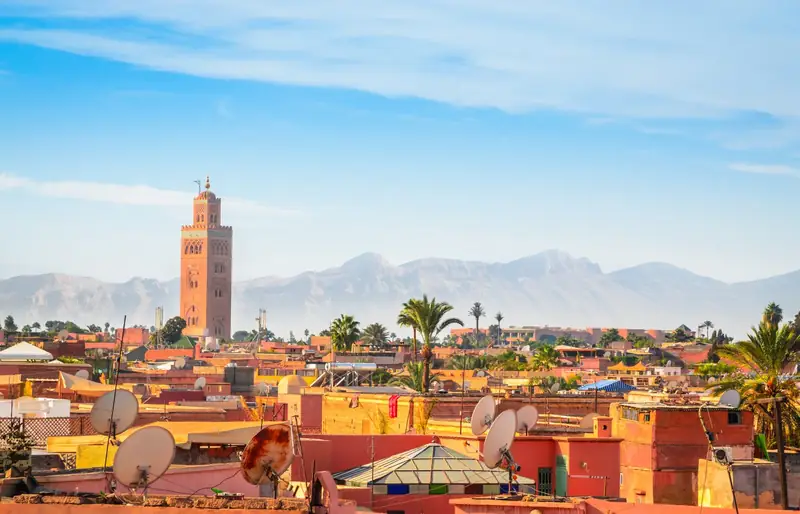
The Bahia sits in the densest cluster of monuments in Marrakech, all reachable on foot in a single morning. Do the palace first, then El Badi, then the Saadian Tombs, and finish with mint tea on Place des Ferblantiers. Jemaa el-Fna is the obvious next stop, and Ben Youssef Madrasa if you still have legs after the medina. Every site sells its own ticket, and El Badi and the tombs are both around 100 MAD for foreign adults.
| Destination | Distance | Why go |
|---|---|---|
| Place des Ferblantiers | 5 min walk | Cafés, lantern shops, a seat |
| El Badi Palace | 10 min walk | Stripped Saadian ruin |
| Saadian Tombs | 12–15 min walk | Carved marble and stucco |
| Mellah | 5 min walk | Old Jewish quarter |
| Jemaa el-Fna | 14–15 min walk | Food stalls from dusk |
Two warnings. El Badi is a largely stripped palace ruin rather than a furnished residence, so do not expect a second Bahia. The Saadian Tombs are small and queue-heavy in season: go before 10:30 or after 15:00, or skip them.
Practical Tips and Etiquette
- Cover up. It is a monument rather than a mosque, but shoulders and knees covered is the local norm, and a scarf helps in the shaded galleries.
- Photography is allowed. Light in the side rooms is dim, so brace the phone against a column instead of using flash on the paintwork.
- Carry water. The courtyards are open to the sky and there is no café inside; drink before you go in.
- Access. Much of the visit is at ground level, but thresholds, surfaces and temporary barriers can complicate wheelchairs and pushchairs. Ask staff about the day’s accessible route.
- Ignore the ‘official’ guides in the lane. Licensed guides wait at the gate with a badge; anyone who intercepts you 100 metres earlier is selling the same tour for more.
- Tipping. 10–20 MAD for a guide who answers a few questions, or the agreed fee for a full tour. Nothing for directions.
- Phone and phrases. Download an offline map before entering the medina; buy a Maroc Telecom or Orange SIM from an authorised shop with your passport. Salam alaikum is a greeting, Shukran means thank you, and La shukran is a polite no.
Prices may vary. Euro and dollar figures use November 2026 rates (€1 ≈ 10.9 MAD, $1 ≈ 9.9 MAD). Monument tickets, guide fees and taxi fares change; check them on the spot before you pay.
Frequently asked questions
How much is the Bahia Palace ticket?
100 MAD for a foreign adult. Ask at the gate about child, resident and other reduced rates. Cash is safest at the gate, and older guides quoting 70 MAD are out of date.
Is the palace open every day?
Yes, 09:00–17:00 daily, with last entry around 16:30 and shorter hours during Ramadan. It closes occasionally for official functions, so check the gate or your hotel on the morning you plan to go.
How long does a visit take?
Sixty to ninety minutes. The route is mostly at ground level and compact, but the courtyards are open to the sun and the palace is busy between 10:30 and 13:30, which slows everything down.
Is it still worth visiting during the restoration?
Usually yes, if the great courtyard and the painted halls are open ask at the ticket window, which sees the day’s closures before anyone else. If several sections are fenced off, the price stays the same, so it is a fair call to walk away and come back another year.
Why are the rooms empty?
Because Ba Ahmed died on 17 May 1900 and the palace was stripped of its furniture, carpets and valuables within hours, on the order of Sultan Abdelaziz. What is left is the architecture, and that was always the point.