Ben Youssef Madrasa: Beyond the Courtyard Photograph
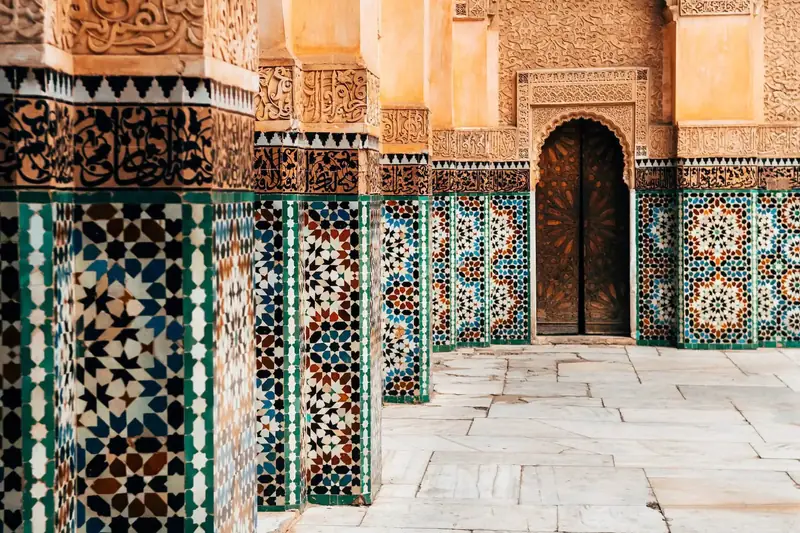
Ben Youssef Madrasa in Marrakech is a former Islamic college where the best part is the contrast: an extravagant courtyard of cut tile and carved plaster, then student rooms scarcely larger than cupboards. Foreign adult entry is 50 MAD (about €4.5 or $5); published hours are daily 09:00–19:00, with exceptions to check locally. Give it an hour, arrive at opening if you can, and explore the upstairs quarters rather than leaving after the pool photograph.
Non-Muslims are welcome: this is a historic monument, not the working mosque next door. The guide below explains what to look for, how the school functioned, how to reach it through the souks and which nearby sights make sense together.
Bring cash and a saved map. Buy admission at the entrance and keep small dirham notes handy. Download the northern medina before leaving your accommodation; a map that works offline is more useful here than a promised shortcut.
At a glance
- What
- Former residential Islamic college
- Built
- Present building completed 1564–65
- Entry
- 50 MAD (≈ €4.5 / $5)
- Hours
- Published daily 09:00–19:00
- Allow
- 60–75 minutes
- Location
- Rue Assouel, northern medina
In this guide
- Is Ben Youssef Madrasa Worth Visiting?
- Tickets, Opening Hours and What to Budget
- Who Built the Madrasa?
- What to See: A Route Through the Building
- Reading Zellige, Plaster and Cedar
- Student Life: Look Beyond the Grand Court
- Best Time, Photography and Access
- Getting There Without an Unwanted Guide
- A Sensible Day Around the Madrasa
- Dress, Money and Everyday Etiquette
Is Ben Youssef Madrasa Worth Visiting?
Yes, especially if you want to understand Moroccan craftsmanship without spending half a day in a museum. The building is compact, the central courtyard is immediately legible, and the dormitories explain something that palaces do not: how students from outside the city could live near a major mosque and pursue religious study.
It is not an undiscovered retreat. By mid-morning, groups gather along the pool and people wait for the same symmetrical photograph. The answer is not to skip it but to slow down in the side courts, look up at the cedarwork and return to the main courtyard after a group moves on.
- For architecture: one of the strongest single stops in Marrakech; inspect a complete wall from tile base to wooden eaves.
- For children: short enough to stay manageable, with small rooms and stairs to explore under supervision.
- For a tight budget: the standard foreign adult ticket is half the Bahia Palace adult fee, although the two buildings tell different stories.
Tickets, Opening Hours and What to Budget
Foreign adult admission is widely published as 50 MAD; buy at the entrance. A walking tour may exclude admission. Check inclusions online: a website bearing the monument’s name is not necessarily its operator.
| Item | Budget | Notes |
|---|---|---|
| Foreign adult | 50 MAD (≈ €4.5 / $5) | Per person |
| Reduced entry | Check locally | Bring relevant ID |
| Private guide | Agree locally | Entry may be extra |
Prices may vary; always check them on site.
Published hours are daily 09:00–19:00. Sources disagree on Ramadan schedules; reconfirm at your accommodation or the entrance. Leave a full hour before closing and follow the staff’s current admission cutoff.
Carry cash for admission, preferably notes that do not require a large amount of change. Add a separate allowance for water and a café stop outside, but you do not need to hire someone simply to get through the door. There is no need to tip the ticket seller, and nobody in the lane should require a fee to let you pass.
Who Built the Madrasa?
The building you see was commissioned by the Saadian sultan Abdallah al-Ghalib and completed in 1564–65, a date supported by inscriptions. Accounts commonly trace an earlier college to the Marinid period; that should not obscure the Saadian identity of the surviving monument. The name comes from the neighbouring Ben Youssef Mosque and, through it, the Almoravid ruler Ali ibn Yusuf.
The decoration continues a long Moroccan tradition. The plan combines a public court and prayer hall with residential wings around smaller light wells. Rich shared spaces advertised patronage; ordinary rooms provided lodging.
The college stopped operating in 1960 and later opened as a historic monument. A further restoration closure began in 2018, and visitors returned in April 2022. That restoration predates the September 2023 earthquake: do not confuse the two events or assume that every repaired surface is recent earthquake work.
What to See: A Route Through the Building
Pause in the entrance passage before stepping into the courtyard. The shift from shade to a bright rectangle is part of the architecture. Let your eyes adjust and identify materials before using the camera.
- Central courtyard: follow the long rectangular basin towards the prayer-hall doorway. Look at the relationship between the low water surface, pale paving and richly worked upper walls.
- Prayer hall: identify the mihrab, the niche indicating the direction of prayer, and inspect the carved decoration around it. Follow barriers and staff instructions rather than assuming every recess is accessible.
- Upper galleries: take the stairs if suitable for you and look back towards the court. Keep moving at narrow viewing points so others can pass.
- Small residential courts: compare their modest scale with the ceremonial courtyard; these are part of the school’s daily workings, not leftover corridors.
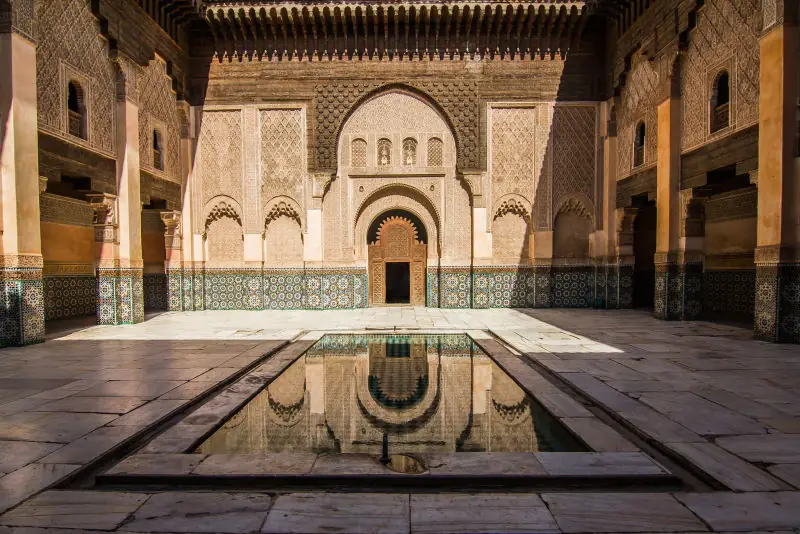
Descriptions commonly cite about 130 rooms and capacity for up to 800 students, a reported historical maximum rather than a constant occupancy. Compare a few rooms carefully instead of trying every doorway.
Reading Zellige, Plaster and Cedar
Start at floor level and work upwards. Zellige is a mosaic assembled from individually cut glazed pieces, not a single tile printed with an entire pattern. At a corner or doorway you can see how the geometry changes direction while maintaining a continuous band around the courtyard.
Above it, carved plaster turns solid wall into apparent lace. Look for plant forms, interlaced geometry and calligraphy, but do not invent a translation from the shape of a few letters. The wooden zone above is cedar: deep eaves cast shadow over the detail and help explain why the courtyard reads differently as the sun moves.
The mihrab and important entrances receive especially concentrated decoration. Muqarnas, the tiered, honeycomb-like ornament used in transitions and recesses, is easier to understand from a slight angle than head-on. Our Moroccan architecture guide explains the vocabulary if you want to recognise it again elsewhere.
Not every bright surface is untouched sixteenth-century work. This conserved building has centuries of repairs; look at how materials and spaces work together, not how old a patch appears.
Student Life: Look Beyond the Grand Court
A madrasa was not simply an ornate classroom. It supported religious education and provided lodging, particularly valuable to students coming to the city from elsewhere. Teaching and study belonged to the broader religious quarter as well as to this building, so the dormitories matter as much as the monumental hall.
Step into an open room without blocking its entrance and compare the amount of light with the courtyard outside. Some rooms face small courts rather than the main one; privacy, ventilation and limited floor space shaped the experience. They were shared residential spaces, not rows of private hotel rooms with identical amenities.
Most visitors photograph the patron’s public statement and hurry past the accommodation it supported. Ten minutes in the residential wings makes the court more interesting on your return.
Best Time, Photography and Access
Choose the first hour after opening for the best chance of space around the pool, not a guarantee of an empty building. Late afternoon can also work; midday brings strong contrasts between sunlit paving and dark galleries. Spring and autumn are pleasant for walking but busy, while summer makes the approach through the medina the most tiring part of the visit.
- Photographs: step out of the main doorway, wait for a gap and take a few frames rather than claiming a spot indefinitely. The pool may not always give a perfect reflection.
- Equipment: a phone is enough; ask before using a tripod or professional kit. Avoid flash on delicate surfaces and never climb onto a ledge for an angle.
- Mobility: the upper student quarters require stairs. Check current ground-floor access, thresholds and restrictions directly; do not plan on a fully step-free visit.
- With children: watch the pool edge, stairs and narrow galleries; a carrier may be easier than manoeuvring a pushchair upstairs.
Getting There Without an Unwanted Guide
The madrasa is near the Marrakech Museum and Almoravid Koubba in the northern medina. Allow roughly 15–25 minutes on foot from Jemaa el-Fna, longer if you stop to shop or take a wrong turn. Search for the madrasa itself, not just the mosque, and keep the saved pin visible as lanes change direction.
Ask a taxi driver for a suitable medina access point and where the walk begins; a drop-off at the entrance is not guaranteed. Use the meter where available or agree the fare before departure.
If someone says the madrasa is closed and offers a detour, verify at the entrance. A firm La shukran, meaning no thank you, is enough. Avoid turning a refusal into an argument, keep to public lanes, and ask a shopkeeper for a landmark rather than handing your phone to a stranger.
A Sensible Day Around the Madrasa
- MorningVisit at opening, allow an hour to seventy-five minutes, then choose the nearby Marrakech Museum or Almoravid Koubba if open. Both have separate entry arrangements.
- AfternoonWalk south through the souks, take lunch and a rest, then choose another monument only if you still want one. Allow a proper walking buffer rather than treating the medina as a straight road.
- EveningReturn to Jemaa el-Fna as food stalls assemble. There is no need to rush the madrasa and race to a garden across the city in the same morning.
| Stop | From madrasa | Best for |
|---|---|---|
| Marrakech Museum | A few minutes | Palace setting |
| Almoravid Koubba | A few minutes | Earlier architecture |
| Jemaa el-Fna | 15–25 min walk | Evening atmosphere |
| Bahia Palace | 30–40 min walk | Later domestic grandeur |
If you only have room for one more paid monument, Bahia Palace provides a useful nineteenth-century contrast rather than more student rooms. Jemaa el-Fna is a different experience again: public performance and food instead of architecture. Our Marrakech guide helps put these stops into a realistic stay.
Dress, Money and Everyday Etiquette
Dress modestly, with shoulders and knees covered as a respectful choice in a former religious college. The nearby working mosque has different entry rules; a madrasa ticket is not permission to enter it. Keep voices low in the prayer hall and follow any instructions about footwear rather than copying another visitor.
Salam alaikum is a greeting, Shukran means thank you, and La shukran politely declines an offer. Ask before photographing people, keep your bag zipped in crowded lanes and carry small notes separately from your main cash. At a café, a small dirham tip is appreciated; a guide’s fee should be agreed in advance, with any extra tip voluntary.
Download your map on Wi-Fi before leaving. If you need mobile data, buy a Maroc Telecom or Orange SIM from an authorised shop and bring your passport for registration. Reception inside thick-walled buildings is not a substitute for knowing your next landmark, and a charged phone is more useful than a bag full of camera accessories.
Prices may vary. Euro and dollar amounts are approximate planning conversions (€1 ≈ 10.9 MAD; $1 ≈ 9.9 MAD), not guaranteed exchange rates. Recheck admission, holiday hours and tour inclusions locally.
Frequently asked questions
Can non-Muslims enter Ben Youssef Madrasa?
Yes, visitors of all faiths can enter the former college as a ticketed historic monument. Do not confuse it with the adjacent working mosque, which has different access rules.
How much does Ben Youssef Madrasa cost?
The published standard foreign adult price is 50 MAD, approximately €4.5 or $5. Bring cash and check reduced rates at the entrance; a guided-tour price is not necessarily an admission ticket.
How long do you need inside?
Allow about an hour to seventy-five minutes for the courtyard, prayer hall and student quarters. A short photo stop misses the residential part that explains the building’s purpose.
Is Ben Youssef Madrasa open every day?
Published regular hours are daily 09:00–19:00, but Ramadan and exceptional arrangements need checking locally. Arrive well before closing rather than assuming a last-entry time that has not been confirmed.
Do you need a guide or an advance ticket?
An independent visit is straightforward with a map and a ticket bought at the entrance. A licensed guide can add context, but agree the price, duration and whether admission is included before starting.