Morocco Entry Requirements: Check Your Documents Before Travel
Morocco entry requirements depend on the passport you travel with, your purpose and sometimes your residence or existing visas. Check your own nationality’s rules before booking: visa-free travel, an eVisa and a consular visa are different routes, and none replaces a valid travel document. There is no reliable single passport-validity rule to apply to every visitor.
Keep your passport, any required approval and your first accommodation address accessible before joining the border queue. The useful preparation happens earlier: match names and dates, understand the stay actually authorised and confirm that your carrier will accept your documents. This guide separates those decisions so that an airport arrival, ferry crossing or longer journey starts with fewer avoidable uncertainties.
Check twice, for different reasons. Use Moroccan official services to establish your visa or authorisation route, then check passport-specific advice and your carrier’s document rules. Recheck near departure; this guide is not an individual admission decision.
Before you travel
- Passport
- Rules depend on your document
- Visa
- Check nationality and purpose
- eVisa
- Single entry, up to 30 days
- Arrival
- Check your entry stamp
- Extension
- Apply before permission expires
- Customs
- Separate cash and goods rules
In this guide
- Start with your passport, nationality and purpose
- How much passport validity do you need?
- Visa exemption, eVisa, AEVM or a consular visa?
- Understand the eVisa’s two different clocks
- Prepare one accessible document folder
- At the airport or ferry port: check the entry stamp
- Customs: cash, drones and your own vehicle
- Health paperwork is not the same as health advice
- Longer stays, extensions and leaving Morocco
- A final check before you lock the itinerary
Start with your passport, nationality and purpose
A residence permit is not your nationality. Someone living in Germany with an Indian passport should not use the German-passport exemption as their own rule. Equally, a visa issued by another country does not itself grant entry to Morocco; it may qualify an otherwise eligible traveller to apply for a Moroccan eVisa.
Use Accès Maroc and the Moroccan consular service to identify the route for your passport type and purpose. Check each person separately, including children. Ordinary, emergency, refugee and other travel documents can have different conditions. Ask the relevant Moroccan consulate if the portal does not clearly cover yours.
Tourism permission is not permission to take local employment or establish residence. Study, paid work, family settlement and longer stays may need a different process. For a complicated case, obtain a specific answer before buying non-refundable transport rather than relying on another traveller’s successful holiday.
How much passport validity do you need?
Published government advice differs by passport. These are scoped examples, not a nationality list or a universal Moroccan six-month law. Consult the linked advice for its full conditions and check again before departure, especially if your expiry date is close to a threshold.
| Passport covered | Published validity advice | Official source |
|---|---|---|
| Full British citizen | At least 3 months after arrival | UK FCDO |
| United States | At least 6 months at entry | US State Department |
| German | At least 6 months at entry | German Foreign Office |
| Regular Canadian | At least 6 months beyond expected departure | Government of Canada |
The different starting points matter: six months after arrival and six months after departure are not equivalent on a long trip. Check passport condition, space for stamps and transit-country rules too. An identity card is not a safe substitute for a passport, even when you are travelling with an organised group.
If you renew a passport after an approval is issued, ask the issuing authority what must be changed or reissued. Do not assume that carrying the old and new books will solve a document-number mismatch. A photograph of a passport is useful backup information, not a replacement travel document.
Visa exemption, eVisa, AEVM or a consular visa?
| Route | What it means | What to verify |
|---|---|---|
| Exemption | No advance visa for an eligible visit | Passport, purpose, stay, approval |
| eVisa | An electronic visa issued after application | Eligibility and the conditions on the approval |
| AEVM | Separate electronic approval | Current rules for your case |
| Consular visa | Application through a Moroccan consular service | Documents, appointment and processing time |
British citizen, US, German and Canadian tourist guidance describes visa-free visits of up to 90 days. That does not establish the rule for every nationality or every purpose. Follow your own category and the permission granted at the border; do not import the Schengen 90-in-180 calculation into Morocco without an applicable official rule.
AEVM and eVisa are not interchangeable names. Use the current official portal to find out whether an authorisation is required, including where visa exemption otherwise applies. Old event-specific instructions and nationality lists copied by visa sellers can remain online after their validity ends. Do not pay an intermediary merely because its website looks like a government portal.
Understand the eVisa’s two different clocks
The official eVisa conditions distinguish the approval’s validity from the visit itself. The eVisa has a maximum validity of 180 days from issue, is single-entry and permits a stay of up to 30 days. Read the dates and restrictions on your issued document; a 180-day validity window does not authorise six months in Morocco.
Eligibility can come through nationality or qualifying residence or visas abroad. The published conditions require an ordinary passport valid for at least 90 days at application; qualifying residence documents need at least 180 days, while a qualifying foreign visa must be non-electronic, multiple-entry and valid for at least 90 days at application. Eligible countries and categories must still be checked in the live service.
Those application thresholds do not cancel passport-specific travel advice or carrier checks at departure. Official standard and express processing targets are 72 and 24 Moroccan working hours for complete, accurate files, not guaranteed elapsed calendar hours. Allow time for corrections, weekends and requests for information; an application receipt is not an issued visa.
The conditions call for supporting travel documents, funds and medical and repatriation insurance. Their funds wording allows an international bank card or cash exceeding 70 euros per person per day; it is not an instruction for every visitor to carry that amount in cash. Keep the approval and the residence permit or foreign visa supporting your eligibility available for inspection.
Prepare one accessible document folder
Keep paper or offline copies of your booking address, onward or return plans, insurance details and relevant approvals. Officials may ask about accommodation, purpose, funds and your intention to leave. Answer accurately; do not invent a hotel reservation or assume a friend’s address removes the need to explain the visit.
- Compare the passport number, names and birth date across tickets and approvals before travel.
- Save the first accommodation’s full address and a contact number, not only a map pin.
- Keep essential originals in hand luggage and backups separately, with access protected.
- Check transit and return-entry documents as well as Moroccan admission requirements.
For children travelling without both parents, ask about consent evidence and supporting family documents for the exact itinerary. Requirements can also arise in the departure country. Dual nationals should check Moroccan documentation and their right to return to the country where they live, rather than relying on a generic tourist checklist.
At the airport or ferry port: check the entry stamp
Present the original passport and any required approval. Follow the current instructions at your arrival point rather than assuming every visitor must complete a paper arrival card. Keep your accommodation details ready and check that the entry stamp is present and legible before leaving the controlled area. If it is missing or unclear, ask an officer for help immediately.
A visa or boarding pass does not guarantee admission. Border officers can check whether the journey matches the documents. Keep the process separate from collecting luggage and buying a SIM: immigration comes before the practical tasks of beginning your holiday. Allow a connection buffer rather than treating advertised landing time as your station departure time.
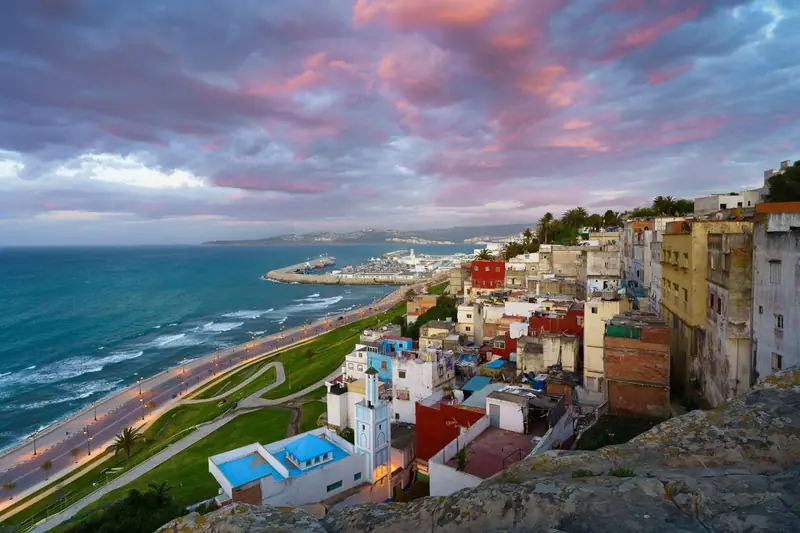
For a ferry or private-boat journey, establish where and how the operator handles immigration before you travel. Private boats must use a recognised port of entry. The Algeria land border is closed; do not build an overland itinerary around crossing it. See the Tangier guide for planning the city after arrival, not as a substitute for border instructions.
Customs: cash, drones and your own vehicle
Immigration and customs answer different questions. Moroccan exchange rules require declaration of covered foreign-currency payment instruments worth 100,000 MAD or more. That threshold is not a blanket guarantee of unrestricted export below it: status, the instrument and documentary conditions can matter. Ask customs before passing the declaration point if uncertain, and keep any validated declaration.
The Office des Changes permits travellers to carry up to 2,000 MAD in Moroccan banknotes across the border under its stated exception. Do not confuse this with the foreign-currency declaration threshold. Keep exchange receipts and read the money guide for the distinction between border rules, reconversion and everyday cash planning.
Do not pack a drone on the assumption that recreational use is automatically allowed. Check Moroccan authorisation requirements before bringing one. For your own or a borrowed vehicle, verify registration, permission, insurance and temporary-import paperwork. A temporarily imported vehicle generally needs to leave or have its customs position formally resolved; abandoning it or flying home does not settle the obligation.
Health paperwork is not the same as health advice
TravelHealthPro’s Morocco guidance states that no yellow-fever certificate is required under the International Health Regulations. Do not treat an unsupported blanket yellow-fever requirement as a reason to buy a certificate. Separate route-dependent conditions can apply: British and German advice flags possible polio documentation for arrivals from affected countries.
Discuss your itinerary, recent travel and vaccination history with a qualified travel-health service, ideally several weeks before departure. Recommended vaccines and compulsory admission documents are different categories. Check current health notices again close to travel, and arrange insurance suitable for your activities and medical circumstances without assuming that a visa approval proves adequate coverage.
Longer stays, extensions and leaving Morocco
Check your authorised departure date as soon as you arrive and plan with a buffer. For an extension, contact the competent local police or foreigners service before permission expires; approval is not automatic. Canadian guidance advises applying at least 15 days before the 90-day limit. Do not interpret that as a universal guarantee that every application or visa category can be extended.
Overstaying can cause fines, legal procedures and delayed departure. A booked flight, illness or a rejected extension does not automatically regularise the stay. Seek official advice promptly if plans change. A quick trip out and back is not a guaranteed reset, and a single-entry eVisa cannot simply be reused after exit.
A final check before you lock the itinerary
Reopen the official sources near departure, particularly after a passport renewal, a route change or new residence status. Check names, approved dates and the actual permitted stay together. Resolve uncertainty with the Moroccan authority responsible for your case and your carrier before travelling, keeping written replies where available without assuming they bind a border officer.
Then plan the enjoyable details: use travel tips for practical preparation, safety advice for everyday decisions and the best time to visit for seasonal planning. Check documents before online check-in.
Frequently asked questions
Does every visitor need six months on their passport?
No single rule should be applied to every passport. Published British, US, German and Canadian advice differs, including whether validity is measured from arrival or departure. Check your document’s official guidance and your carrier before travel.
Is a Morocco eVisa valid for a 180-day stay?
No. The official conditions describe validity of up to 180 days from issue, single entry and a stay of up to 30 days. Follow the specific dates and conditions printed on your approval.
Does living in Europe make me visa-exempt?
Not by itself. Nationality, passport type and purpose determine the route. Qualifying residence may support eVisa eligibility, but you must check and obtain any approval required before departure.
Do I always need an arrival card or yellow-fever certificate?
Do not assume either is a universal requirement. Follow current border instructions; TravelHealthPro lists no yellow-fever certificate requirement under the International Health Regulations. Route-dependent health requirements, including possible polio evidence, need a separate check.
Can I stay longer by making a short trip abroad?
Do not rely on a border run to renew permission. Admission is assessed again, and a single-entry eVisa is not reusable. Ask the competent Moroccan service about a lawful extension before the current permission expires.