Meknes Travel Guide: The Imperial City, Volubilis and Moulay Idriss
This Meknes travel guide starts with the short answer: give the city two days, one for Sultan Moulay Ismail’s imperial monuments and one for the Roman ruins of Volubilis and the holy town of Moulay Idriss. Meknes was Morocco’s capital from 1672 to 1727, and its sultan ringed it with gates, granaries and stables on a scale that earned it the nickname “the Versailles of Morocco”. Today it is calmer and cheaper than Fes, 45 minutes away by train, with a UNESCO-listed old town and good-value riads.
It rewards travellers who want history without the crowds. Below: sights, prices, a two-day plan, where to stay, food, transport, seasons and etiquette.
Check what is open. Restoration has closed some monuments or wrapped them in scaffolding in recent years. Dar Jamaï closes on Tuesdays, and the mausoleum usually shuts at midday and on Friday mornings.
At a glance
- Location
- Saïss plain, Fès-Meknès region
- Population
- About 550,000 (2024 census)
- UNESCO
- Historic city (1996), Volubilis (1997)
- Allow
- 2 days, including Volubilis
- By train
- Fes about 45 min, Rabat 2–2.5 h
- Best time
- March–May, September–November
In this guide
- Is Meknes Worth Visiting?
- Best Things to Do in Meknes
- Meknes Prices: Sights, Tours and Transport
- A 2-Day Meknes Itinerary
- Where to Stay in Meknes
- What to Eat in Meknes
- Getting to Meknes and Getting Around
- Best Time to Visit Meknes
- Day Trips from Meknes
- Safety and Etiquette in Meknes
- Money, SIM Cards and Tipping
Is Meknes Worth Visiting?
Yes, especially on a trip between Fes and Rabat. The trade-off is polish: signage is thin, some sights close for works without warning, and evenings are quiet.
- History lovers: Moulay Ismail’s gates, granaries and mausoleum, with Roman Volubilis 30 km away.
- Budget travellers: good-value riads and meals, and fewer touts than in the big medinas.
- Fes visitors: 45 minutes away by train, Meknes pairs easily with Fes.
Best Things to Do in Meknes
Most sights cluster around Place el-Hedim, with the medina to the north and Moulay Ismail’s walled imperial city behind Bab Mansour to the south. The new town and the train stations lie across the valley to the east.
Bab Mansour and Place el-Hedim
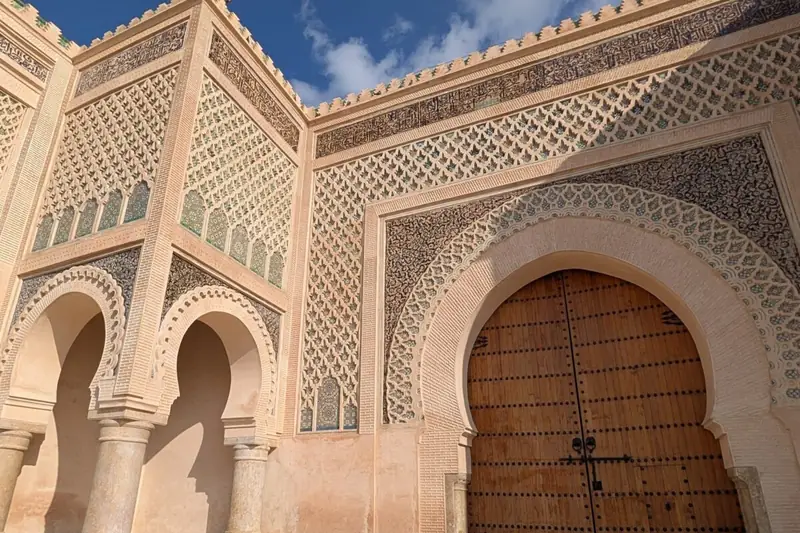
Bab Mansour, often called the finest gate in Morocco, was finished in 1732, five years after Moulay Ismail’s death. Its carved lattice, green tilework and marble columns, said to come from Volubilis, glow in the late-afternoon sun, though scaffolding sometimes hides parts of it. At dusk, Place el-Hedim opposite fills with food stalls, storytellers and families. See our guide to Moroccan architecture.
The Mausoleum of Moulay Ismail
The sultan who built Meknes lies in one of the few active shrines in Morocco open to non-Muslims. You leave your shoes at the door, cross quiet courtyards to an anteroom of zellige, carved stucco and cedar, and look into the tomb chamber, where two clocks are said to be a gift from Louis XIV. It usually closes at midday and on Friday mornings; dress modestly, as our guide to religion in Morocco explains.
Heri es-Souani and the Agdal Basin
About 2 km south of Bab Mansour, Heri es-Souani is a vast complex of vaulted granaries whose thick walls kept Moulay Ismail’s grain cool, with the roofless arcades of the royal stables behind. Many visitors find the 70 MAD ticket steep for so little explanation, so hire a guide at the gate or come for the architecture alone. Next door, the Agdal Basin (Sahrij Swani), a reservoir of about 320 by 150 metres, is free and busy with families at weekends.
The medina, Bou Inania Madrasa and Dar Jamaï
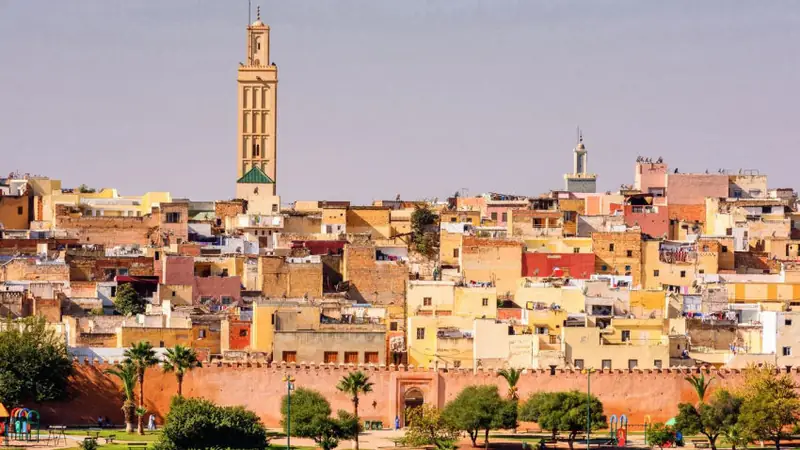
North of Place el-Hedim, the medina is smaller and gentler than Fes’s, with souks for carpets, spices and damascene, the local craft of inlaying iron with silver thread. The Bou Inania Madrasa, completed in the 1350s, has a courtyard of zellige, stucco and cedar and a roof terrace overlooking the green tiles of the Grand Mosque. On the square itself, Dar Jamaï, an 1882 vizier’s palace, has housed the National Museum of Music since 2022, with instruments in painted rooms around an Andalusian garden.
Volubilis and Moulay Idriss
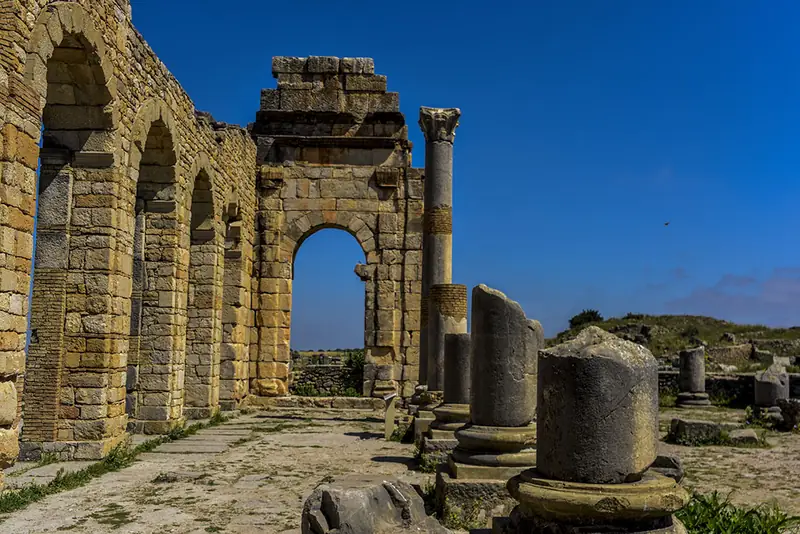
About 30 km north, Volubilis was a Roman city on the empire’s far edge, and its UNESCO-listed ruins include the basilica, the Capitol, the Arch of Caracalla and floor mosaics still in place in houses such as the House of Orpheus. Much of its stone was later carted off to build Meknes. The site has almost no shade, so arrive at opening time.
Moulay Idriss Zerhoun, 3–4 km away, climbs two hills around the shrine of Idris I, who founded Morocco’s first Islamic dynasty in the 8th century. Non-Muslims may walk its lanes but not enter the shrine. Climb to the Grande Terrasse for the classic view, and look for the cylindrical minaret of the Sentissi mosque.
Getting to Volubilis. Shared grands taxis to Moulay Idriss leave from the rank opposite the Institut Français for 10–12 MAD a seat. A whole taxi for half a day, about 300–350 MAD, covers both sites; agree the price and waiting time first.
Meknes Prices: Sights, Tours and Transport
Bab Mansour, Place el-Hedim, the Agdal Basin and the medina cost nothing. These are typical 2026 prices for foreign visitors; Moroccans often pay less.
| Item | Cost | Tip |
|---|---|---|
| Mausoleum of Moulay Ismail | Free | A donation is welcome |
| Heri es-Souani | 70 MAD (≈ €6 / $7) | Agdal Basin is free |
| Bou Inania Madrasa | 60 MAD (≈ €6 / $6) | Climb to the roof |
| Dar Jamaï music museum | 30 MAD (≈ €3 / $3) | Closed Tuesdays |
| Volubilis | 70 MAD (≈ €6 / $7) | Guide 150–200 MAD |
| Grand taxi seat to Moulay Idriss | 10–12 MAD (≈ €1 / $1) | Half-day hire 300–350 MAD |
Prices may vary; always check them on site.
A 2-Day Meknes Itinerary
Spend the first day on the imperial city and the second on Volubilis and Moulay Idriss.
- Day 1 · MorningBab Mansour, then the mausoleum before its midday break and the Bou Inania Madrasa.
- Day 1 · AfternoonDar Jamaï (closed Tuesdays), then a calèche or taxi to Heri es-Souani and the Agdal Basin.
- Day 1 · EveningPlace el-Hedim at dusk, then dinner in a medina riad.
- Day 2 · MorningVolubilis at opening time, before the heat and the tour coaches.
- Day 2 · AfternoonLunch in Moulay Idriss, then the climb to the Grande Terrasse.
- Day 2 · EveningBack to Meknes, or on to Fes by train in about 45 minutes.
With a third day, add Ifrane and the cedar forest near Azrou.
Where to Stay in Meknes
Choose the medina for atmosphere, the new town for transport and Zerhoun for Volubilis.
| Area | Best for | Trade-off |
|---|---|---|
| Medina | Riads near Place el-Hedim, close to the sights | Dark lanes at night; few riads reachable by car |
| New town (Hamria) | Modern hotels, cafés, both train stations | Less atmosphere; a taxi to the medina |
| Moulay Idriss and Zerhoun | Guesthouses with views near Volubilis | Quiet evenings; you need transport |
| Wine country | Estate hotels among the vineyards | Pricier; a car is essential |
Meknes is usually cheaper than Fes or Marrakech, but rooms fill during SIAM, the giant agricultural show (19–27 April 2027).
What to Eat in Meknes
Meknes cooking follows Fes: tagines, Friday couscous and pastilla, plus the olives of the Saïss plain, piled in pyramids in the covered market on Place el-Hedim beside dates and nougat. Try khlii, spiced preserved beef, fried with eggs at breakfast.
The hills around the city produce much of Morocco’s wine, including the Guerrouane appellation, but wine is served mainly in new-town restaurants and hotels, rarely in the medina.
Getting to Meknes and Getting Around
- By train: of the two stations in the new town, Al Amir Abdelkader is closer to the medina. Trains reach Fes in about 45 minutes, Rabat in 2–2.5 hours, Casablanca in about 3 hours and Tangier in 3–4 hours, some with a change at Kenitra; see our train times.
- By bus: CTM and Supratours run to Fes, Rabat, Casablanca and Chefchaouen, but direct Chefchaouen buses are few, so many travellers change in Fes.
- By air: Fes–Saïss Airport (FEZ) is about an hour away. A taxi costs around 400 MAD, or take bus 16 to Fes station and then the train.
- In the city: light-blue petits taxis use the meter, carry up to three passengers and charge 10–20 MAD for most rides, more after dark. Calèches wait at Place el-Hedim and Place Lalla Aouda; agree the route and price first, often 100–200 MAD an hour.
- By car: a hire car makes Volubilis, Ifrane and the vineyards easy, and the A2 motorway links Meknes with Fes and Rabat.
Works on the Kenitra–Marrakech high-speed line have changed some timetables since September 2026, so check times before you travel. Marrakech is about 6 hours away by train, often with a change in Casablanca.
Best Time to Visit Meknes
| Season | Weather | Verdict |
|---|---|---|
| Mar–May | About 20–26 °C; green fields, some rain | Ideal; wildflowers at Volubilis |
| Jun–Aug | About 30–35 °C; heatwaves top 40 °C | Sightsee early |
| Sep–Nov | About 31 °C in September, 20 °C in November | Excellent in October |
| Dec–Feb | About 15–17 °C by day, 5 °C at night; the wettest months | Quiet; riads can be chilly |
SIAM, one of Africa’s largest agricultural shows, fills hotels from 19 to 27 April 2027. The Aissawa Sufi brotherhood gathers at its founder’s shrine around the Prophet’s birthday, in August in 2027; Moulay Idriss holds its moussem in late summer; and Ramadan, expected from about 8 February to 9 March 2027, changes opening hours.
Day Trips from Meknes
Beyond Volubilis and Moulay Idriss, the cedar-clad Middle Atlas begins an hour’s drive to the south.
- Fes: about 45 minutes by train, Morocco’s great medieval medina, worth a night of its own.
- Ifrane: about 64 km south, a 1930s mountain town of steep roofs and cool air at 1,650 m, nicknamed Morocco’s Little Switzerland.
- Azrou cedar forest: about 75 km south, with ancient cedars and wild Barbary macaques; never feed them.
- Wine estates: Château Roslane, south of the city, offers cellar visits, tastings and lunch by reservation only.
| Destination | Distance | Best for |
|---|---|---|
| Volubilis and Moulay Idriss | About 30 km | Roman ruins, holy town |
| Fes | About 60 km | Medina and tanneries |
| Ifrane | About 64 km | Cool air and lakes |
| Azrou cedars | About 75 km | Cedars and macaques |
Ifrane and Azrou fit into one day by car or with a driver; Fes is better as an overnight stop.
Safety and Etiquette in Meknes
- Unofficial guides: they are fewer than in Fes but may approach you near the main sights; decline politely and keep walking.
- Shrines: dress modestly at the mausoleum and in Moulay Idriss; the tomb chambers are for Muslims only.
- Heat: summer afternoons top 35 °C, so see Volubilis early and carry water and a hat.
- Evenings: watch your bag on Place el-Hedim and avoid empty medina lanes late at night.
- Photos: ask before photographing people, especially women and market traders.
Money, SIM Cards and Tipping
- Cash and cards: better hotels take cards, but taxis, ticket desks, souks and small cafés want cash; ATMs are easy to find in the new town.
- SIM cards: a Maroc Telecom or Orange SIM costs around 30 MAD with your passport, from the operators’ shops.
- Tipping: 1–2 MAD in cafés, 5–10 MAD in casual restaurants and 50–100 MAD a day for a driver or guide; round up taxi fares.
- Phrases: “Salam alaikum” (hello), “shukran” (thank you) and “la, shukran” (no, thank you) go a long way, and French is widely spoken.
- Ramadan: out of respect, avoid eating, drinking or smoking in public during daylight hours.
Prices may vary. Euro and dollar figures use November 2026 rates (€1 ≈ 10.9 MAD, $1 ≈ 9.9 MAD). Entry fees, guide rates and taxi fares change, so check them on site before you pay.
Frequently asked questions
Is Meknes worth visiting?
Yes. It has some of Morocco’s grandest imperial monuments, a calmer medina than Fes and good-value riads, and it is the best base for Volubilis and Moulay Idriss.
Can you visit Meknes as a day trip from Fes?
Yes. Trains take about 45 minutes, so the main sights fit into a day; Volubilis and Moulay Idriss are easier with a driver or a night in Meknes.
How do you get from Meknes to Volubilis?
Take a shared grand taxi to Moulay Idriss for 10–12 MAD, then a short taxi ride, or hire a grand taxi for half a day for about 300–350 MAD. The drive takes about 45 minutes.
Is Meknes better than Fes?
Fes has the bigger medina and far more sights; Meknes is smaller, calmer and cheaper, with grander royal monuments. If you have time, see both: they are about 45 minutes apart by train.
Is Meknes safe for tourists?
Generally yes, and there are fewer touts than in Fes or Marrakech. Use metered taxis, watch your bag on Place el-Hedim in the evening and avoid empty lanes late at night.