Paradise Valley: Plan a Gorge Walk, Not a Guaranteed Swim
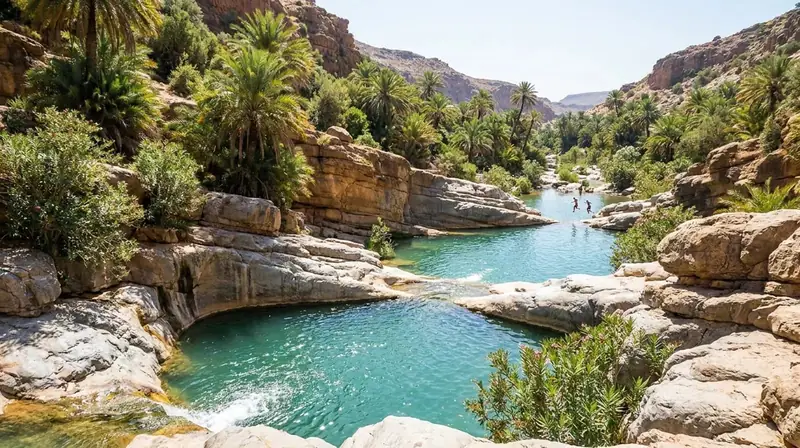
Paradise Valley is a palm-lined gorge inland from Agadir, in the western High Atlas foothills. Visit for the rocky landscape and a walk, with swimming only a possibility: drought, recent rain and water quality can completely change the pools. Allow roughly five to six hours from Agadir, including about an hour to an hour and a half on the road each way and time to climb back out.
The pale rock shelves and green pockets are attractive without a swim, but the uneven approach is not a paved garden stroll. Ask about current water, weather and access before paying for a tour. Avoid the gorge during heavy rain or flood warnings, do not cliff-jump, and settle the return pickup before leaving your driver.
Ask for conditions, not the brochure photograph. Request a recent, dated report of the pools and path. A turquoise promotional picture does not prove today’s depth, cleanliness or access; book a walk you would still enjoy without entering the water.
At a glance
- Setting
- Asif Tamraght gorge, inland from Agadir
- Drive each way
- Roughly 1–1½ hours from Agadir
- Door to door
- Allow about 5–6 hours
- Initial walk
- Often 20–30 minutes each way
- Water
- Rainfall-dependent; check locally
- Main limits
- Heat, rough footing and flood risk
In this guide
- Is Paradise Valley Worth a Half-Day?
- Where Is It, and Is Imouzzer the Same Stop?
- When to Go: Water Depends on Rainfall
- How Difficult Is the Walk to the Pools?
- Can You Swim, and Why Avoid Cliff Jumping?
- Getting There from Agadir or Taghazout
- Entry, Parking and What a Tour Actually Includes
- Shoes, Children, Mobility and Packing
- Cafés, Argan Stops and Respectful Visiting
- A Realistic Day, Plus Sensible Nearby Stops
Is Paradise Valley Worth a Half-Day?
Come for rocky scenery, palms on dry hillsides and water sometimes gathering between pale ledges. Cafés offer pauses, but this is a popular excursion, not untouched wilderness or a reliably full natural swimming pool.
If swimming is your only reason, check again before departure and consider alternatives. Reports range from enjoyable pools to low, murky water, litter and crowds. They do not describe every day, but explain why guaranteed clear water would mislead.
| Plan | Best for | Trade-off |
|---|---|---|
| Shared tour | Simple transport | Fixed pace |
| Private driver | Flexible stops | Agree waiting |
| Rental car | Your own timing | Mountain driving |
Where Is It, and Is Imouzzer the Same Stop?
The valley lies inland from the Aourir and Tamraght coast, on the approach towards Imouzzer Ida Outanane. This western High Atlas excursion is not the Sahara or Imlil near Marrakech. Use the access and parking agreed with your driver.
Imouzzer is a separate mountain stop farther along the road, associated with honey, orchards and seasonal waterfalls. A Paradise Valley booking does not automatically include it, and a photograph of an Imouzzer cascade is not proof of a flowing waterfall beside your swimming stop. Ask exactly which valley, viewpoints and walking sections the itinerary includes before booking.
When to Go: Water Depends on Rainfall
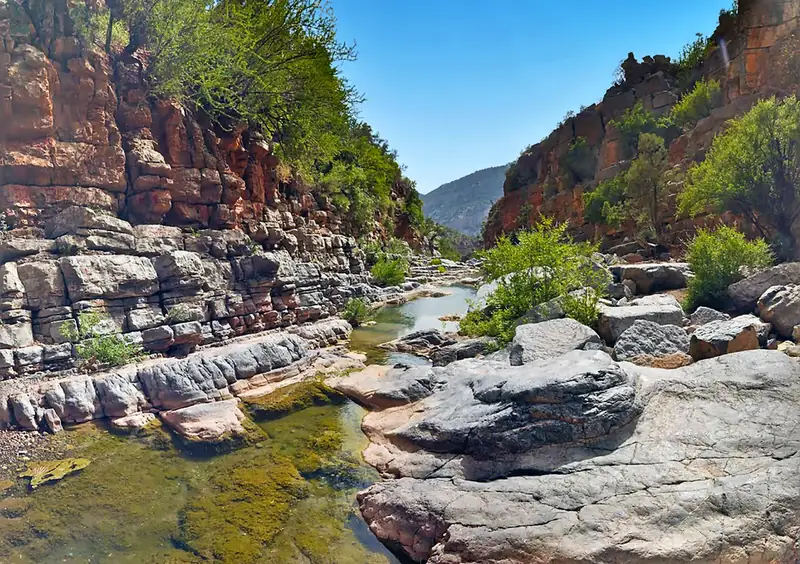
Spring and autumn often offer more comfortable walking than the hottest summer afternoons, but they do not guarantee full pools. Extended dry weather can reduce the stream to scattered pools; summer heat also makes the return climb more demanding. Start early when practical, particularly on weekends and holidays, without expecting any weekday or hour to be empty.
Rain is not simply a reason to rush here for better water. Heavy rainfall in the catchment can send floodwater through a narrow gorge, even when the sky immediately above looks fine. Check local forecasts and warnings, ask about upstream conditions, and postpone if access is uncertain. Our weather guide gives broader seasonal context, not a live clearance for this walk.
Do not enter a gorge under flood warnings. Check the whole catchment forecast, not just sunshine at the coast. Rising or fast water, closed access and heavy rain are reasons to cancel, not to seek fuller pools.
How Difficult Is the Walk to the Pools?
Allow roughly twenty to thirty minutes from the access to the first main pools, depending on route, pace and water. Expect steps, loose gravel, rock shelves and possible crossings. Save water and energy for the uphill return.
Ask which route is currently open and how you will recognise the return, then keep the first walk modest. Farther pools can involve rougher terrain and scrambling; “quieter upstream” is not a reason to follow strangers across wet rock. If reaching the next section requires a jump, slippery traverse or uncertain crossing, stop. A short out-and-back still counts as a visit.
- At the entrance: confirm the open route and return meeting point, not just which way other groups go.
- On the path: use grippy shoes and a pace that leaves energy for the climb out.
- At crossings: turn back if unsure; a narrow wet ledge is not made safe by a queue of visitors.
Can You Swim, and Why Avoid Cliff Jumping?
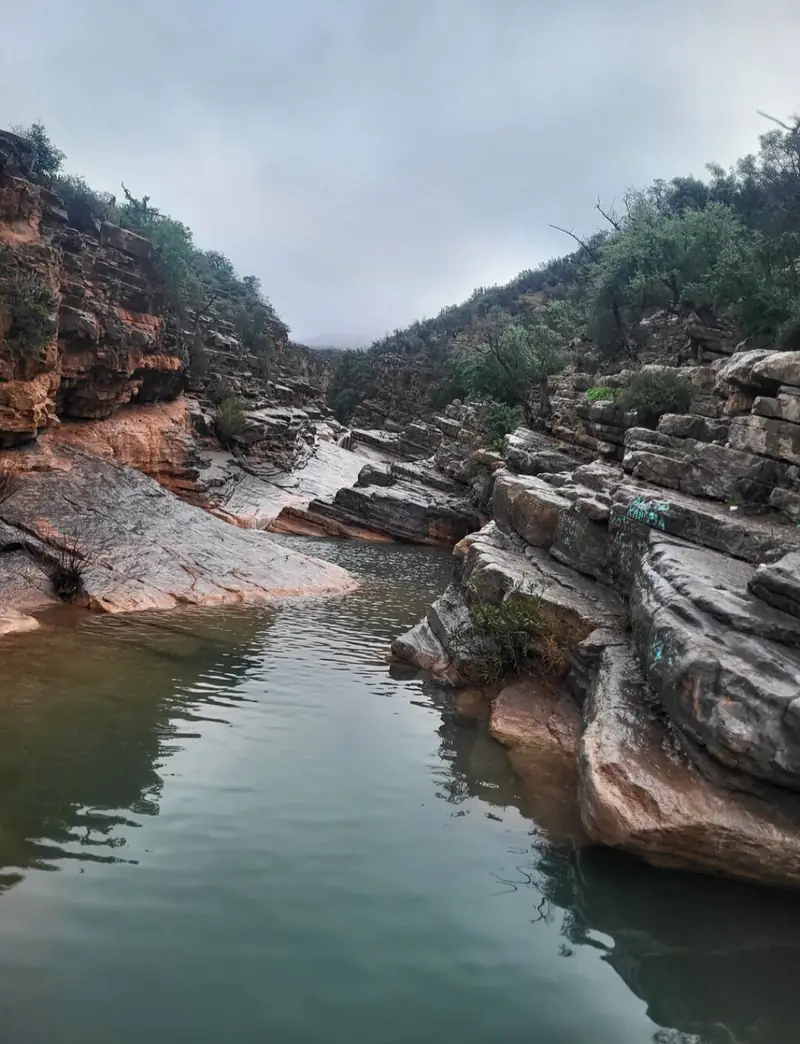
Swimming is conditional, not a guaranteed activity included with admission or a tour. Depth changes, submerged rock may be hard to see, and clear-looking water is not a water-quality test. Skip stagnant, murky or questionable water; do not enter during rising flow or after heavy rain, and never assume lifeguards or an organised rescue service are present.
Do not jump or dive from the rocks, even if a guide or other visitors do. Looking at the surface or seeing one successful jump cannot establish a safe landing area. If conditions are uncertain, remain out of the water; there is no need to buy into the idea that visiting without swimming means missing the attraction. Grippy shoes do not remove water hazards.
Getting There from Agadir or Taghazout
From Agadir, the usual route heads north towards Aourir, then inland on the winding road towards Imouzzer. Allow roughly one to one and a half hours each way, depending on your hotel, traffic, stops and current road conditions. From Taghazout or Tamraght, an inland transfer is still needed; being on the nearby coast does not mean the pools are a beachside walk away.
Renting gives flexibility; a booked grand taxi or driver avoids self-driving. Agree the valley access, waiting time, return pickup and total before setting out. Public or shared connections may require changes and waiting; do not assume an on-demand ride will be available at the end. See our transport guide for the distinction between city taxis, shared routes and private hire.
Entry, Parking and What a Tour Actually Includes
Independent travel guides describe access as free and report parking around 10–20 MAD, but arrangements vary; ask at the access what a charge covers and request a ticket or receipt where provided. Parking, a guide, food and a packaged excursion are different purchases, not entry fees.
Compare actual walking time, group size, transfers and inclusions, not headline price. Ask whether lunch, guide, hotel pickup and shopping stops are included, and plans for dry pools or closed routes. A low price may mean less walking and more sales stops; purchases remain optional. Do not accept an unsolicited service before its price and purpose are clear.
| Expense | Budget / basis | Confirm |
|---|---|---|
| Valley access | Usually free | Local rules |
| Parking | About 10–20 MAD | Posted charge |
| Driver / tour | Quote first | Return, extras |
| Food / guide | Separate cost | Menu, terms |
Prices may vary; always check them on site. Parking reports are planning estimates, not an official tariff. For scale, 10–20 MAD is roughly €1–2 or US$1–2, with exchange rates and fees varying; pay or agree the actual amount in Moroccan dirhams.
Shoes, Children, Mobility and Packing
Wear trainers or secure walking sandals with grip rather than flip-flops; wet limestone and loose gravel need attention. Bring sufficient drinking water for the whole walk and return, sun protection, a hat and a light layer for changing conditions. Keep hands free and valuables protected; cafés do not replace essentials.
With children, choose a short route, supervise around drops and pools, and return before fatigue. Steps, rock and soft sections prevent promises of wheelchair or pushchair access. Ask about the current approach and authorised stable viewpoints; vehicle access does not imply everyone can reach the pools.
- Sun and water: carry your own supply, refill only from a safe source and shorten the walk in heat.
- Possible swim: a towel or water shoes do not commit you to entering; decide from current conditions.
- Waste: take packaging back, avoid glass, and never use soap or shampoo in the stream.
Cafés, Argan Stops and Respectful Visiting
Simple cafés and food stops line parts of the approach and valley. Check the menu, portion size, full price and expected preparation time before ordering a tagine, and ask about toilets and handwashing rather than assuming full facilities. Choose somewhere whose hygiene you are comfortable with, carry a backup snack and do not drink untreated stream water. A chair standing in water is not evidence that it is clean.
Argan, honey and amlou stops can give context to the region when they are genuinely of interest, but they also use excursion time. Ask before booking how many are planned; there is no obligation to buy after a demonstration or tasting. Our shopping guide covers polite price discussions. Ask before photographing residents, respect fields and private plots, and keep music low.
A Realistic Day, Plus Sensible Nearby Stops
Choose one clear purpose for a five- to six-hour outing. After the valley, Aourir, Tamraght or Taghazout can provide a coastal meal or pause if time allows. Imouzzer adds more mountain driving and a separate seasonal-waterfall question; Legzira, Taroudant and Essaouira are not adjacent stops to squeeze into the same half-day.
Set a turnaround with your driver before walking, leaving a buffer for the climb, traffic and a late meal. Save access, contacts and meeting details offline; tell someone your independent walking plan. If the weather or path is unsuitable, change the day rather than looking for an unmarked shortcut around a barrier. Do not return through the gorge after dark.
- MorningCheck weather and access, leave with water and a return agreement, then walk before the strongest heat if conditions permit. Shopping stops should not consume the planned valley time.
- AfternoonAllow time for the climb out and lunch. A short coastal stop is optional; if the valley is unsuitable, use the day in town instead of forcing a different gorge.
- EveningReturn with daylight to spare. A sunset add-on should not turn a manageable excursion into a rushed descent or an uncertain ride home.
- Cash: small MAD notes help for parking and food. Check card acceptance; tips are voluntary and separate from agreed services.
- Phone: save maps and pickup details offline. Buy a Maroc Telecom or Orange SIM with your passport at an authorised shop; reception does not replace a return arrangement.
- Etiquette: Salam alaikum greets, Shukran thanks, La shukran declines. Cover up away from a swimming spot, particularly near villages and cafés.
- Local care: stay on permitted paths, leave plants and stone in place, do not feed animals, and carry out your rubbish even if litter is already present.
Confirm the small print before paying. Access, parking charges, menus and tour inclusions can change. Clarify the total in MAD, cancellation arrangements and time actually spent walking; a paid tour cannot guarantee full pools or safe conditions.
Frequently asked questions
Are the Paradise Valley pools always full?
No. Rainfall and drought change the flow and depth, and some visits find very little water. Check recent conditions and plan a landscape walk that does not depend on a swim.
Can you swim or jump at Paradise Valley?
Swimming depends on water, weather, access and quality; never assume supervision. Do not cliff-jump or dive into natural pools, whose depth and submerged hazards can change.
How long is the walk from the parking area?
Often around twenty to thirty minutes to the first main pool stops, with uneven ground and an uphill return. Routes and pace vary, so allow extra time and turn back if footing or crossings are unsuitable.
Do I need a guide or an entry ticket?
Ordinary access is generally described as free, but parking and services may be charged.
Can I visit from Agadir in half a day?
Allow roughly five to six hours including the drive, walk and return climb. Add time for lunch or extra stops, and confirm pickup rather than expecting to find transport at the exit.