Fes Travel Guide: How to See the Medina, Tanneries and Madrasas
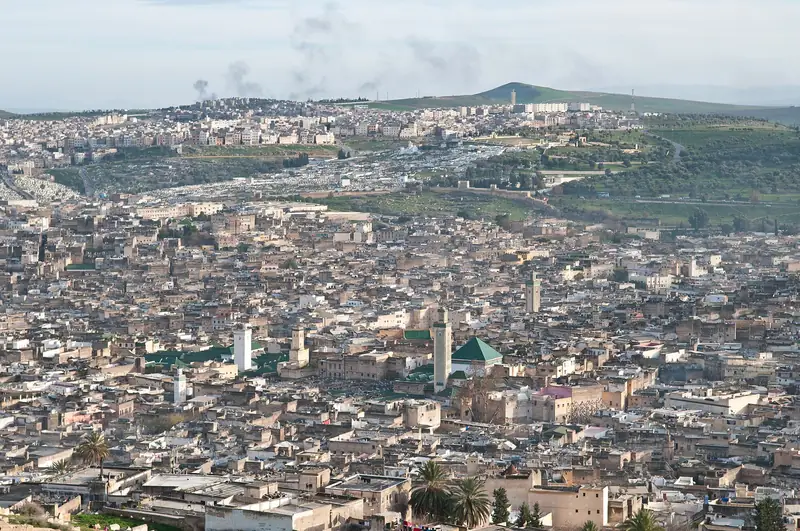
This Fes travel guide starts with the essentials: give the city two or three days, sleep in a riad inside or beside the medina, and hire a licensed guide for your first morning in the lanes. Founded in 789, Fes is the oldest of Morocco’s imperial cities and its spiritual and craft capital. Its UNESCO-listed old town, Fes el-Bali, is one of the world’s largest car-free urban areas: thousands of lanes, mule carts, tanneries, madrasas and the Al-Qarawiyyin mosque, founded in 859.
It is less polished than Marrakech and more rewarding for it. Below you will find what to see with current ticket prices, a two-day plan, where to stay, what to eat, day trips, transport and how to handle the touts.
Arriving after dark? Taxis stop at the medina gates and the lanes are hard to follow at night, so ask your riad to meet you at the nearest gate. Save its location offline before you land, because many lanes have no name on map apps.
At a glance
- Founded
- 789 (Idris I)
- UNESCO
- Fes el-Bali listed in 1981
- Allow
- 2–3 days
- Airport
- Fes-Saïss (FEZ), about 15 km away
- From Casablanca
- About 4 h by train
- Best time
- March–May and September–November
In this guide
Is Fes Worth Visiting?
Yes, if you want to see a medieval Islamic city that still works: coppersmiths hammering trays, mules hauling hides, students in madrasa doorways. The trade-off is navigation, because the lanes are steep, unsigned and confusing, and touts target newcomers. Weighing it against the Red City? Our Marrakech vs Fes comparison helps you split your time.
- First visit: two full days cover the madrasas, the tannery and Fes el-Jdid.
- With a day trip: allow three or four nights for Volubilis, Meknes or the Middle Atlas.
- Prefer calm: stay near a medina gate and explore early, before the tour groups arrive.
Best Things to Do in Fes
Fes el-Bali slopes down from Bab Boujloud in the west to the river at its centre, threaded by two main lanes, Talaa Kebira and Talaa Sghira. Most sights sit along them or just off them, while Fes el-Jdid and the Mellah lie a 20-minute walk or short taxi ride to the south-west.
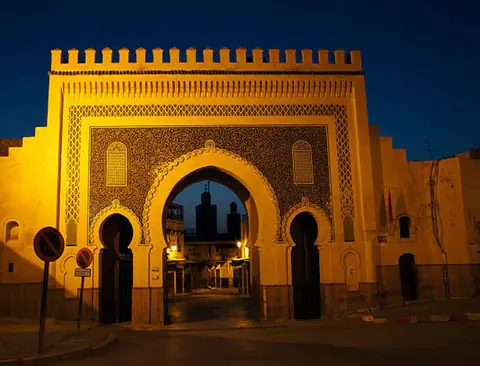
Bab Boujloud
The main gate of Fes el-Bali, built in 1913: blue tiles outside, green inside, best at dusk.
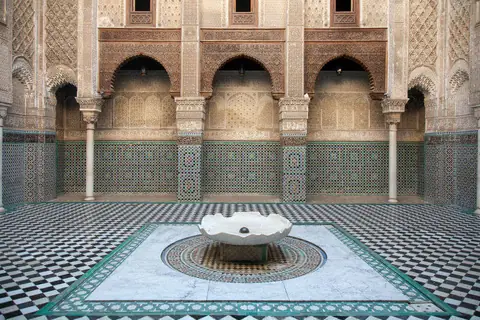
Al Attarine Madrasa
A small, intricately decorated Marinid college from the 1320s beside the spice market.
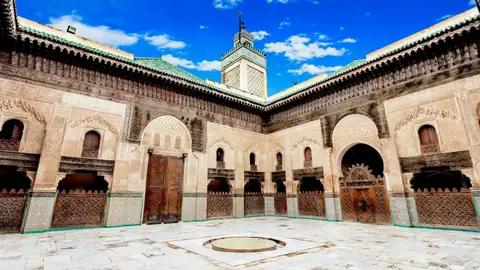
Bou Inania Madrasa
Built in the 1350s, the grandest madrasa in Fes and still a working mosque.
The medina’s craft quarters
Below Bab Boujloud, the lanes sort themselves loosely by trade: woodworkers around the Nejjarine fountain, coppersmiths beating trays on Place Seffarine, and dyers by the river. Goods still move by mule and handcart, so step aside when you hear “balak!” (watch out). Go in the morning, when workshops are busiest and the lanes are cooler.
Chouara Tannery
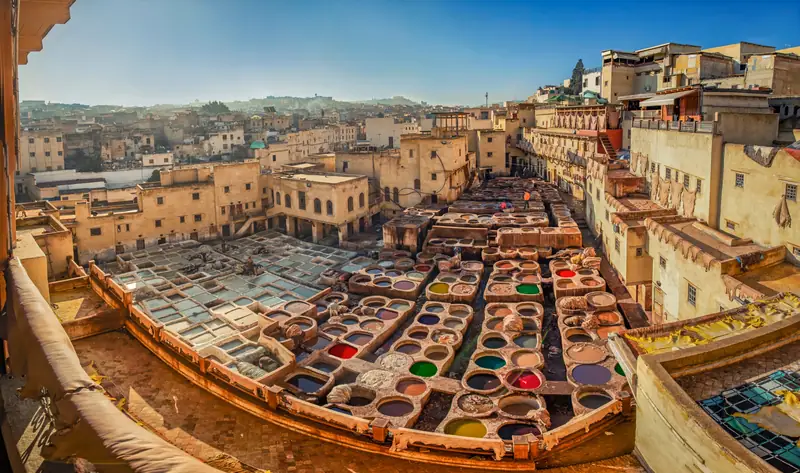
The largest of the city’s three tanneries has worked hides in stone pits since at least the 11th century. There is no ticket: you climb through a leather shop to its terrace, accept a sprig of mint for the smell, and tip about 20 MAD if you buy nothing. Before 10am, the dyers are at work and the light falls into the pits.
Madrasas and Al-Qarawiyyin
The Bou Inania Madrasa, built in the 1350s, is the grandest of the Marinid colleges, with carved cedar, stucco and zellige around a marble courtyard. The smaller Al Attarine Madrasa is even more finely detailed. Al-Qarawiyyin, founded in 859 by Fatima al-Fihri and often called the world’s oldest working university, is closed to non-Muslims, but its doorways give glimpses of the courtyard.
Museums, the Mellah and Fes el-Jdid
The Batha Museum, a late-19th-century palace reopened in 2025 as a museum of Islamic arts, is strong on ceramics and has a lovely garden. The Nejjarine Museum shows woodwork in an 18th-century merchant inn. In Fes el-Jdid, photograph the Royal Palace’s brass doors from the square outside, walk the Mellah, the Jewish quarter founded in 1438, and see its new Museum of Moroccan Jewish Culture, inaugurated in October 2026.
Viewpoints over the medina
For the classic panorama, take a petit taxi to the hillside by Borj Nord and the Merenid Tombs an hour before sunset; the tomb ruins were fenced off for restoration in 2026, but the views are open. Borj Sud, above Bab Ftouh, is quieter. Head back before dark rather than walking down alone.
Hire a licensed guide. Ignore anyone who offers a free tannery visit or says a lane is closed. Official guides carry a badge; book one through your riad and agree the fee, the length and any shopping stops in advance.
Fes Sights: Ticket Prices and Tips
Prices are for foreign adults as published in 2026; Moroccan residents pay less. Monuments in the medina take cash only, so carry small notes.
| Sight | Ticket (foreign adult) | Tip |
|---|---|---|
| Bou Inania Madrasa | 20 MAD (≈ €2 / $2) | Closed for Friday midday prayers |
| Al Attarine Madrasa | 20 MAD (≈ €2 / $2) | Small courtyard; go early |
| Batha Museum | 60 MAD (≈ €6 / $6) | Opens 10am; closed Tuesdays |
| Nejjarine Museum | 20 MAD (≈ €2 / $2) | Woodwork in an old merchant inn |
| Chouara Tannery | No ticket; tip about 20 MAD | Go before 10am |
| Museum of Moroccan Jewish Culture | Check locally | Opened October 2026 in the Mellah |
Prices may vary; always check them on site.
A 2-Day Fes Itinerary
This route keeps the steepest walking for the cooler hours and leaves room for tea breaks.
- Day 1 · MorningEnter at Bab Boujloud with a licensed guide: Bou Inania Madrasa, the Talaa Kebira lane and Al Attarine Madrasa.
- Day 1 · AfternoonAl-Qarawiyyin’s doorways, the Nejjarine Museum and the coppersmiths of Place Seffarine.
- Day 1 · EveningSunset over the medina from the Borj Nord hillside, then dinner in a riad.
- Day 2 · MorningChouara Tannery before 10am, then the dyers’ souk and the leather workshops.
- Day 2 · AfternoonThe Batha Museum (not on Tuesdays), then Jnan Sbil garden, the Royal Palace gates and the Mellah.
- Day 2 · EveningA cooking class or a hammam, then a set dinner on a riad terrace.
With a third day, add Meknes and the Roman ruins of Volubilis, about an hour away.
Where to Stay in Fes
Pick the area first, then the riad or hotel.
| Area | Best for | Trade-off |
|---|---|---|
| Inner medina | Riads, atmosphere, walking to sights | Hard to find; luggage hauling |
| Bab Boujloud | Easy taxis, cafés, quick access | Busier, with touts at the gate |
| Ville Nouvelle | Modern hotels, station, restaurants | Taxi to the medina; less character |
| Hillside hotels | Views and pools | Taxi needed for everything |
First-timers usually prefer a riad inside the medina, ideally within ten minutes’ walk of a gate where taxis stop. Book early for spring, autumn and festival dates.
What to Eat in Fes
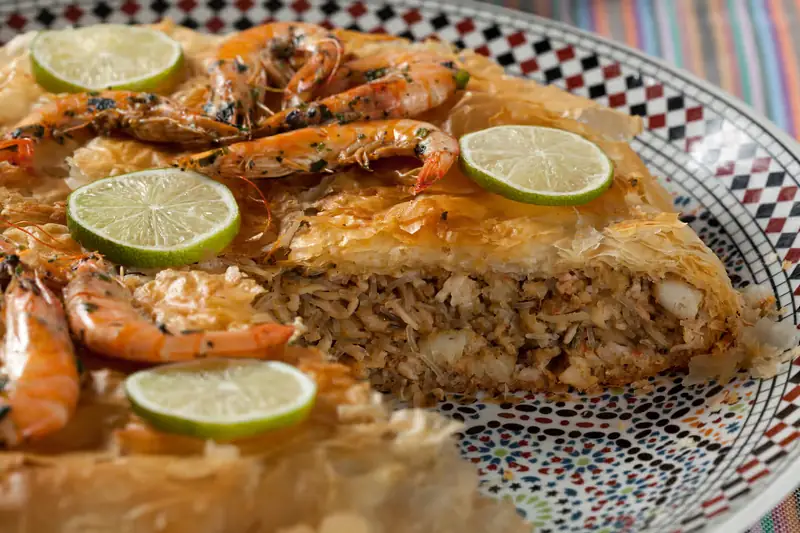
Fes is famous for pastilla, a flaky pie of pigeon or chicken with almonds, cinnamon and powdered sugar, and for khlii, spiced preserved beef often fried with eggs at breakfast. On cold mornings, locals queue for bissara, a thick fava bean soup with olive oil and cumin.
Most riads serve set dinners, and cooking classes often start with a market walk. At food stalls, follow the locals and check prices before you order.
Getting to Fes and Getting Around
- By air: Fes-Saïss (FEZ) is about 15 km from the centre. Taxis charge fixed fares posted at the rank, about 120–150 MAD by day, and bus 16 runs roughly hourly to the train station for 4 MAD.
- By train: direct ONCF trains reach Meknes in under an hour and Casablanca in about 4 hours via Rabat; Marrakech takes about 7 hours and Tangier 3.5–4.75 hours, depending on the service. Check departures on our train times page.
- By bus: CTM and Supratours link Fes with Chefchaouen (4–4.5 hours), Tangier and Marrakech.
- By taxi: red petits taxis use meters; the station to Bab Boujloud costs about 15–25 MAD by day, with about 50% extra after 8pm.
- On foot: Fes el-Bali is car-free, steep and slippery when wet, so wear shoes with grip.
Petits taxis take up to three passengers. For Volubilis, the Middle Atlas or groups of four or more, hire a grand taxi or a driver for the day.
Best Time to Visit Fes
| Season | Weather | Verdict |
|---|---|---|
| Mar–May | Mild to warm; green hills | Ideal; busy around Easter |
| Jun–Aug | Around 36 °C; heatwaves above 40 °C | Go early; rest at midday |
| Sep–Nov | Warm, then cooler with first rains | Ideal; fewer crowds than spring |
| Dec–Feb | About 15 °C by day, near 5 °C at night; wettest season | Pack layers; riads can be cold |
The Fes Festival of World Sacred Music usually falls in late May or early June (4–7 June in 2026); the 2027 dates have not been announced. Ramadan is expected from about 8 February to 9 March 2027, when some cafés close by day and opening hours shorten.
Day Trips from Fes
Travel times are one way by road.
| Destination | Time | Best for |
|---|---|---|
| Meknes | About 1 h | Imperial gates and granaries |
| Volubilis and Moulay Idriss | 1–1.5 h | Roman mosaics and a holy hill town |
| Ifrane | About 1 h | Alpine-style town and cool air |
| Azrou cedar forest | About 1.5 h | Cedars and Barbary macaques |
| Chefchaouen | 3.5–4.5 h | Blue lanes; better overnight |
Chefchaouen deserves at least one night; see our Chefchaouen guide. Fes is also a common starting point for two- and three-day Sahara tours that cross the Middle Atlas to Merzouga.
Safety, Scams and Etiquette
- Fake guides: politely ignore anyone who says a lane is closed or insists on leading you; a firm “la, shukran” and walking on usually ends it.
- Getting lost: everyone does. Uphill generally leads back towards Bab Boujloud and downhill towards the river; ask a shopkeeper, and expect to tip anyone who walks you somewhere.
- After dark: the lanes empty quickly once shops close, so ask your riad to walk you back if you are unsure of the way.
- Dress and photos: cover shoulders and knees, and ask before photographing people, especially artisans at work.
- Fridays: many shops close and the madrasas shut during midday prayers, so plan the big sights for other days.
Money, SIM Cards and Tipping
- Cash: small shops, taxis and monuments take cash only; ATMs are easy to find in the Ville Nouvelle and near the main medina gates, and cards work mainly in hotels and larger shops.
- SIM cards: a Maroc Telecom or Orange SIM costs around 30 MAD with your passport from the operators’ shops.
- Tipping: 1–2 MAD in cafés, 5–10 MAD in casual restaurants, about 20 MAD for a tannery terrace and 50–100 MAD a day for a driver.
- Guides: agree the fee, the length and any shopping stops before you set off, because guides often earn commission in the shops they visit.
- Bargaining: start well below the first price and settle in the middle; workshops will often show you how a piece is made before you buy.
- Phrases: “Salam alaikum” (hello), “shukran” (thank you) and “la, shukran” (no, thank you) carry you a long way.
- Ramadan: avoid eating, drinking or smoking in public during daylight hours out of respect.
Prices may vary. Euro and dollar figures use November 2026 rates (€1 ≈ 10.9 MAD, $1 ≈ 9.9 MAD). Ticket prices change, especially at state-run monuments, so verify locally or on official sites before you go.
Frequently asked questions
How many days do you need in Fes?
Two full days cover the medina, the madrasas, the tannery and Fes el-Jdid. A third day lets you add Volubilis and Meknes, or the cedar forests of the Middle Atlas.
Is Fes safe for tourists?
Generally yes. The main problems are fake guides, persistent touts and getting lost, so book a licensed guide through your riad, agree prices in advance and avoid empty lanes late at night.
Do you need a guide in the Fes medina?
It is not compulsory, but a licensed guide makes the first morning far easier and explains what you are seeing. After that, most visitors manage alone with an offline map.
How much does it cost to see the Fes tannery?
There is no ticket. You view the Chouara Tannery from leather shop terraces, and a tip of about 20 MAD per person is fair if you do not buy anything.
How do I get from Fes airport to the medina?
Taxis charge fixed fares of about 120–150 MAD by day and stop at the medina gates. Bus 16 costs 4 MAD to the train station, where you can switch to a red petit taxi.