Merzouga and Erg Chebbi: Desert Camps, Camel Treks and How to Get There
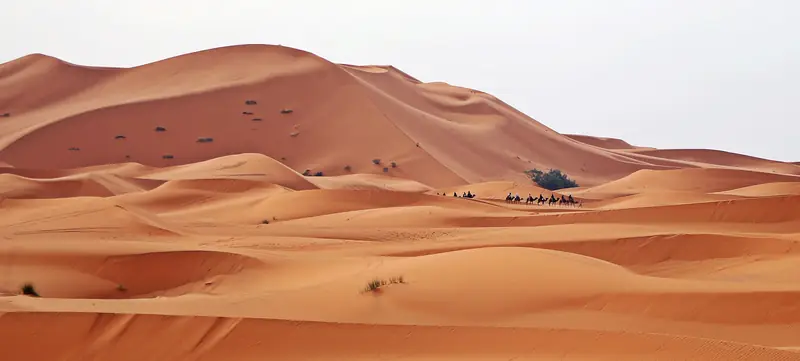
Walk a few minutes past the last guesthouse in Merzouga and the ground changes under your feet: gravel turns to soft orange sand, and the dunes of Erg Chebbi rise to about 150 m in front of you. If you want the Sahara of camel caravans and starry nights, this is the most reliable place in Morocco to find it, as long as you accept long road days to get here.
This Merzouga desert guide covers how many nights to plan, what camps really cost, the best things to do beyond the camel ride, where to stay and how to arrive from Fes, Marrakech or Errachidia airport. It is written for independent travellers deciding between a tour and doing it themselves.
Ask where the camp is. “In the dunes” can mean 15 minutes or 90 minutes by camel. Ask for the ride time, whether bags go by 4×4 and where your car or big luggage stays overnight.
At a glance
- Where
- Edge of Erg Chebbi, Errachidia province
- Dunes
- Up to about 150 m high, 22 km long
- Allow
- 1–2 nights, plus travel days
- Drive
- Fes 7–8 h, Marrakech 9–10 h
- Nearest airport
- Errachidia (ERH), 130 km
- Best months
- October to April
In this guide
- How Many Nights Do You Need in Merzouga?
- The Camel Trek and Desert Camp: What to Expect
- Best Things to Do in Merzouga Beyond the Camel Ride
- A 2-Day Merzouga Itinerary
- Day Trips and Stops Around Merzouga
- Where to Stay: Desert Camp, Merzouga Village or Hassi Labied?
- Getting to Merzouga: Roads, Buses and Flights
- Best Time to Visit Merzouga
- Money, SIM Cards and Desert Etiquette
How Many Nights Do You Need in Merzouga?
Plan one night in a camp at minimum, and two in the area if you can. Merzouga is 7–8 hours from Fes and 9–10 from Marrakech by road, so a single night often means arriving tired at sunset and leaving after breakfast.
- One night: camel ride at sunset, dinner and drumming at camp, sunrise on a dune, then back on the road.
- Two nights: add Khamlia, Rissani’s souk or a 4×4 loop, with one night in a hotel at the dune edge.
- Marrakech round trip in two days: possible on a tour, but it means about 20 hours in a vehicle; three days is the sensible minimum.
The Camel Trek and Desert Camp: What to Expect
Treks leave the edge of the village in the late afternoon and take one to two hours to reach camp, depending on distance and photo stops. The saddle is wide and the gait rolls, and downhill stretches are the uncomfortable part, so hold the handle and lean back. If riding is not for you, most camps send a 4×4 for a small supplement.
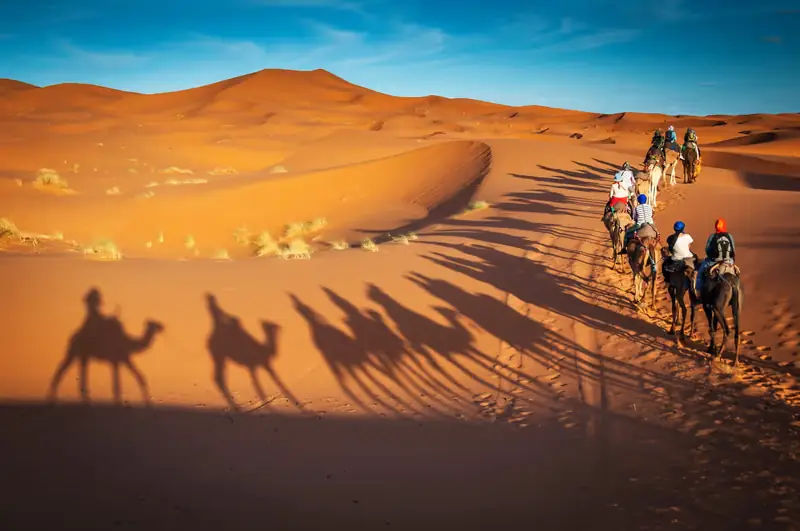
Operators’ 2026 rates start at about 440 MAD (≈ €40 / $45) per person for a standard camp with the camel ride, dinner and breakfast; “luxury” tents with private bathrooms run about 760–1,640 MAD (≈ €70–150 / $75–165) or more. Drinks other than tea and water are usually extra.
- Location: ride time to camp, and whether it is out of sight of the hotels.
- Bathrooms: a shared block or en-suite, and whether the water is hot.
- Winter nights: heating or extra blankets, since January nights can approach freezing.
- Noise: some camps run drumming and generators late into the night, others are quiet.
- Luggage and car: where big bags and your car stay overnight.
Camel welfare. Choose operators whose camels look well fed, carry one adult each and rest between trips. Skip midday rides in summer, for their sake and yours.
Best Things to Do in Merzouga Beyond the Camel Ride
Climb a high dune for sunrise
The climb to a high crest takes 20–40 minutes on soft sand, so start 45 minutes before sunrise with a headlamp and a warm layer; the sand is cold before dawn. Walk up the ridgelines, where the sand is firmer, rather than straight up the face.
Hear Gnawa music in Khamlia
Khamlia, 7 km south, is home to Gnawa families whose ancestors came from sub-Saharan Africa, many through the trans-Saharan slave trade. Musicians play the guembri lute and metal krakeb castanets for visitors over tea. There is no ticket, but a donation is expected, and the musicians depend on it.
Rissani’s souk and Erfoud’s fossils
Rissani, 35 km north, holds its market on Tuesday, Thursday and Sunday, the last being the biggest, with a donkey “car park” at the edge. Erfoud, about 50 km from Merzouga, cuts and polishes fossil-rich black limestone: orthoceras dishes are a safe buy, but free-standing trilobites are often resin casts or heavily reconstructed.
Sandboarding, 4×4 tours and quads
Most camps keep a few sandboards for guests. Half-day 4×4 loops visit nomad families, the abandoned Mfis mines and Khamlia. Quads and buggies are loud and scar the dunes; if you rent one, keep well away from camps and grazing herds.
A 2-Day Merzouga Itinerary
This plan assumes you arrive by early afternoon, from Fes or after a night in the Dades or Todra valleys, and leave on day three.
- Day 1 · AfternoonCheck in at a hotel by the dunes, leave big bags there and drink plenty of water. Meet your guide one to two hours before sunset.
- Day 1 · EveningRide to camp, watch the sunset from the nearest high dune, then dinner and drumming by the fire. Step away from the lights to see the stars.
- Day 2 · MorningSunrise climb, breakfast and the ride back. Shower at the hotel and rest through the late morning.
- Day 2 · AfternoonDrive to Khamlia for Gnawa music and on to Rissani if it is a market day, or take a 4×4 loop past the Mfis mines.
- Day 2 · EveningSunset from the dunes behind the village, then dinner at your guesthouse.
- Day 3 · MorningLeave early for Fes (7–8 hours) or head west to the Todra Gorge and Ouarzazate.
Day Trips and Stops Around Merzouga
Most sights lie on the road north towards Rissani and Erfoud, or on desert tracks to the south and east. Distances are short, but tracks are slow.
| Place | Distance, time | Why go |
|---|---|---|
| Khamlia | 7 km, 10 min | Gnawa music over tea |
| Dayet Srji | West of the village | Seasonal lake, flamingos after rain |
| Mfis mines | 10 km, by 4×4 | Abandoned mining village |
| Rissani | 35 km, 35 min | Souk on Tue, Thu and Sun |
| Erfoud | 50 km, 50 min | Fossil workshops, dates |
| Tinghir, Todra | 190 km, 3 h | Gorge walls, palm groves |
Dayet Srji fills only after winter rains, usually holding water from about February to April, when flamingos may stop over; by summer it is usually a dry lakebed. Erfoud’s international date fair took place from 28 October to 1 November in 2026. For the Todra Gorge, see Tinghir.
Where to Stay: Desert Camp, Merzouga Village or Hassi Labied?
| Base | Best for | Trade-off |
|---|---|---|
| Standard desert camp | A real dune night, low cost | Shared toilets, cold in winter |
| Luxury desert camp | En-suite tents, real beds | Pricier, some generator noise |
| Hotel in Merzouga | ATM, shops, bus stop | Touts meet the buses |
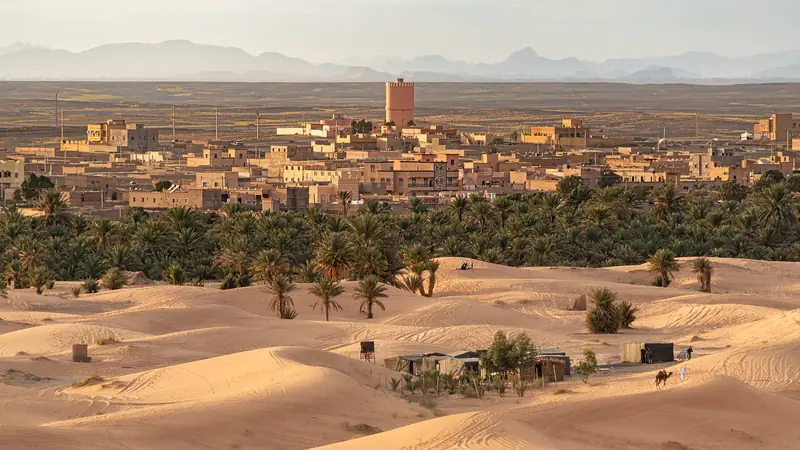
| Hassi Labied, 5 km north | Quiet guesthouses by the dunes | Few services, need transport |
Most travellers spend one night in camp and one in a hotel at the dune edge, where they can leave bags and shower. Book a camp directly or through a trusted tour, and ignore touts at the bus stop who offer “better” camps.
Getting to Merzouga: Roads, Buses and Flights
- From Fes: about 470 km and 7–8 hours via Ifrane, Midelt and the Ziz valley, the easiest approach and doable in one long day. See our Fes guide.
- From Marrakech: about 560 km and 9–10 hours of driving over the Tizi n’Tichka; break it with a night in Ouarzazate or the Dades valley.
- By bus: Supratours and CTM run daily long-distance coaches from Marrakech and Fes, some overnight. Some services end in Rissani, 35 km short, so check the final stop. See bus times in Morocco.
- By air: Errachidia airport (ERH) is 130 km north, about 2 hours by road. Royal Air Maroc connects via Casablanca, and Ryanair, Transavia and Vueling have run routes there; check current schedules.
- Self-drive: the road is paved all the way to Merzouga. Never drive into the dunes without an experienced driver and a proper 4×4.
Organised tours bundle the drive, camp and camel ride; our Sahara desert tours guide explains how to compare them, and Zagora is the shorter desert trip from Marrakech.
Best Time to Visit Merzouga
| Season | Weather | Verdict |
|---|---|---|
| Oct–Nov | Warm days, cool nights | Excellent, but busy |
| Dec–Feb | 17–19 °C days, cold nights | Clear skies; pack warm layers |
| Mar–May | Warm, with windy spells | Good; sandstorms possible |
| Jun–Sep | Highs above 40 °C | Early mornings only |
Rain is rare, under 100 mm a year. In July and August, Moroccans come for traditional hot-sand baths, believed to ease joint pain; for visitors, those months mean dawn-only activity. Ramadan is expected from about 8 February to 9 March 2027, and our Morocco packing list covers desert layers.
Money, SIM Cards and Desert Etiquette
- Cash: Merzouga has a single ATM that often runs dry in peak season, so withdraw in Erfoud, Rissani or before you leave Fes or Ouarzazate. Hotels may take cards, but camps, tips and extras usually need cash.
- SIM cards: a Maroc Telecom or Orange SIM costs around 30 MAD with your passport; Maroc Telecom is usually stronger on desert roads, and the signal fades between the dunes.
- Tipping: 20–50 MAD for a camel handler who looked after you, a little more for camp staff, and 50–100 MAD a day for a private driver. Tip in dirhams.
- Dress: loose, covering clothes protect from the sun and suit the villages; a scarf or cheche keeps sand out of your face.
- Phrases: “Salam alaikum” (hello), “shukran” (thank you) and “la, shukran” (no, thank you) go a long way.
- Alcohol: Merzouga has no liquor shop and many camps serve none, so buy beer or wine in Fes or Ouarzazate and ask the camp before bringing it.
- Leave no trace: carry out your rubbish and ask before photographing nomad families.
Prices may vary. Euro and dollar figures use November 2026 rates (€1 ≈ 10.9 MAD, $1 ≈ 9.9 MAD). Camp prices vary with season and group size, so verify locally and compare what is included, not just the headline price.
Frequently asked questions
Is Merzouga worth the long drive?
Yes, if you want Morocco’s highest dunes and a night in the desert. Give it at least one night, ideally two, and break the journey from Marrakech rather than rushing it.
Merzouga or Zagora: which desert should I choose?
Merzouga has the big Erg Chebbi dunes and pairs well with Fes. Zagora is closer to Marrakech, but its nearby dunes are small; the large Erg Chigaga dunes need a further 4×4 trip beyond M’Hamid.
How much does a night in a desert camp cost?
Expect about 440 MAD (≈ €40 / $45) per person for a standard camp with camel ride, dinner and breakfast, and 760–1,640 MAD (≈ €70–150 / $75–165) or more for en-suite tents, based on operators’ 2026 rates. Ask what is included before you pay.
Can I visit Merzouga without a tour?
Yes. Take a bus or drive, book a hotel at the dune edge and arrange the camel trek and camp through it or directly. Agree prices in writing and ignore touts at the bus stop.
Is Merzouga safe?
It is generally calm and used to visitors; the main risks are heat, dehydration and getting lost in the dunes at night. Stay with your guide after dark, carry water and see is Morocco safe for more.