Bab Boujloud: Start the Fes Medina with Your Bearings
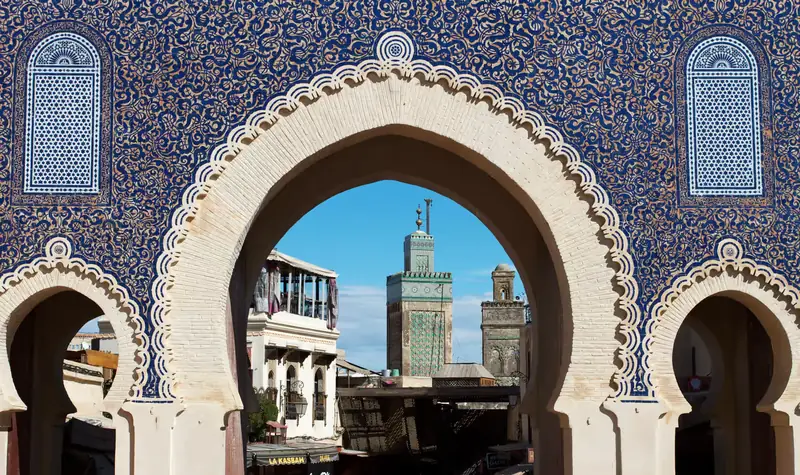
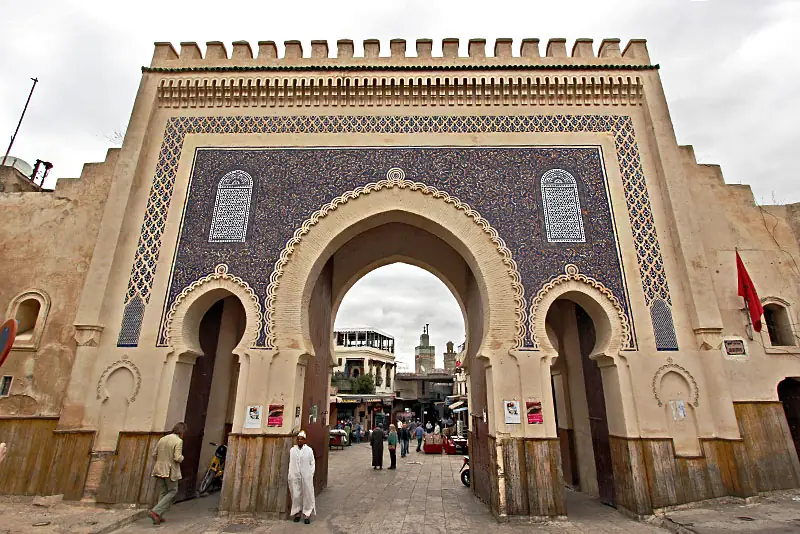
Bab Boujloud is the Blue Gate on the western side of Fes el-Bali, a public entrance rather than a ticketed attraction. Walking through is free, and fifteen to thirty minutes is enough to see both faces and take photographs. The familiar three-arched structure dates to 1913, not the medieval founding of the city; its outside is blue and its medina-facing side green.
Its real value is practical: this is an easy landmark for beginning a walk, meeting a booked guide or arranging an edge-of-medina taxi. Save your accommodation and the exact meeting side before going farther. Below are the history, the details worth noticing and a realistic route that does not mistake a gate photograph for a whole day in Fes.
Agree which side you will meet on. “At the Blue Gate” is not a precise arrangement when a driver stays outside and you are sitting in an inner café. Exchange a saved pin, a time and a fallback contact; confirm where any luggage-carrying service begins.
At a glance
- Built
- 1913, present monumental gate
- Faces
- Blue outside; green towards medina
- Entry
- Free public passage
- Allow
- 15–30 minutes, longer for a café
- Leads towards
- Talaa Kebira and Talaa Sghira
- Location
- Western edge of Fes el-Bali
In this guide
- Is Bab Boujloud Worth Visiting?
- A 1913 Gate on an Older Threshold
- Blue Outside, Green Inside: Reading the Design
- Free Entry, Public Access and Nearby Spending
- Arriving by Taxi, Car or with Luggage
- Talaa Kebira or Talaa Sghira?
- A Day Plan That Starts at the Gate
- When to Photograph It, and When to Rest
- Eating Near Bab Boujloud Without Guesswork
- Guides, Accessibility and Everyday Courtesy
Is Bab Boujloud Worth Visiting?
Yes, but not as an isolated excursion that needs half a day. The gate is an attractive introduction to the medina and a useful place to orient yourself before the lanes narrow. Look from outside, pass through, turn back for the green side, then decide whether you want a short nearby circuit or a longer downhill walk.
It is also a working thoroughfare. Deliveries, residents and travellers need the arches while visitors pause for photographs, so step to one side rather than treating the central opening as a private studio. A small amount of patience gives you a better visit than waiting for a completely empty entrance that may never appear.
- First visit: use it to orient yourself and see both tiled faces, not just the blue photograph.
- Short stop: gate, nearby streets and a café can fit without committing to the deep medina.
- Long walking day: arrange the finish as carefully as the start, especially with children or luggage.
A 1913 Gate on an Older Threshold
The current monumental gate was built in 1913 during the French protectorate. It took over the role of an older, simpler entrance; the age of the medina must not be transferred to the three arches in front of you. This is a relatively modern statement using a traditional architectural vocabulary.
The important contrast is between defensive access and ceremonial presentation. Older gateways often controlled movement through more constrained passages, whereas this broad façade introduces the old city visibly. You do not need a dramatic legend about secret mechanisms to appreciate it. The date and arrangement are interesting enough, and the wider medina contains much earlier buildings.
Blue Outside, Green Inside: Reading the Design
The central horseshoe arch is flanked by two smaller openings beneath a crenellated top. Stand back to see the whole composition before studying the dense tiled ornament, framing bands and geometric patterns. Through the central opening you can frame the minaret of Bou Inania, but people and shopfronts are part of that view too.
Blue is commonly linked to Fes and its ceramics, while green is associated with Islam. Treat that as the familiar interpretation of the colours, not proof of a documented instruction from the original designer. Our Moroccan architecture guide explains how arches, tile and revival styles relate to older traditions without making everything medieval.
Free Entry, Public Access and Nearby Spending
Bab Boujloud is not a museum with a general entrance ticket or a normal ticket-desk timetable. Public passage is free; there is no need to pay someone to let you into Fes el-Bali. Temporary restrictions or works are possible in any public place, and neighbouring monuments and businesses set their own arrangements.
Money spent here is normally for transport, a guide, food or a drink, not the gate itself. Ask what a requested fee covers and distinguish a private service from public access.
| Item | Cost | Check |
|---|---|---|
| Gate passage | Free | Public space |
| Taxi or parking | Check locally | Before committing |
| Guide or porter | Agree first | Service and duration |
| Café terrace | Menu price | Minimum order? |
Prices may vary; always check them on site.
Arriving by Taxi, Car or with Luggage
From the railway station or the newer city, a petit taxi is usually the simplest way to reach the western medina edge. Give the driver Bab Boujloud and confirm the permitted drop-off; traffic arrangements and nearby works can change the exact stopping point. Use the meter where available or agree the fare before departure, rather than relying on a fixed figure from an old travel page.
A vehicle reaching the gate area does not mean it reaches your riad. Ask your accommodation for its recommended access point before travelling: another gate may be closer. With bags, agree any porter’s price, destination and responsibility for the luggage before handing it over. Our getting-around guide distinguishes local taxis, private transfers and other transport options.
Talaa Kebira or Talaa Sghira?
The two principal walking streets beyond the gate lead down into the medina, with branches and changes of name that a simplified tourist map may not show well. Talaa Kebira is the natural choice if you want the Bou Inania area and a route towards the religious quarter. Talaa Sghira provides another main approach, not a guaranteed quiet or shop-free alternative.
Save your route before leaving Wi-Fi, keep a landmark in mind and expect the return to involve climbing. A downhill first hour can conceal how tired you will feel going back uphill. If you plan to finish elsewhere, confirm an appropriate exit and taxi meeting point instead of wandering towards a vaguely remembered road.
| Choice | Useful for | Remember |
|---|---|---|
| Talaa Kebira | Monuments and souks | Return climbs |
| Talaa Sghira | Another main route | Still busy |
| Different exit | One-way walk | Arrange pickup |
A Day Plan That Starts at the Gate
For a first visit, see the gate and nearby lanes, then choose a few deeper stops rather than every famous sight. Bou Inania is close, but its admission and any religious restrictions need checking separately. Do not assume that looking through the gate’s arch gives permission to enter a mosque whose minaret you can see.
Farther in, Al Attarine Madrasa offers a concentrated architectural visit beside Al-Qarawiyyin. Allow roughly twenty to thirty minutes or more of walking from the gate, plus the visit itself and navigation pauses. The adjacent working mosque has its own access rules; non-Muslims should view only from permitted public positions.
- MorningPhotograph both faces, take a nearby architectural stop if open, then walk downhill with a saved route. Build in time to find the entrance of each monument.
- AfternoonChoose Al Attarine or the Nejjarine and Seffarine area, eat and rest. Do not let a list of stops replace a realistic walking pace.
- EveningReturn while comfortable navigating, or use the exit arranged with your driver. A final drink near the gate is optional, not a compulsory tour purchase.
When to Photograph It, and When to Rest
The two sides receive different light, so “best time” depends on the photograph. Later light often suits the blue outer face; morning can favour the inner side, and overcast conditions can make a bright arch and its shaded opening easier to expose together. Dusk changes the atmosphere, but illumination and pedestrian flow are not a guaranteed photography schedule.
Summer makes a long medina walk demanding even when a café corner is shaded. Carry water, wear grippy shoes and rest before the uphill return becomes a slog. Winter evenings can be cool; comfortable layers matter more than dressing for an imagined desert climate. Visiting the gate does not require a religious dress code, but modest clothes suit the neighbourhood and any later religious-heritage stop.
- Camera position: leave the main flow clear and never step backwards into road traffic for a frame.
- People: ask before photographing individuals, particularly stallholders and children; a public street is not consent for a close portrait.
- Access: confirm steps and surfaces locally, including the route from taxi to accommodation, not only the arch itself.
Eating Near Bab Boujloud Without Guesswork
Cafés and casual restaurants make the gate area a convenient place to stop, not automatically the best-value food in Fes. Read the menu, check whether a terrace has a minimum order and ask for the total before accepting extras. A visible price for tea is more useful than a vague promise of a special rooftop view.
Choose freshly cooked food and a busy turnover rather than a menu photograph alone. If you need a quiet seat, toilet access, a child’s portion or a dietary adjustment, ask before ordering. You need not order a full meal if you only want tea, provided the café accepts a drinks-only order; the point is to recover your bearings and watch the street without being hurried.
Guides, Accessibility and Everyday Courtesy
You do not need a guide to cross the gate or take a short walk. For a longer guided visit, use a licensed guide and agree time, route, fee and any shop stops before starting. A person who begins walking beside you has not automatically been hired; a calm La shukran is enough to decline.
The gate approach is easier than many deeper lanes, but that does not make the medina step-free. Ask your accommodation about surfaces, slopes and the exact accessible route if using a wheelchair or pushchair. Our Fes guide helps choose a manageable day and accommodation approach instead of assuming the best-known gate is best for every visitor.
- Polite words: Salam alaikum is a greeting, Shukran means thank you, and La shukran declines an offer. No argument is needed.
- Cash: keep small dirham notes separate for food and transport. Guide tips are voluntary beyond an agreed fee; a small café tip is appreciated.
- Phone: download an offline map and your riad’s contact details. Buy a Maroc Telecom or Orange SIM from an authorised shop with your passport, and keep the phone charged.
- Crowds: close your bag, step aside for deliveries and stop in a wider place before checking directions. If someone says a route is closed, verify rather than following an unsolicited shopping detour.
Prices may vary. The public gate is free, but taxi fares, parking, guiding, porter services and menus vary. Check locally in MAD; no single verified price applies to every journey or service.
Frequently asked questions
Is there an entrance fee for Bab Boujloud?
No, it is a public gateway and passage into the medina is free. Nearby museums, madrasas, cafés and guides charge separately for their own services.
Is Bab Boujloud medieval?
The familiar monumental gate dates to 1913, though it stands at an older entrance to the city. Its traditional-looking design should not be confused with the age of Fes el-Bali itself.
Why is one side blue and the other green?
The outside is blue and the medina-facing side green. The usual interpretation connects blue with Fes and its ceramics, and green with Islam, rather than establishing a proven original design brief.
Can a taxi take me to my riad from the gate?
Usually you continue into the walking medina on foot, and the gate may not be the nearest access to your riad. Ask the accommodation for a precise meeting point and arrange luggage help beforehand if needed.
How long should I stay at the gate?
Fifteen to thirty minutes covers both sides and photographs. Add time for a café and treat any deeper medina walk as a separate outing with its own distance, slopes and stops.