Aït Benhaddou: How to Visit the Ksar Without Rushing
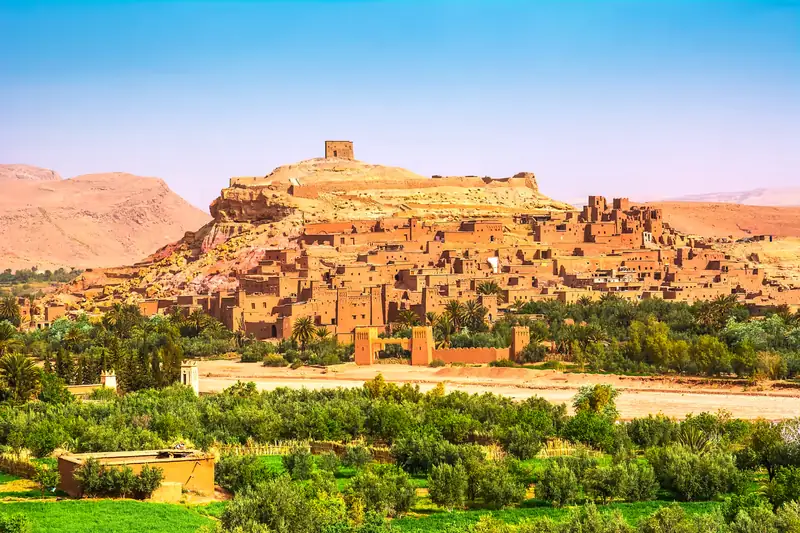
Aït Benhaddou is a fortified earthen village near Ouarzazate, not one giant kasbah and not just a film set. Public lanes can be visited free; individual houses, museums and terraces may charge separately. Allow two to three hours to cross the river, explore and climb towards the hilltop if the route is open. From Marrakech, reckon on roughly four hours of mountain driving each way, before extended stops or difficult weather.
The best version of the visit is an overnight: walk in late afternoon, sleep across the river and look again in the morning. A day trip is possible, but much of it belongs to the road. This guide explains access, architecture, costs and sensible route choices.
Use the public approach, not a paid shortcut. Ask for the public footbridge and village lanes. A route through a private house can legitimately carry an admission fee, but it is not the same as a general ticket for the ksar. Check crossings and closed paths locally.
At a glance
- What
- Fortified village, or ksar
- UNESCO
- World Heritage since 1987
- Public entry
- Free; private interiors extra
- Allow
- 2–3 hours
- From Ouarzazate
- About 30 km / 40 minutes
- From Marrakech
- Roughly 4 hours each way
In this guide
- Is Aït Benhaddou Worth the Journey?
- What Is a Ksar, and How Old Is This One?
- Entry Fees, Guides and Opening Arrangements
- A Walking Route from River to Hilltop
- How to Read the Earthen Architecture
- When to Go: Light, Heat and River Conditions
- Getting There from Marrakech or Ouarzazate
- Day Trip or Overnight: the Honest Trade-off
- Films, Nearby Stops and What Not to Cram In
- Practical Courtesy, Access and Money
Is Aït Benhaddou Worth the Journey?
Yes, if you give it more than a roadside photograph. From across the river, houses form a sculpted hillside; inside, narrow lanes reveal separate domestic spaces. That contrast makes the visit rewarding.
Expect souvenir shops and groups, not a deserted medieval settlement. Come early or stay late, accept the visitor economy, and notice doors, timber and repairs rather than only filming angles.
- On a southern road trip: a natural stop between the Atlas crossing and Ouarzazate.
- On a Marrakech city break: worthwhile if the mountain journey appeals too, less convincing if you dislike long drives.
- For photographers: an overnight buys two different light windows without making a tired return over the pass.
What Is a Ksar, and How Old Is This One?
A ksar is a fortified settlement with multiple homes and shared spaces; a kasbah can be a fortified residence within it. Lanes, walls, mosque, storage and houses form a community, not a single palace.
UNESCO inscribed Aït Benhaddou in 1987 for its southern Moroccan earthen architecture and traditional settlement form. Its assessment places the oldest surviving buildings no earlier than the seventeenth century, while recognising that the building tradition is much older. Treat claims that every visible tower is a thousand years old with caution.
The village stood on trading routes to Marrakech. Most residents now live across the river, but the old ksar is not ownerless: respect boundaries around homes, religious spaces and workplaces.
| Term | Meaning | Look for |
|---|---|---|
| Ksar | Fortified village | Shared lanes |
| Kasbah | Fortified residence | Corner towers |
| Granary | Communal storage | Hilltop position |
Entry Fees, Guides and Opening Arrangements
Public lanes have no general admission ticket. Some approaches pass through private houses or cultural spaces that charge separately. Ask what payment covers, or request the public route rather than arguing on a private doorstep.
| Item | Cost | Check |
|---|---|---|
| Public lanes | Free | Use public approach |
| House or museum | Check locally | Before entering |
| Local guide | Agree locally | Duration and scope |
| Parking | Check locally | Who collects it |
Prices may vary; always check them on site.
Bring small dirham notes for optional visits, parking and purchases. There is no reliable single tariff for every house or guide. On a tour, check whether guiding, transport, meals and private admissions are included.
Plan a daylight visit: the village has no universal opening hour, and private interiors set their own arrangements. A guide is optional; agree the fee and route, distinguishing a service from public access.
A Walking Route from River to Hilltop
Find the public footbridge approach from the newer village. The Ounila’s condition changes; a previously dry riverbed does not guarantee safe crossing. Use a route locals confirm is usable, not stepping stones from an old photograph.
- First, look back: from the public approach, notice the cultivated strip and the clustered towers above it. This is the most useful place to understand the settlement’s relation to water.
- Then enter the lanes: follow the open public route uphill, pausing where the passage widens. Keep doorways clear and ask before entering a house.
- Choose one interior: if a host offers a visit, settle the charge first. A short explanation of a room or roof can add more than a circuit of souvenir stalls.
- Climb only as far as suitable: the upper route leads towards the old communal granary area. Damage, repairs or barriers may limit access; no viewpoint is worth ignoring a closure.
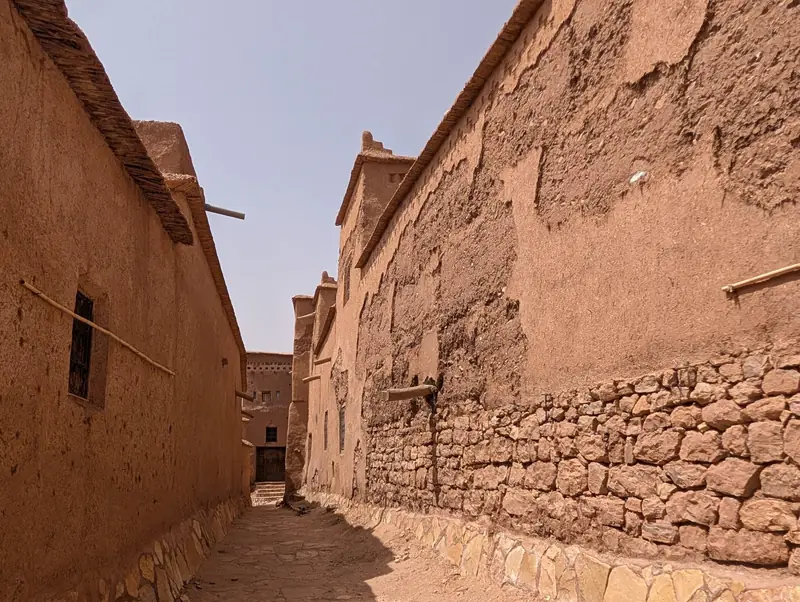
Return by an open public route, allowing time for water and rest. The climb is short but exposed, with steps and loose surfaces. Lower lanes and the opposite-bank view are worthwhile without reaching the summit.
How to Read the Earthen Architecture
Look at the wall base first. Stone helps separate the lower structure from ground moisture; above it, earth and timber do most of the work. Rammed earth is compacted in forms, while sun-dried bricks can be used in upper work and decorative patterns. The warm colour comes from the material itself, not a painted film-set finish.
Thick walls, small openings and compact grouping help moderate a harsh climate, but earth is not maintenance-free. Rain attacks exposed surfaces, and roofs and render need regular attention. A repaired patch is not automatically a loss of authenticity: keeping earthen buildings alive depends on renewal with appropriate materials and skills.
Study the upper towers for geometric relief and changes in brickwork. Compare an elaborate façade with a simpler neighbouring wall rather than assuming every house had the same status. Our Moroccan architecture guide explains the wider vocabulary of ksour, kasbahs and earthen construction.
The September 2023 earthquake damaged parts of the settlement. Current barriers matter more than roof-top travel photographs; do not lean against fragile walls, remove fragments or climb unmarked terraces.
When to Go: Light, Heat and River Conditions
Spring and autumn usually make walking easier than midsummer, but the approach is exposed even outside summer. Early morning and late afternoon give softer light and more breathing room between groups. At midday the walls can look flat in photographs while the climb feels much hotter than the village road below.
Winter can bring pleasant sunny walking at the ksar and cold nights, while the High Atlas crossing has entirely different conditions. Snow, rain or road works can stretch the journey considerably. Check the forecast for the pass as well as your destination; a clear sky in Marrakech does not tell you what the mountain road will be like.
- Heat: carry water, a hat and sun protection before crossing; do not depend on a hilltop stall.
- Footwear: choose grippy soles for rough steps and dusty slopes. Wet earth can be slippery.
- Rain: avoid the riverbed and follow local advice if water rises; do not wade across to save a few minutes.
- After sunset: leave time to descend in daylight. A phone torch is a backup, not a reason to start the climb late.
Getting There from Marrakech or Ouarzazate
From Marrakech, the N9 crosses Tizi n’Tichka at around 2,260 metres before the turn towards the village. Allow roughly four hours, longer with stops or difficult conditions. A navigation app’s fastest time excludes your lunch, photographs and walk.
Self-driving offers freedom, but bends and changing conditions require attention. Avoid a first mountain drive after dark; stop only in safe places. With a driver, agree realistic breaks and a return that does not require speeding.
From Ouarzazate, about 30 kilometres away, the road journey is commonly around 40 minutes. Arrange the return as well as the outward transfer if using a taxi; do not assume a vehicle will be waiting at the exact moment you finish. Intercity coaches serve Ouarzazate, but that does not mean your ticket delivers you to the ksar.
For public transport, check current coaches and arrange the local connection; routes and drop-offs vary. Our getting-around guide distinguishes coaches, shared taxis and private transfers, without promising a direct bus or fixed fare.
Day Trip or Overnight: the Honest Trade-off
A day trip from Marrakech is possible, but roughly eight hours or more of driving can surround just a couple of hours in the village. Before booking, ask how much time is actually on foot, whether a shop stop is compulsory and when the return is expected. Cheap transport is not automatically good value if the visit is rushed.
Staying in the newer village makes evening and morning visits easier. Choose by actual location, parking, temperature control and meals, not just a “kasbah view” photograph. Confirm late arrival or early breakfast directly.
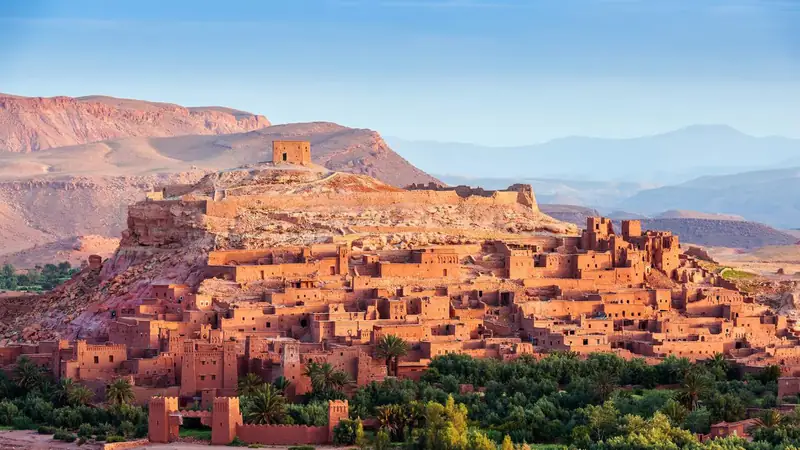
- MorningIf already nearby, cross early and explore while it is cool. If arriving from Marrakech, give the mountain drive its proper time rather than promising a sunrise visit.
- AfternoonCheck in or take lunch and rest, then walk the lanes and an open viewpoint in softer light. Do not try to cover every nearby kasbah too.
- EveningDescend before dark, eat in the newer settlement and keep any next-day driving flexible. An overnight is useful precisely because it removes a deadline.
Films, Nearby Stops and What Not to Cram In
Gladiator and Game of Thrones made the silhouette familiar, but screen scenery mixes real buildings, additions and effects. Expect neither a preserved arena nor signs for every scene. The village’s architecture matters more than a hunt for props.
Ouarzazate’s studios are a separate stop, subject to filming. The Ounila Valley is an alternative drive, not extra time. Confirm Telouet’s kasbah access after earthquake-related closures.
Aït Benhaddou is not the Sahara’s dune country. Reaching the dunes is another long drive: choose a coherent route rather than collecting distant names.
Practical Courtesy, Access and Money
This is private property and community space as well as heritage. Dress respectfully, ask before photographing residents and do not treat a welcoming doorway as consent to explore bedrooms. Salam alaikum is a greeting, Shukran means thank you, and La shukran declines an offer politely.
Pay an agreed charge directly to the person providing the visit. Guide tips are voluntary on top of a clearly agreed fee; a small dirham tip at a café is appreciated, but nothing is owed for an unsolicited shortcut. Carry cash, as a card payment in a larger guesthouse does not mean every small seller takes cards.
The upper ksar is not step-free. Travellers using wheelchairs or pushchairs should discuss the crossing, gradients and usable lower routes with local hosts; the opposite-bank view may be the more comfortable visit. For mobile data, buy a Maroc Telecom or Orange SIM from an authorised shop with your passport, and download maps before the mountain drive.
Prices may vary. Public access is distinct from private admissions, parking, guiding and transport. No single verified tariff covers those services; check locally in MAD and confirm what is included before paying.
Frequently asked questions
Is Aït Benhaddou free to enter?
The public lanes are free to visit. Private houses, small museums or terraces can charge separately, so check what a requested payment covers and ask for the public route if that is all you want.
How long do you need at Aït Benhaddou?
Allow two to three hours for the crossing, lanes, an optional interior and a safe climb if open. Shorter visits are possible, but leave time to return before dark and do not confuse sightseeing time with the long journey from Marrakech.
Can you visit as a day trip from Marrakech?
Yes, but expect roughly four hours of driving each way in ordinary conditions. Staying overnight or including it in a southern road trip usually gives a less hurried experience.
Do you need a guide?
No guide is required for an independent walk on the public lanes. A local guide can add context; agree the price, duration and any private admissions before starting.
Can everyone climb to the granary?
No: the route is steep in places, uneven and potentially affected by closures or repairs. Follow current barriers and assess your mobility and the heat; the village is worth seeing without reaching the top.