Hassan II Mosque: Plan the Interior Tour, Not Just a Photo
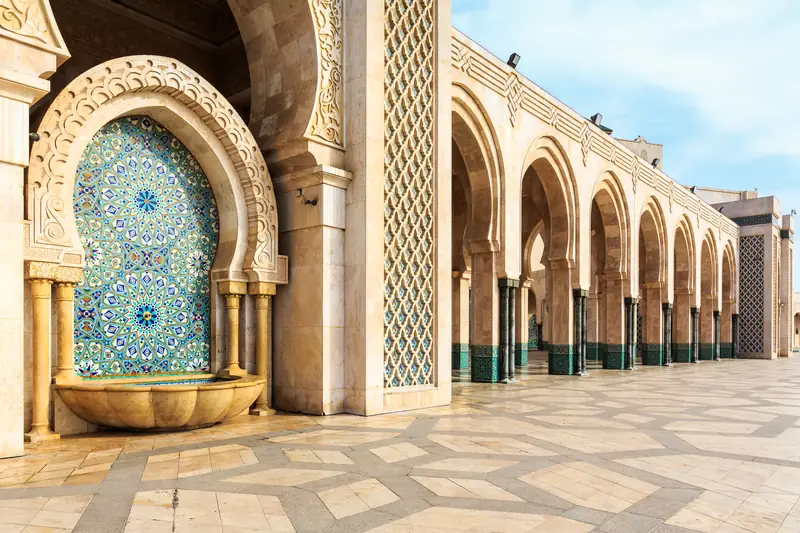
Hassan II Mosque in Casablanca admits non-Muslim visitors on official guided tours outside worship times. The foundation lists 140 MAD for a foreign adult, including the guided visit; seeing the exterior is a different experience and does not give access to the prayer hall. Allow about ninety minutes to two hours overall, including tickets, waiting and photographs, rather than just the roughly forty-five-minute tour.
The Atlantic setting and monumental scale make the outside impressive, but the interior rewards looking closely at carved wood, stone and tile. Check the current departure, dress to the mosque’s rules and arrive with time to find the visitor ticket office. Below are the distinctions that matter, including conflicting published schedules and what a city-tour booking actually covers.
Confirm interior admission, not just a mosque stop. A tour itinerary can say “Hassan II Mosque” and mean a photograph outside. Ask whether the foundation’s interior admission, official guided visit, chosen language and transfers are included, and where the organiser hands you over.
At a glance
- Interior visit
- Official guided tour for non-Muslims
- Adult fee
- 140 MAD, foreign visitor
- Completed
- 1993
- Architect
- Michel Pinseau
- Allow
- 90 minutes–2 hours overall
- Setting
- Atlantic seafront, Casablanca
In this guide
- Is the Interior Tour Worth It?
- Tickets, Tour Fees and What You Are Paying For
- Tour Times: Why You Must Check the Day
- Dress Code, Shoes and Respectful Behaviour
- A Modern Monument, Completed in 1993
- What to Look At: Scale First, Details Second
- The Official Route Is Not a Hammam Appointment
- Getting There from the Centre, Station or Airport
- Photos, Atlantic Weather and the Esplanade
- Build a Casablanca Day Around the Confirmed Visit
Is the Interior Tour Worth It?
Yes, if you want to understand the building rather than only tick off its skyline. The exterior gives you the minaret, ocean edge and enormous scale; inside, rows of columns and finely worked surfaces become the main event. You do not need specialist knowledge to notice the contrast between a vast engineered structure and decoration made to be examined at close range.
For a quick stop, permitted public areas may suffice. Exterior access is normally free but subject to security, worship and temporary restrictions, not a twenty-four-hour promise. The paid interior is separate, and a driver’s fee is not admission.
| Choice | What you get | Remember |
|---|---|---|
| Exterior | Scale and sea views | Access may change |
| Official tour | Guided interior route | Fixed departures |
| City package | Transport and stops | Check admission |
Tickets, Tour Fees and What You Are Paying For
The foundation’s published foreign-adult tour rate is 140 MAD. It lists 70 MAD for Moroccans, residents and foreign students, with a lower 30 MAD category covering Moroccan students and eligible children. Bring evidence for any concession; the English and French official pages disagree over the child age cut-offs, so check a child’s exact category at the visitor office rather than relying on a blanket “under six free” claim.
Visit the foundation’s ticket office to confirm the next departure and language. Agencies may add transport or assistance, but higher prices do not prove extra access. Check religious-event cancellation and refund terms before paying an intermediary.
| Visitor category | MAD | Approx. € / $ |
|---|---|---|
| Foreign adult | 140 | €13 / $14 |
| Resident / student* | 70 | €6.5 / $7 |
| Lower-rate group* | 30 | €3 / $3 |
Prices may vary; always check them on site. Asterisks mark categories needing proof: 70 MAD covers Moroccans, residents and foreign students; 30 MAD covers Moroccan students and eligible children, whose age band must be confirmed locally. Euro and US-dollar equivalents are rounded budget guides, not live exchange rates.
Tour Times: Why You Must Check the Day
This is a working mosque, not an interior you can wander through between any two advertised opening hours. The foundation publishes seasonal departures, a reduced Friday pattern and separate Ramadan arrangements. Its language versions and homepage are not fully consistent: afternoon departures differ, and some pages list extra morning times. Check fmh2.ma and confirm with the visitor office for your actual date before fixing the rest of the day.
Both language schedules list 09:00 and 10:00, still requiring confirmation around prayer or special events. Arrive thirty to forty-five minutes early as a buffer, not a guaranteed place. Friday has some visits, and Ramadan has its own arrangements.
Do not build a tight connection around a copied timetable. The foundation’s published language versions disagree on some departures and child age bands. Confirm the date, local clock time, language and visitor category with the official office before buying or booking onward transport.
Dress Code, Shoes and Respectful Behaviour
The foundation asks for shoulders and torso covered and clothing reaching below the knees; it explicitly prohibits shorts and sleeveless clothing. Choose long trousers or a long skirt and a sleeved top before travelling, not a last-minute improvised wrap at the door. Women do not normally need a headscarf for the visitor tour, but staff directions on the day take priority, and a light scarf can be useful for comfort.
Remove shoes before entering and carry them with you; the foundation says bags are supplied at the entrance. Wear socks if you prefer and shoes that are easy to remove, keep with the group and avoid loud conversation. Our religion in Morocco guide explains why permission for this supervised visit should not be treated as permission to enter other active mosques elsewhere in the country.
- Clothes: sleeves, covered torso and a hem below the knees; no shorts, even for a hot afternoon.
- Shoes: remove and carry them as directed, keeping the group moving at the entrance.
- Conduct: keep voices low, silence your phone and never cross chains around restricted water features.
A Modern Monument, Completed in 1993
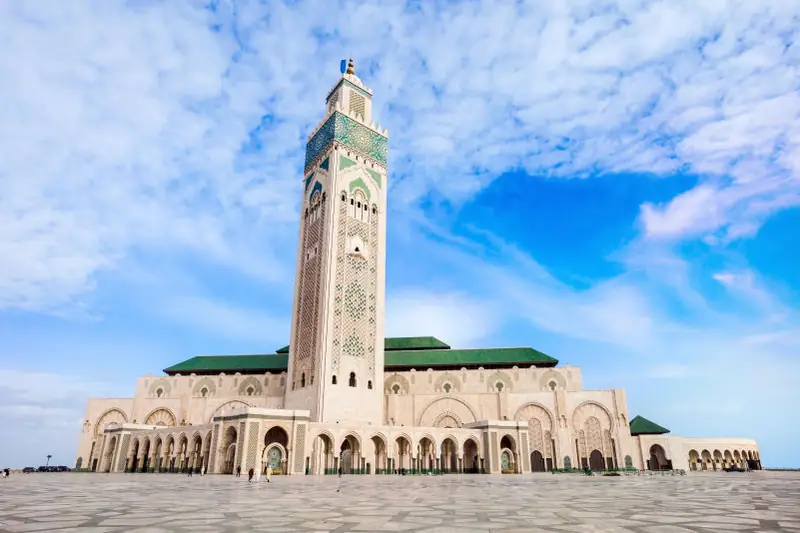
Commissioned under King Hassan II and designed by French architect Michel Pinseau, the mosque was completed in 1993. Its traditional decorative language can make the date surprising, but it is not a medieval survivor. Modern construction allowed a monumental prayer space and a coastal setting, while Moroccan craftspeople supplied the carved and assembled surfaces that give the building its character.
A nationwide public subscription helped fund the project, whose scale and cost also attracted criticism. Admiration need not erase that context. The minaret is commonly quoted at 210 metres, the foundation describes about 200; neither promises a tourist climb or justifies an outdated “world’s tallest” ranking.
What to Look At: Scale First, Details Second
Follow the repeated columns and hall height, then study a small area of tile, carved plaster or wood. Zellige builds geometry from cut pieces; carving changes with moving shadows. Look at material junctions as well as taking the obvious wide-angle view.
Our Moroccan architecture guide gives context for these materials without turning a contemporary building into an ancient one. The prayer hall also has a retractable roof, an engineering feature rather than a performance included in every tour. Do not schedule your visit around seeing it open, a laser demonstration or a particular lighting effect: routine access does not guarantee these operations.
The Official Route Is Not a Hammam Appointment
The foundation describes three tour stages: the prayer hall, the minaret hall and the ablution hall. “Minaret hall” means the hall at its base, not ascent to the top; the ablution area is for ritual washing, not a bath included in your sightseeing ticket. Follow the guide’s route, since temporary works or religious use can alter which areas are shown.
Museum and hammam facilities have separate arrangements: ask if interested. Do not expect a spa treatment or guaranteed ocean view through a glass floor on the interior tour. The coastal platform needs neither claim; ask which spaces today’s route actually visits.
- Prayer hall: architecture during an authorised visitor tour, not independent access during worship.
- Minaret hall: the base of the tower, not a panoramic climb.
- Ablution hall: ritual-washing facilities on the official route, not an included hammam treatment.
Getting There from the Centre, Station or Airport
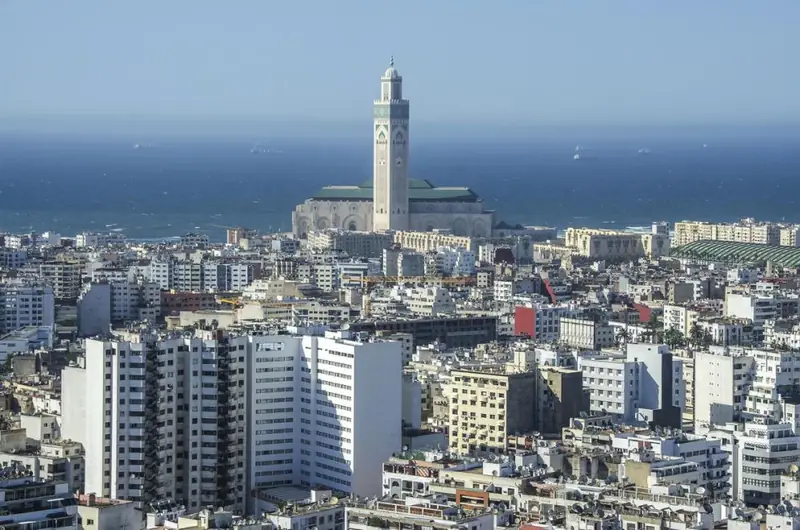
The mosque stands on Casablanca’s Atlantic edge, west of the central port area. A petit taxi from the centre or a station is often the simplest approach; agree on the mosque visitor entrance, not just a distant photo point, and ask for the meter where available or settle the fare first. Traffic and the final walk across the site matter more than a promised ten-minute journey.
Save your return address and confirm the pickup point. Rail and tram can help, but no station is directly at the mosque door. Our getting-around guide explains options; airport arrival, baggage and onward departures need more buffer than a central taxi ride.
Photos, Atlantic Weather and the Esplanade
From the permitted outer areas, step back for the relationship between minaret, building and water, then move closer for an arch or tiled panel. Morning and later light produce different views; sunset is for the exterior, not a promise of an interior tour at that hour. Keep behind barriers and never climb onto the sea edge for an unobstructed frame, especially in rough weather.
Inside, ask before taking still photographs and follow the guide’s limits around worshippers and restricted areas. The foundation prohibits video cameras and sound devices during the visit: do not interpret permission for ordinary photographs as permission to film or record commentary. Bring a light windproof layer even on a sunny day, protect yourself from glare and remember that wet polished paving can be slippery.
- People: ask before individual portraits, and do not turn worshippers into a photographic subject without consent.
- Weather: wind and spray can change comfort quickly; stay away from exposed edges.
- Equipment: check rules for professional kit, large bags and storage before arrival; no luggage locker is promised here.
Build a Casablanca Day Around the Confirmed Visit
Allow time for tickets, finding the group and removing shoes. With children, use toilets and have a snack beforehand: smoking and consumption are forbidden during the visit. Ask directly about steps, distances and accessible facilities for wheelchairs or pushchairs; large open spaces do not guarantee step-free routes between levels.
Our Casablanca guide combines the old medina, central architecture and longer coastal outings without pretending they are neighbours. Have an unhurried lunch afterwards, checking menu and payment methods first. Keep the return flexible around weather and worship, especially with a cruise-ship deadline or train connection.
- MorningAttend the departure you confirmed, with time for the visitor office and footwear. Keep exterior photos before or after according to weather and access.
- AfternoonEat, rest and choose one further city area rather than every sight. Confirm transport for a longer Corniche or Habous visit.
- EveningIf convenient, return for exterior light or choose dinner elsewhere. Neither a sunset tour nor special illumination is guaranteed.
- Cash: keep small dirham notes for taxis and cafés, and confirm ticket payment methods at the office. A tip is voluntary, not a second admission fee.
- Phone: save the return address and keep battery for transport. An authorised Maroc Telecom or Orange shop can arrange a SIM with your passport.
- Words: Salam alaikum greets, Shukran thanks, and La shukran politely declines; a calm refusal is enough for an unwanted offer.
- Verification: if someone outside claims the mosque is closed, ask official staff instead of automatically accepting a shopping detour; genuine worship restrictions must still be respected.
Check prices and access before committing. The foundation’s fee and daily visitor arrangements take priority over third-party packages or old screenshots. Confirm the MAD total, departure and any separate museum or hammam product with the official office.
Frequently asked questions
Can non-Muslims enter Hassan II Mosque?
Yes, on the mosque’s official guided visitor tours outside worship times. You cannot use that permission to wander independently or enter other mosques in Morocco.
How much is the interior tour?
The foundation lists 140 MAD for a foreign adult, with reduced categories requiring proof. Confirm children’s exact eligibility locally because the official language pages disagree on age cut-offs.
Is Hassan II Mosque closed to visitors on Fridays?
Not necessarily: the foundation lists fewer Friday departures rather than a blanket closure. Confirm the current local-time schedule, especially during Ramadan and religious events.
What should I wear?
Cover shoulders and torso, with clothing below the knees; shorts and sleeveless tops are prohibited. Remove shoes for entry, and follow staff directions on the day.
Does the tour include a minaret climb or hammam?
The published route includes the minaret hall at the base and the ablution hall, not a tower ascent or bathing session. Ask separately about museum or hammam access rather than assuming it is included.