Jemaa el-Fna: Marrakech’s Great Square, Stall by Stall
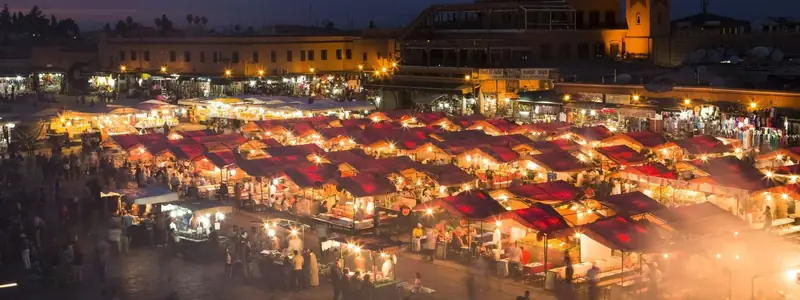
Jemaa el-Fna travel guide, short version: come twice, once in daylight and once after sunset, and give the square two or three hours in total. It is free, it never closes, and it belongs to everyone, which is exactly why UNESCO lists its living traditions as intangible cultural heritage. By day it is juice carts, dried fruit and a few performers; at dusk the numbered food stalls roll in, the charcoal smoke rises and the square turns into an open-air theatre that runs past midnight.
This guide covers what actually happens there, fair 2026 prices, the terraces with the best view, how to eat well without being overcharged, and what to see within a five-minute walk.
Agree the price first. Performers, henna artists and anyone posing for a photo expect payment, usually 10–20 MAD and up. At the stalls, read the printed menu before you sit, and check the bill against what arrived.
At a glance
- Where
- Centre of the Marrakech medina
- UNESCO
- Intangible heritage, inscribed 2008
- Entry
- Free, open day and night
- Stalls
- From dusk to about midnight
- Allow
- 2–3 hours, ideally twice
- Best time
- An hour before sunset
In this guide
Is Jemaa el-Fna Worth Visiting?
Yes, but not for the reason the postcards suggest. The square is not beautiful in the way a palace is; it is interesting because it is a working public space where Moroccans shop, eat, argue, perform and pray, and tourists are a minority of the crowd until the evening. Come with an hour to spare and no plan and it rewards you.
- First-time visitors: the essential Marrakech experience, and free.
- Photographers: the light and smoke between sunset and about 8pm are the whole point.
- Families: fine by day and early evening; after that it is loud, smoky and very crowded.
What Happens on the Square
The square changes character three times a day, and the entertainment is arranged in circles, called halqa, with the crowd standing around the performer rather than sitting in rows. Walk the edge of a circle rather than pushing into the middle; you will be invited to contribute, and a few dirhams is the usual courtesy. The circles form by themselves: someone unrolls a mat and starts playing, and within a minute thirty people are watching; half an hour later they have dispersed as if nothing had happened.
Performers, storytellers and musicians
Gnawa musicians with their low three-stringed guembri, drummers from the Atlas, acrobats, boxers, and the last few storytellers, whose art is dying with the generation that still practises it: the Halqa storytelling tradition was placed on UNESCO’s urgent-safeguarding list in 2022. Snakes, monkeys and dancing boys are part of the scene too, often in poor conditions; many travellers choose to watch the music and keep walking past the animals.
The food stalls after dark
At dusk, dozens of numbered stalls are towed in on carts and set up in rows, each with a laminated menu and benches. They serve the same core repertoire: harira soup, snail broth, grilled brochettes of lamb or kefta, merguez, fried fish, salad and bread, plus tea and pastries. Regulars have favourite numbers, and the busiest stalls are usually the ones worth joining.
Juice carts and the daytime square
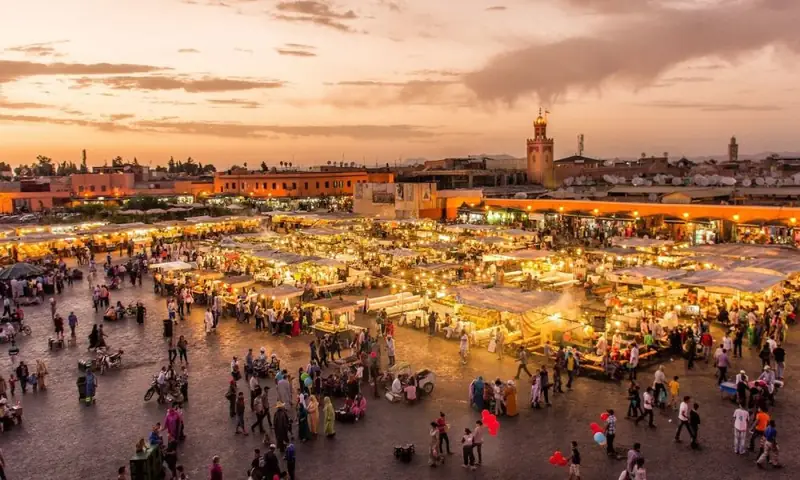
By day the square is a market, and its most famous ritual is the row of orange-juice carts, each squeezing to order for a few dirhams. Dried fruit, nuts, dates and spices are sold from barrows, water sellers in fringed hats pose for photos, and the terraces above are quiet enough to read a book. Spices, leather slippers, fabric and cheap souvenirs are laid out under awnings, and the carts at the edge squeeze mango, pomegranate and avocado; this is also the best hour to sit on a terrace with a mint tea and watch the square work without the evening crush.
The Koutoubia next door
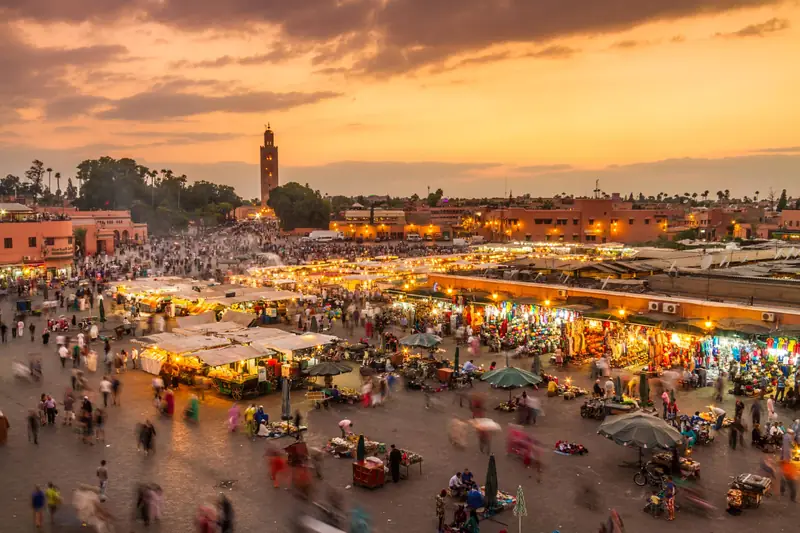
Five minutes west, the 77-metre minaret of the Koutoubia rises over its gardens of roses, palms and orange trees. Non-Muslims cannot enter the prayer hall, but the gardens and esplanade are free and open at any hour, and the minaret is at its best in the hour before sunset. It is the city’s compass: if you can see it, you can find the square.
Jemaa el-Fna Prices
The square itself costs nothing. These are the prices you should expect to pay for food, drinks and the small transactions that catch people out; they are the same for locals and visitors, which is not true everywhere in the medina.
| Item | Typical price | Note |
|---|---|---|
| Orange juice | 5–10 MAD (≈ €0.5–1 / $0.5–1) | Fixed; pay per glass |
| Harira soup | 10–15 MAD (≈ €1 / $1–2) | With bread and dates |
| Snail broth | 15–25 MAD (≈ €1–2 / $2–3) | Cumin and pepper |
| Brochettes | 30–45 MAD (≈ €3–4 / $3–5) | Per skewer or small plate |
| Full stall meal | 40–80 MAD (≈ €4–7 / $4–8) | Grill, salad, bread, tea |
| Rooftop mint tea | 20–35 MAD (≈ €2–3 / $2–4) | Buys you the view |
| Photo of a performer | 10–20 MAD (≈ €1–2 / $1–2) | Agree before shooting |
Prices may vary; always check them on site.
The Square Through the Day
If you only have one evening, arrive about an hour before sunset, take a terrace table while it is still light, then come down and eat at the stalls.
- MorningJuice carts, dried fruit and a handful of snake charmers; the calmest light for photos.
- MiddayHot and half empty from May to September; the terraces and the Koutoubia gardens are better.
- Late afternoonThe carts and performers return as the heat lifts; terraces start filling.
- SunsetThe best hour: the Koutoubia turns copper and the first stalls are towed in.
- 7–10pmPeak theatre: circles of music, smoke over the grills, the square at its busiest.
- After midnightStalls pack up and the square empties, except in Ramadan, when it runs much later.
In July and August the square stays nearly empty and very hot until about 6pm, so give the afternoon to a garden or a riad courtyard.
How to Eat at the Stalls
- Choose a crowd: a stall ringed by Moroccan families is a better bet than one with a tout waving a menu.
- Read the menu: every stall posts prices; ask what bread, salad and tea cost before they land on the table.
- Order to share: a few plates of kefta, merguez, salad and bread feed two people for well under 100 MAD.
- Check the bill: count what arrived, and query anything you did not order before you pay.
The classic dinner here is a bowl of harira, a plate of lamb and kefta brochettes, a little salad and bread, a glass of juice and a mint tea to finish, for about 60–90 MAD a head. For lamb, also look at Mechoui Alley beside the square, where it is roasted in clay ovens and sold by weight; it often sells out by mid-afternoon.
Watch the hygiene. Stalls with high turnover and long queues are the safest, and food straight off the grill is safer than anything sitting in a tray. Skip raw salads if you have a sensitive stomach, and drink sealed water rather than tap.
Safety, Scams and Etiquette
- Pickpockets: the square is well patrolled but crowded; keep phones and wallets in a front pocket or zipped bag.
- Photos: performers expect payment for posed shots. Photograph the general scene from a distance if you would rather not pay.
- Henna: black henna can cause allergic reactions; stick to traditional brown henna, and agree the design and price first.
- Animals: snakes, monkeys and caged birds are usually kept in poor conditions; watching is not illegal but it funds the trade.
- Unofficial guides: anyone offering to show you a “secret” souk route is selling something; decline politely.
- Dress: shoulders and knees covered is the comfortable default in the medina, especially away from the square.
Getting There
- On foot: almost every medina riad is 5–20 minutes away, and walking there after dark is normal; keep to lit streets.
- By petit taxi: taxis stop at the edge of the medina, not the square; from Guéliz expect 20–30 MAD on the meter.
- By calèche: horse-drawn carriages wait around the square and the Koutoubia; agree the route and the fare, about 100–150 MAD for 30 minutes, before you climb in.
- By bus: the nearest stops are on Avenue Mohammed V and Avenue Houmane el-Fetouaki, a few minutes’ walk away.
The square is closed to traffic, so anyone offering a taxi “right to the door” is overpromising; you will walk the last few minutes.
What to See Nearby
The square is the natural start of a medina day: the souks begin at its northern edge, and Marrakech’s other set pieces are all within a walk.
- The souks: straight north, the largest market in Morocco; see our souk shopping guide.
- Bahia Palace: 15 minutes south-east, a 19th-century palace of painted cedar and zellige; see the Bahia Palace guide.
- Ben Youssef Madrasa: about 15 minutes north, the city’s finest carved plaster; see the Ben Youssef guide.
- Marrakech beyond the square: Jardin Majorelle is 30 minutes on foot or a short taxi west; our Marrakech guide covers the rest.
| Destination | Distance | Best for |
|---|---|---|
| Koutoubia gardens | 5 min walk | Sunset and shade |
| Souks | 2 min walk | Crafts and haggling |
| Bahia Palace | 15 min walk | Palace interiors |
| Ben Youssef Madrasa | 15 min walk | Carved plaster |
| Jardin Majorelle | About 2.5 km | Gardens and colour |
Two of the palaces charge 100 MAD for foreigners and Majorelle is best booked online; the square and the Koutoubia cost nothing at all.
Money, SIM Cards and Tipping
- Cash: the stalls, carts and performers take dirhams only; carry small notes and coins.
- Cards: cafés and restaurants on the square accept cards, but the signal can fail; keep cash as backup.
- SIM cards: a Maroc Telecom or Orange SIM costs around 30 MAD with your passport, from shops in Guéliz or the medina.
- Tipping: 2–5 MAD for a juice or a bowl of soup, 10 MAD in a terrace café and 10–20 MAD for a performer you photograph.
- Ramadan: during daylight the square is quiet, and after iftar it is at its most crowded and joyful; avoid eating and drinking in public by day.
Prices may vary. Euro and dollar figures use November 2026 rates (€1 ≈ 10.9 MAD, $1 ≈ 9.9 MAD). Stall prices, terrace minimums and performer tips change; check them on the spot before you pay.
Frequently asked questions
Is Jemaa el-Fna free to visit?
Yes. The square is a public space open day and night with no ticket and no gate. You only pay for food, drinks on a terrace, or a tip to a performer you photograph.
What time do the food stalls open?
They are towed in around dusk and are fully set up by about 7pm, then serve until roughly midnight. In Ramadan they run much later, and the square stays busy into the small hours.
Is it safe at night?
Generally yes; the square is well lit and patrolled, and families stay out late. Watch for pickpockets in the crush, keep cash separate from your phone, and walk back along lit streets rather than empty alleys.
How much should a meal cost?
A full plate from a stall with bread, salad and tea costs 40–80 MAD per person. A bowl of harira is 10–15 MAD and a glass of orange juice 5–10 MAD.
Can you go inside the Koutoubia Mosque?
No. The prayer hall is reserved for Muslims, as in most Moroccan mosques. The gardens and esplanade around the minaret are free and open at any hour.