Morocco Souk Shopping: Choose the Item Before the Deal
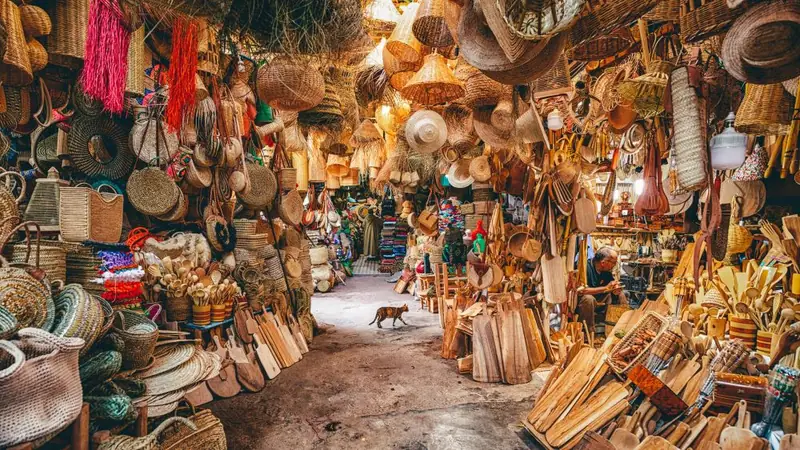
Shopping in Morocco works best when you decide what an object is worth to you before a negotiation starts. Souks offer rugs, leather, ceramics, lanterns, spices and oils, but a large discount does not establish quality or authenticity. Compare similar pieces, inspect the actual item and keep enough time to leave without buying.
You do not need to bargain everywhere or follow a rule about offering a fraction of the first price. Fixed-price shops are a useful alternative, and browsing is allowed. For an expensive purchase, dimensions, material, condition, delivery and the complete cost matter more than the performance of the negotiation. This guide helps you make those decisions here, from your first question to packing or shipping the purchase home.
Agree the object, currency and total together. Point to the exact piece and settle what is included before paying. Tea, a demonstration or a long conversation does not oblige you to buy.
At a glance
- Good starting point
- Compare like-for-like items before negotiating
- Bargaining
- Only where prices are negotiable
- Payment
- Agree a total in Moroccan dirhams
- Quality
- Inspect the item, not just its story
- Large purchases
- Keep an itemized receipt and delivery terms
- Going home
- Allow for baggage, customs and restrictions
In this guide
- Choose a Shopping Area That Fits the Day
- Bargain Without a Universal Percentage
- Inspect Rugs, Textiles and Leather Before Paying
- Ceramics, Lanterns, Jewellery and Wood
- Argan Oil, Spices and Food Gifts
- Handle Pressure and Paid Introductions
- Pay Carefully and Keep the Exact Purchase Identifiable
- Shipping, Customs and Getting It Home
Choose a Shopping Area That Fits the Day
In Marrakech, combine the lanes north of Jemaa el-Fna with a short route back to a known meeting place. In Fes, the craft quarters sit within a working medina; a tannery-viewing stop and a purchase are different decisions. Do not let the search for a bargain take over the time you need for walking, rest and the return.
Essaouira offers woodwork, art and other crafts within its medina; Rabat includes the Rue des Consuls shopping area. Neither city guarantees lower pressure or better prices at every shop. The official shopping overview introduces regional craft traditions. Choose where you have time to compare, not a city that supposedly guarantees authenticity.
| Area | Possible focus | Plan for |
|---|---|---|
| Marrakech | Mixed souks | Walking and pauses |
| Fes | Craft quarters | Medina navigation |
| Essaouira / Rabat | Wood, art, crafts | Comparing shops |
Bargain Without a Universal Percentage
First establish whether the price is fixed or open to negotiation. In a fixed-price shop, you can accept the price or leave. For negotiable crafts, compare similar size, material, finish and condition, set a maximum you can afford and make a specific offer you would genuinely pay. There is no reliable universal fraction of an opening quote that reveals the fair price.
Move calmly and keep the unit clear: one item, a pair, a set or a weight. If several items are bundled, ask for the total and what remains optional. Do not make a final agreement just to escape a conversation; say that you are not buying and leave politely. Once you do choose to buy, confirm the exact piece and price again before payment, without treating ordinary negotiation as a legal promise about cancellation rights.
Inspect Rugs, Textiles and Leather Before Paying
For a rug, measure the space at home first and bring the dimensions. Lay out the actual piece, examine both sides, edges, repairs, stains and any visible shedding, and record the stated fibre and size on the receipt. A regional name or a claim that it is old does not establish age, origin, natural dyes or value. Buy for the piece you can inspect rather than a resale story.
For bags, slippers and poufs, check seams, lining, fasteners, soles and the fit of the exact pair. Open and close zips, look inside and check whether a pouf is sold filled or as a cover. Smell, softness or a flame demonstration is not a dependable authentication test. A workshop or cooperative sign can provide context, but it is not a guarantee that every object was made there or that every material claim is correct.

Ceramics, Lanterns, Jewellery and Wood
Separate decoration from food use and cooking. A painted tagine is not automatically suitable for heat or food contact; glazing and appearance do not prove safety. The FDA pottery guidance explains why lead can migrate from unsuitable ceramics. If you cannot establish suitable manufacture for the intended use, treat it as decoration rather than cookware or tableware. Washing or boiling does not make an unsafe glaze safe.
Check ceramics for cracks and lanterns for sharp edges, stable fittings and practical size. An electric lamp may need appropriate wiring and a compatible bulb fitting at home; have it assessed rather than assuming a plug adapter settles safety. For jewellery, get claimed metal content and weight recorded, without relying on a colour or stamp alone. For woodwork, inspect hinges, joins and cracks; avoid protected wildlife materials or objects with unclear export status.
Argan Oil, Spices and Food Gifts
For argan oil, read ingredients, intended cosmetic or culinary use, producer details, volume, seal and date information. A cooking oil and a fragranced cosmetic product are not interchangeable. Colour, a sales demonstration or the word cooperative is not proof of purity. Choose a clearly described product with traceable packaging rather than an unlabelled refill bought only on a story.
For spices, agree the weight and price unit before filling a bag. Keep labels and packaging for food gifts, and consider allergies, storage and the rules at your destination before buying. Amlou commonly contains nuts, and recipes vary. Saffron colour tests or a seller’s dramatic demonstration are not a reliable basis for an expensive purchase. Start small if you cannot judge quality; you do not need to buy a large quantity to be polite.
Handle Pressure and Paid Introductions
You can decline tea, demonstrations, unsolicited guiding and shopping stops. A useful boundary is “No, thank you” followed by leaving, not a debate about the seller’s costs. Keep your bag and phone secure, save the return route and meet companions at a known public place. Ask before photographing people or merchandise. Do not hand over a passport or valuables to hold an item while you think.
If using a guide, agree beforehand whether you want shopping stops and whether introductions involve commissions. A commission is not proof of fraud, but it can change incentives and should not remove your choice. At Chouara Tannery, settle terrace access or guiding separately from any leather purchase. The travel tips help with broader etiquette; a polite refusal remains a valid end to a sales conversation.
| Situation | Useful response | Before payment |
|---|---|---|
| Fixed price | Accept or decline | Confirm inclusions |
| Negotiable craft | Make a considered offer | Exact item and total |
| Pressured stop | Decline and leave | No obligation from tea |
Pay Carefully and Keep the Exact Purchase Identifiable
Set the final total in dirhams, including packing and any agreed delivery, and use the money guide for cash preparation. Small notes help with modest purchases; avoid displaying all your cash. If paying by card, read the amount and currency on the terminal yourself and retain the transaction record. Do not assume a foreign-currency offer, card payment or a verbal refund promise guarantees a better deal or an automatic refund.
For a substantial purchase, get the shop’s contact details and a dated receipt describing the object, quantity, material claims, size, price and delivery arrangement. Photograph the piece with permission and watch it being packed, so a similar-looking replacement does not go unnoticed. If ordering later work, specify finish, dimensions, deposit, balance, completion and cancellation terms before paying. Keep the records offline as well as on your phone.
Shipping, Customs and Getting It Home
For shipping, distinguish the item price from packing, transport, insurance, destination duties, taxes and handling. Establish who ships, the declared value, tracking, delivery address, timing estimate and claim procedure if damaged or missing. “Free shipping” does not necessarily mean no arrival charges. Do not agree to underdeclare a value or assume a shop’s promise overrides customs rules.
Before buying food, seeds, plants, untreated wood, animal materials, antiques or cultural objects, establish both Moroccan export rules and your destination’s import requirements. Rules are country-specific: the US customs restricted-items guide is for US-bound travellers, not a worldwide allowance. For baggage, measure size and weight, protect breakables and check liquid/carry-on limits with your carrier. The culture guide adds context, but no souvenir is compulsory; leaving with a small well-chosen piece, or nothing, is fine.
- Before negotiating: comparable item, purpose and budget.
- Before paying: exact piece, currency, total and receipt.
- Before shipping: packing, insurance, tracking and arrival charges.
- Before departure: baggage limits, declaration and import/export rules.
Frequently asked questions
What percentage should I offer in a souk?
There is no universal discount rule. Compare like-for-like pieces, set a budget and make an offer you would actually pay where negotiation is welcome.
Does accepting tea mean I must buy?
No. A drink, demonstration or conversation does not create a shopping obligation. Decline politely and leave if you do not want to buy.
Are cooperative or handmade labels a quality guarantee?
No. Inspect the actual item, clarify materials and production, and keep written details for an expensive purchase. A sign or story is not proof.
Can every tagine be used for cooking?
No. Decorative, serving and cooking ceramics are different. If you cannot establish food-contact and heat suitability, keep the piece decorative rather than use it for food.
Does free shipping include customs charges?
Not necessarily. Separate packing, carriage, insurance, taxes, duties and handling, and check destination rules before buying.