Al Quaraouiyine in Fes: What Visitors Can Actually See
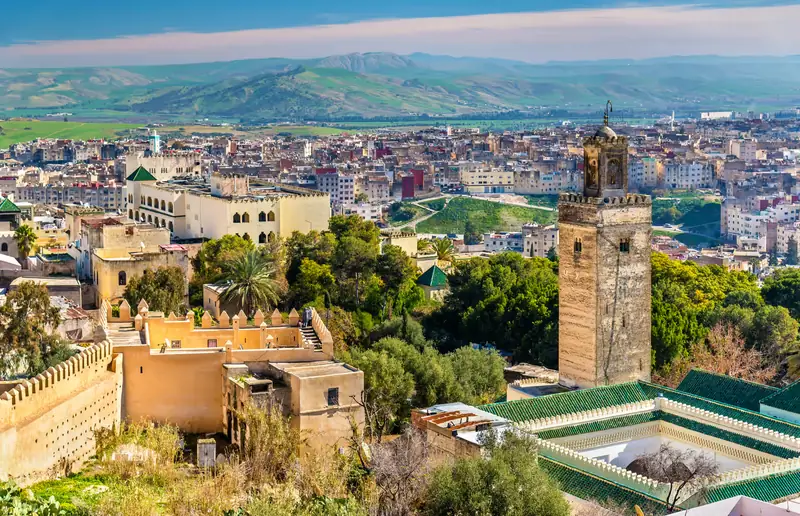
Al Quaraouiyine in Fes is a working mosque and historic centre of learning, not a university campus you can freely tour. Non-Muslims cannot enter the mosque; plan an exterior stop within a wider medina walk, and treat library access as a separate question requiring confirmation. The green roofs, entrances and surrounding scholarly quarter make more sense when you understand what is behind them, even if no interior view is available.
Traditionally founded in 859 and associated with Fatima al-Fihri, the institution has changed over centuries. Come for that history and the neighbourhood, not a promised doorway photograph. This guide separates the mosque, library and university, explains the oldest-university claim, and shows how to combine nearby visits without blocking worshippers or relying on unofficial access offers.
An open door is not an invitation to enter. Stay on permitted public routes and follow staff instructions. A guide, donation or purchase does not override mosque restrictions. Confirm any library arrangement directly with the institution before making it the reason for your visit.
At a glance
- Location
- Central Fes el-Bali
- Foundation
- Traditionally 859
- Founder
- Traditionally Fatima al-Fihri
- Mosque access
- Not open to non-Muslims
- Library
- Separate access; confirm ahead
- Visit style
- Exterior stop within a medina walk
In this guide
- Is Al Quaraouiyine Worth Visiting from Outside?
- Mosque, Library and University Are Not One Visitor Ticket
- The Foundation Story and Fatima al-Fihri
- Is This Really the World's Oldest University?
- Mosque Access: Respect the Boundary
- Can You Visit the Library?
- Architecture to Understand Without Promising an Interior View
- Finding the Complex in Fes el-Bali
- A Flexible Half-Day Around the Scholarly Quarter
- Guides, Costs and Photography
- Weather, Timing and a Realistic Backup Plan
Is Al Quaraouiyine Worth Visiting from Outside?
Yes, if you are interested in how Fes works as a religious and scholarly city. Set the right expectation: you are visiting the neighbourhood of an important living institution, not acquiring access to every part of it.
Allow roughly twenty to thirty minutes for the immediate surroundings as a planning choice, plus your approach and other stops. This is not an official tour duration. Do not wait outside a doorway until someone feels obliged to admit you.
Mosque, Library and University Are Not One Visitor Ticket
The names Al Quaraouiyine, Al-Qarawiyyin, Karaouine and Kairaouine occur across maps and guidebooks. They can refer to different aspects of the same long institutional history. Finding a university pin does not mean you have reached a public campus entrance, and a library reference does not establish permission to cross the mosque courtyard. Check exactly which building an offer describes.
| Part | What it means for a visit | Do not assume |
|---|---|---|
| Mosque | Active place of worship | Non-Muslim entry or a public tour |
| Historic library | Separate collection and arrangements | Walk-in access or manuscripts on show |
| University | An evolving institution of learning | A freely accessible historic campus |
| Nearby madrasa | A distinct monument with its own rules | Its ticket admits you to the mosque |
Ask an operator to name each admission included in a medina walk. Hearing history outside can be legitimate, but it is not an interior visit. Resolve ambiguous wording before paying.
The Foundation Story and Fatima al-Fihri
The mosque's foundation is traditionally dated to 859 and associated with Fatima al-Fihri, remembered as a patron from a family linked to Kairouan in present-day Tunisia. That connection also helps explain the name. Use the traditional attribution without turning a short visitor introduction into certainty about every detail of her life, the building process or the first teaching programme.
The building did not remain fixed at its ninth-century size. Archnet's account of the mosque's rehabilitation highlights major twelfth-century expansion under the Almoravids and its continuing role in worship and learning. The complex visible today reflects many periods of construction, patronage and repair, not a complete survival of the founder's original building.
Is This Really the World's Oldest University?
There is a strong basis for the familiar description, but attribution and wording matter. Guinness World Records calls Karueein the oldest existing and continually operating educational institution, founded in 859. UNESCO's Medina of Fez listing also refers to the world's oldest university in several language descriptions. These are useful references, not evidence that the institution always had its present form.
Mosque-based learning and a modern university are not interchangeable categories. Teaching, qualifications and organisation evolved. The key is the exceptional longevity of learning, not an unsupported claim about the first modern degree or an unchanged curriculum.
The World Heritage property is the Medina of Fez, not a separately inscribed university building. Recognition does not endorse a particular tour or guarantee visitor access.
Mosque Access: Respect the Boundary
Non-Muslims cannot enter the mosque. Dress or a head covering does not change that rule, and a small payment does not create an exception. From a permitted public position there may be a limited view when doors are open, but this is incidental, not an attraction staff must provide. A photograph online is not proof of current access or of permission to reproduce the photographer's position.
Keep entrances and the flow of worshippers clear. If asked to move, do so without negotiating for one last photograph. Muslim visitors should also follow local instructions about the appropriate entrance, prayer, dress and any areas unavailable at that time; religious access is not the same as a scheduled sightseeing circuit through the whole complex.
- At the threshold: remain outside restricted areas, even when another visitor steps across.
- During prayer: reduce noise and avoid gathering in a doorway; there is no guaranteed sightseeing interval.
- With a guide: ask for context on the public route, not an arrangement to bypass staff.
- With children: explain beforehand that this stop may involve looking from outside rather than entering.
Can You Visit the Library?
Treat the historic library as a separate enquiry, not an automatic extension of the mosque visit. Restoration and reopening stories circulate widely, but they do not establish today's public admission, research permissions or exhibition arrangements. The library is associated with the south side of the complex near Place Seffarine. Reaching that area does not itself entitle you to enter a reading room.
If access matters to your trip, seek confirmation from the library or responsible institution before departure and reconfirm locally. State whether you want a public visit, an exhibition or research access, since these are different requests. Ask about the date, entrance, identification and any written permission needed. Without a confirmed arrangement, build a worthwhile exterior-and-medina day instead.
Do not infer that rare manuscripts will be displayed, handled or available to photograph. A working collection has conservation and reader requirements, and images of shelves are not a visitor itinerary. Old reopening articles are not a substitute for confirmation.
Architecture to Understand Without Promising an Interior View
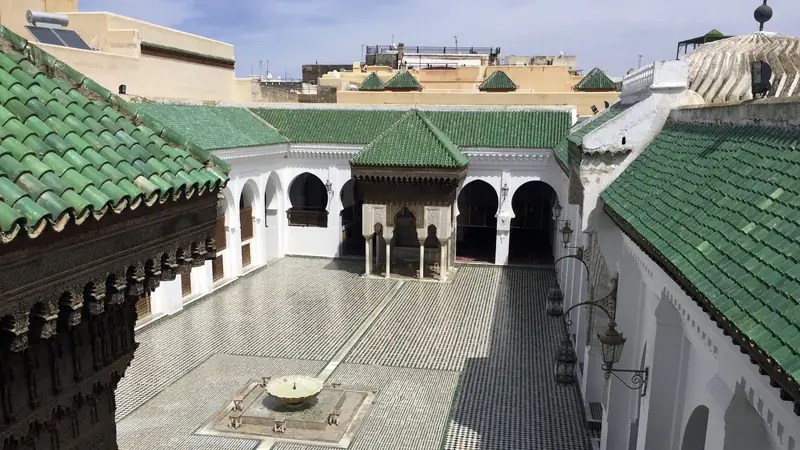
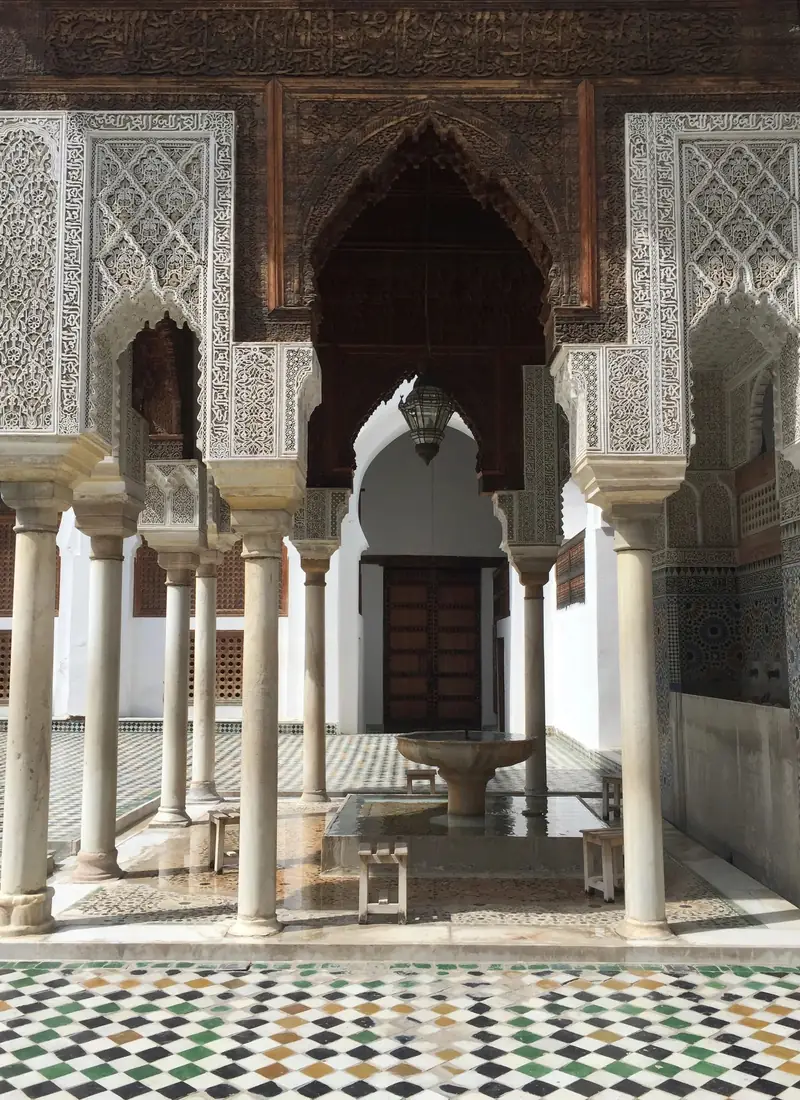
The roofscape helps explain the scale of a complex that is difficult to take in from a narrow lane. Courtyard photographs show a central fountain, surrounding arcades, green-tiled roofs and richly worked pavilions. Looking at the arrangement in advance can make fragments glimpsed legally from outside easier to understand, without needing to identify every visible feature as a particular dynasty's work.
Architectural explanation is not a viewing instruction. Do not lean past barriers for a photograph or pay for a rooftop without confirming permission, safe access and any purchase expectation.
Finding the Complex in Fes el-Bali
Al Quaraouiyine sits deep within the old medina. Bab Boujloud can be a useful starting landmark, but it is not the mosque entrance and the approach is not a straight, level corridor. Save an offline map, your accommodation pin and a return meeting point.
Use our Fes el-Bali guide for the wider walking context and the Fes city guide for arrival planning. Vehicles cannot take you through every lane to the mosque door. Agree a reachable drop-off with your driver or accommodation and allow time for the walking section rather than booking a tight connection based on road distance alone.
Narrow passages, slopes, steps and busy trading space can affect mobility and stroller use. Ask about the specific route rather than accepting a blanket accessible or impossible label. Restricted car access does not mean no moving traffic: deliveries, carts and other users still need room. If you need assistance, arrange it deliberately; do not assume help or a step-free alternative will appear at the entrance.
A Flexible Half-Day Around the Scholarly Quarter
Build the day around places you can actually visit, keeping the mosque exterior as one part rather than the sole objective. Start with an orientation point, choose a ticketed monument separately, then allow time for food and the walk out.
| Stage | Suggested focus | Keep flexible |
|---|---|---|
| First | Bab Boujloud and medina approach | Time to orient and walk |
| Next | Al Attarine Madrasa if open | Separate admission and current hours |
| Then | Al Quaraouiyine exterior and quarter | Prayer, doorways and public routes |
| Later | Seffarine area and a break | Workshops, rest and your return route |
Al Attarine Madrasa is a separate architectural visit nearby, not a side entrance to the mosque. If you also want Chouara Tannery, add time and decide on any viewing or shopping arrangement first. It is optional, not a required final stop.
Guides, Costs and Photography
A licensed local guide can explain the institutional history and help with navigation. Agree the length, language, meeting point, price and shopping expectations before starting. Ask which costs are separate. No legitimate planning benefit requires claiming guaranteed religious access. If someone approaches with an urgent closure story or exclusive entry offer, verify independently rather than immediately changing the whole day.
There is no general non-Muslim mosque sightseeing ticket to quote here. Budget separately for transport, a guide, food and any nearby monuments. Carry suitable cash for small expenses, but do not confuse a tip with admission. Our money guide explains payment planning; exact monument fees should be checked for the actual visit rather than inferred from an old bundled tour price.
Ask before photographing identifiable people, worshippers or working craftspeople. Permission to stand in a public lane does not make intrusive photography considerate. Keep your phone and belongings under control without stopping in the narrowest part of a passage. A respectful greeting and a clear refusal of unwanted help are enough; neither a conversation nor a viewpoint should silently become a purchase obligation.
Weather, Timing and a Realistic Backup Plan
Choose a walking pace and time that suit the forecast, with water and a planned rest. The medina can be demanding in heat, and shade does not remove the need for breaks. Wet paving and crowded lanes can slow the approach. Prayer, religious observances, restoration and local instructions take precedence over a preferred photograph or an online estimate of a quiet hour.
If a doorway is closed or a library visit is unavailable, keep the day intact: visit an open nearby monument, enjoy the neighbourhood and leave time to return comfortably. You do not need to replace every inaccessible room with another paid stop. Understanding why a place matters, while respecting how it functions today, is a complete reason to include Al Quaraouiyine in Fes.
Frequently asked questions
Can non-Muslims enter Al Quaraouiyine Mosque?
No. Plan an exterior visit from permitted public routes. Open doors, modest clothing, a guide or a donation do not override the restriction, and an interior glimpse is not guaranteed.
Is Al Quaraouiyine the world's oldest university?
Guinness recognises it as the oldest existing and continually operating educational institution, founded in 859. UNESCO also uses the oldest-university description for Fez. Its institutional form and teaching evolved over time.
Who founded Al Quaraouiyine?
Its foundation is traditionally dated to 859 and associated with Fatima al-Fihri. Later expansion and restoration mean the present complex is not simply the original ninth-century building.
Is the Al Quaraouiyine library open to tourists?
Do not assume walk-in access. Confirm the current public, exhibition or research arrangement directly with the responsible institution. A restoration or reopening report does not establish today's permission, hours or manuscript displays.
How long should I allow for a visit?
Roughly twenty to thirty minutes around the exterior can work as a planning allowance, separate from the walk there. Combine it with nearby visits and rest; it is not a scheduled interior tour or an official duration.