Bab Mansour and Heri es-Souani: Walking Sultan Moulay Ismail's Imperial Meknes
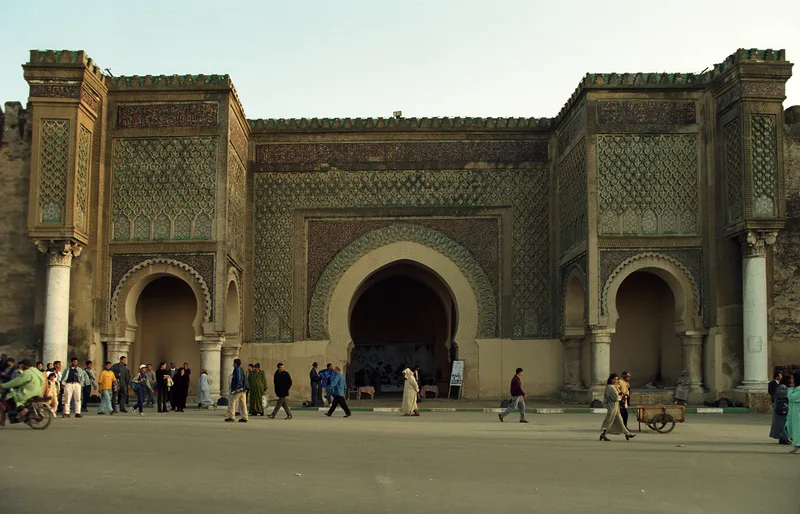
Completed in 1732 at the edge of Place el-Hedim in Meknes, Bab Mansour al-Aleuj is the grandest ceremonial gate of Alaouite Morocco: a monumental horseshoe arch flanked by ancient marble columns and intricate green-and-white zellige darj-wa-ktaf panels. Behind it stretches the vast imperial city built by Sultan Moulay Ismail, anchored by his mausoleum, subterranean prison vaults and the monumental Heri es-Souani granaries beside the Agdal reservoir.
Because parts of Meknes's UNESCO-listed monuments have undergone multi-year restoration, a rewarding visit pairs exterior architectural highlights with whichever interiors are open on the day. Allow half a day between Place el-Hedim and Heri es-Souani, bring cash in dirhams for individual monument tickets and petit taxis, and combine Meknes easily by train from Fes or Rabat.
View Bab Mansour from Place el-Hedim in late-afternoon sun. Bab Mansour functions as a monumental facade and exhibition hall rather than an everyday traffic thoroughfare, and individual kasbah monuments reopen on separate schedules after conservation; verify ticketed interiors locally on the day.
At a glance
- Location
- South side of Place el-Hedim; Heri es-Souani sits about 2 km further south
- Era
- Late 17th to early 18th century under Sultan Moulay Ismail and Moulay Abdallah
- UNESCO status
- Core monuments of the Historic City of Meknes
- Key stops
- Bab Mansour facade, Place el-Hedim, Moulay Ismail Mausoleum, Heri es-Souani & Agdal
- Suggested time
- 3 to 4 hours covering the square, imperial lane and granaries
- Rail access
- Frequent ONCF trains to Meknes al-Amir Abdelkader or Meknes Ville
In this guide
A capital built for ceremony and supply
Moulay Ismail made Meknes his capital during his reign from 1672 to 1727. Bab Mansour, completed under his successor, faces Place el-Hedim and presents imperial authority through its monumental arch, inscription, tilework and reused marble columns. Compare this ceremonial façade with the functional buildings deeper in the imperial city.
Heri es-Souani was an immense grain-storage complex associated with the royal city's water infrastructure; the neighboring Sahrij Swani basin helped store water. Popular accounts often call the whole complex royal stables, but the functions of individual spaces should not be conflated. The UNESCO listing places these structures within the historic city. Restoration can restrict access, so check locally and allow transport time between the square and the basin.
Bab Mansour and the Stagecraft of Place el-Hedim
When Sultan Moulay Ismail chose Meknes as his seventeenth-century capital, he cleared an immense esplanade between the old medina and his new royal kasbah: Place el-Hedim ('Square of Demolition'). Bab Mansour, begun late in his reign and finished in 1732 by his son Moulay Abdallah, was conceived less as a defensive bottleneck than as an imperial proclamation in stone and glazed tile.
Look closely at the projecting flanking bastions resting on Corinthian marble columns repurposed from Roman Volubilis and dismantled Saadian palaces in Marrakech. Above the arch runs a bold black ceramic inscription band praising the builder and framing crisp geometric latticework that glows warmest an hour before sunset.
| Imperial Quarter stop | Distance from Place el-Hedim | Typical access | What stands out |
|---|---|---|---|
| Bab Mansour & Place el-Hedim | 0 m (on the square) | Free exterior viewing | Marble columns, green zellige and covered food market behind |
| Mausoleum of Moulay Ismail & Qara Prison | 400 to 600 m south | Modest ticket / respectful dress | Stucco courtyards and vast vaulted underground chambers |
| Heri es-Souani & Sahrij Swani | About 2 km southeast | Ticketed granary + free basin walk | Thick rammed-earth storage vaults and 4-hectare royal reservoir |
Inside the Imperial Kasbah: Mausoleum and Qara Vaults
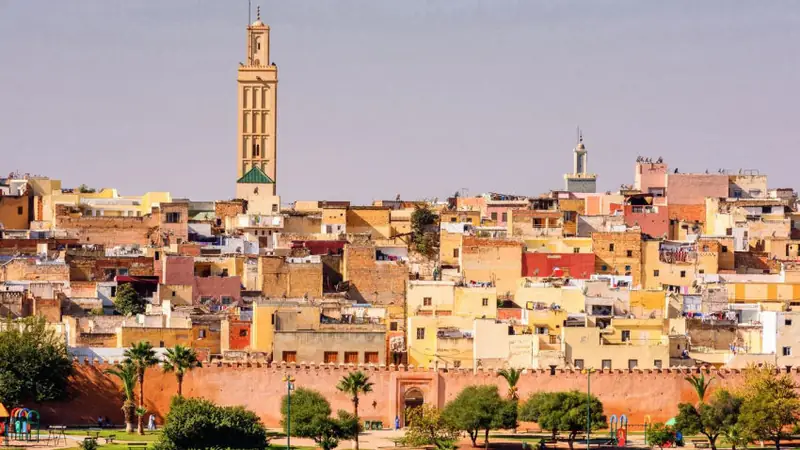
Walking through nearby Bab el-Khemis or the arched carriageway beside Lalla Aouda Square leads into the quiet walled corridor of the kasbah. Unlike most mosques in Morocco, the Mausoleum of Moulay Ismail has historically welcomed non-Muslim visitors into its outer courtyards and ante-chamber (dress modestly, cover shoulders and knees, and remove shoes where indicated), though prayer halls remain reserved.
Nearby lies Habs Qara (Qara Prison), a cavernous subterranean brick hall supported by forests of heavy piers where legend and diplomatic accounts placed captives and grain stores alike. Check at the kasbah ticket booths which sections have reopened following Meknes's heritage refurbishment programme.
Heri es-Souani Granaries and the Sahrij Swani Basin
Two kilometres further south along the walled royal road stand Heri es-Souani, the engineering heart of Moulay Ismail's court. Massive pisé walls several metres thick and underfloor water channels kept grain cool enough to feed thousands of soldiers and up to 12,000 royal horses quartered in the roofless arcaded stables behind.
Directly outside the granaries stretches Sahrij Swani (the Agdal basin), a vast stone-lined reservoir measuring roughly 150 by 320 metres that supplied palace gardens and wells while giving locals a breezy waterside promenade today.
Getting Around Between the Train Station, Square and Granaries
Meknes has two ONCF stations: centrally placed Meknes al-Amir Abdelkader and main Meknes Ville in the Ville Nouvelle; either is a short, inexpensive ride in a metered sky-blue petit taxi to Place el-Hedim. Compare Bab Mansour's Alaouite green zellige with Fes's later Bab Boujloud if travelling between the two cities.
- Walking vs petit taxi to Heri es-Souani: Walking the two-kilometre corridor between high ochre palace walls takes 25 to 30 minutes under open sun; hopping in a metered blue petit taxi for the southward leg saves time and energy. See getting around Morocco.
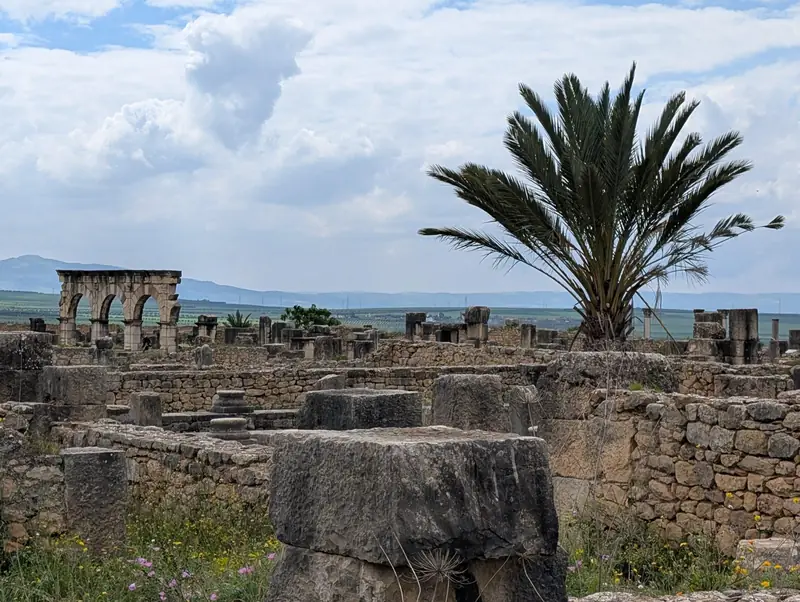
- Combine with Volubilis: Morning at Volubilis and Moulay Idriss followed by afternoon light on Bab Mansour and Place el-Hedim makes one of northern Morocco's best full-day pairings.
- Market snack stop: Directly opposite Place el-Hedim, the covered Marché Central sells olives, pastries and seasonal fruit at calm, posted local prices; review general street-sense tips in is Morocco safe.
Best Season and Photography Tips
Because Bab Mansour faces northwest onto open Place el-Hedim, morning sun backlights the facade while mid-to-late afternoon illuminates the zellige relief evenly. Spring and autumn offer crisp air across the Saiss plain; check monthly weather patterns in our best time to visit Morocco guide.
Frequently asked questions
Can you walk through Bab Mansour gate?
Pedestrians do not normally pass straight through the central arch as a street shortcut; visitors admire the facade from Place el-Hedim and use adjacent gates when entering the kasbah road or interior gallery.
How far is Heri es-Souani from Bab Mansour?
Heri es-Souani and the Sahrij Swani basin lie roughly two kilometres southeast of Bab Mansour, about a 25-to-30-minute walk between the imperial walls or a 5-minute metered petit taxi ride.
Are Meknes's monuments open after restoration?
Meknes has carried out extensive multi-site heritage restoration; while exterior views of Bab Mansour, Place el-Hedim and the Agdal basin are always accessible, check individual ticket booths on the day for interior openings.
Can I visit Bab Mansour and Heri es-Souani on a day trip from Fes?
Yes. ONCF trains connect Fes and Meknes in about 40 to 45 minutes each way, leaving plenty of time for Place el-Hedim, the imperial kasbah and Heri es-Souani.
Where did the marble columns on Bab Mansour come from?
Historical sources record that Alaouite builders reused ancient Roman columns from nearby Volubilis alongside marble stripped from Saadian palaces such as El Badi in Marrakech.