Bou Inania Madrasa in Fes: A Courtyard Worth Looking At Slowly
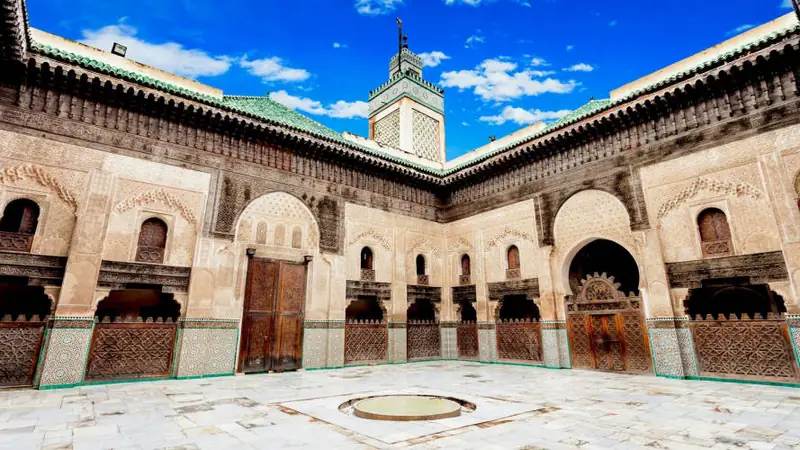
Bou Inania Madrasa in Fes is a fourteenth-century Marinid college whose courtyard brings together carved cedar, fine plaster and geometric zellige. It also served as a congregational mosque, and religious use still shapes visitor access. Non-Muslims can normally visit the designated monument areas, but that does not mean unrestricted entry to the prayer hall, student rooms or minaret. Confirm what is open before paying.
Allow around thirty to forty-five minutes for the building, with extra time for the approach from Bab Boujloud and the water-clock façade opposite. Come for a focused architectural visit, not a guaranteed upstairs circuit. This guide explains the historical setting, what to notice in the courtyard, how to handle uncertain hours and admission, and when to combine it with Al Attarine.
Ask what the ticket includes today. Confirm admission, the areas open and any interruption for worship before paying. A madrasa visit does not grant access to every religious space. Photographs of upper rooms or a tower online are not evidence that those places are currently open.
At a glance
- Location
- Fes el-Bali, near Bab Boujloud
- Period
- Mid-fourteenth century, Marinid
- Patron
- Sultan Abu Inan Faris
- Main focus
- Courtyard, cedar, plaster and zellige
- Allow
- About 30–45 minutes, plus approach
- Admission
- Ticketed; verify current terms locally
In this guide
- Is Bou Inania Madrasa Worth Visiting?
- Who Founded the Madrasa, and What Was It For?
- What Can Non-Muslim Visitors Enter?
- Hours, Tickets and Friday Planning
- Read the Courtyard from Ground Level Up
- The Minaret, Prayer Hall and Water
- Dar al-Magana: The Water Clock Opposite
- Bou Inania or Al Attarine: Which Should You Choose?
- Getting There from Bab Boujloud
- Build a Medina Walk without Rushing
- Etiquette, Photography and a Backup Plan
Is Bou Inania Madrasa Worth Visiting?
Yes, especially if you want to look closely at architecture rather than cover many rooms. The courtyard lets you compare materials at different heights: tilework below, pale carved plaster above and dark timber around screens and eaves. Its appeal is the relationship between those surfaces and the open space, not the number of doors a ticket unlocks.
A quick photograph may take minutes, but a slower visit makes the decoration legible. Stand back to understand the layout, then examine a few details from the permitted route. Do not expect permanent silence or an empty court: other visitors and worshippers have their own reasons to be here.
Who Founded the Madrasa, and What Was It For?
Bou Inania takes its name from its founder, the Marinid sultan Abu Inan Faris, in the mid-fourteenth century. Its architecture reflects royal patronage in a city where religious teaching, accommodation and public life were closely connected.
Archnet's architectural account describes a college that also functioned as a congregational mosque, with student rooms, a prayer hall and side halls arranged around a large courtyard. Associated shops and charitable resources helped place such institutions within everyday community life. A madrasa was not simply an ornamental monument awaiting tourists; it supported people, teaching and religious practice.
The contrast between elaborate public decoration and simpler residential accommodation is part of that story. Patronage had a visible face: the courtyard expressed generosity and prestige as well as serving practical movement and gathering. Do not confuse this building with the madrasa of the same name in Meknes. Check the city as well as the spelling when reading reviews or arranging a guide.
What Can Non-Muslim Visitors Enter?
Bou Inania is normally accessible to non-Muslim visitors in designated monument areas, unlike many working mosque interiors in Fes. That distinction is useful, but it is not blanket permission. Treat the courtyard as the central reason to visit and ask staff about any other space. Follow barriers and signs rather than another visitor who happens to step beyond them.
| Area | Plan around | Confirm separately |
|---|---|---|
| Main courtyard | The core architectural visit | Today's permitted route |
| Side spaces | Look from allowed positions | Which rooms are open |
| Prayer hall | An active religious area | Boundaries and worship needs |
| Upper rooms | Historical context, not a promise | Any actual visitor access |
| Minaret | Understand its role from below | Do not assume climbing is offered |
The ticket is not permission to interrupt prayer or enter a restricted room for a better picture. If access pauses, ask whether a later return is possible and what the ticket permits; do not assume re-entry. Neither a guide nor a tip overrides staff instructions. Muslim visitors should likewise distinguish religious access from a sightseeing route through otherwise unavailable areas.
Hours, Tickets and Friday Planning
Bring cash and check the admission price, visiting hours and areas included before paying. Ask whether prayer or restoration affects the route that day, and leave room to return later if the courtyard is temporarily closed.
Allow flexibility for worship, especially Friday congregational prayer, religious observances, restoration or other events. Do not rely on an exact midday closure or assume a short wait always solves it. If this is your only available day, confirm arrangements in advance and choose a nearby alternative. Do not reorganise a whole medina day on the unverified advice of someone selling a different tour.
- Before paying: ask the price for your party and what can actually be visited.
- Before a tight schedule: check current hours rather than repeating a guidebook timetable.
- Around worship: let staff direct waiting, movement and any temporary closure.
- If access changes: clarify return terms before leaving; a second admission is not automatically included.
Read the Courtyard from Ground Level Up
Begin with the whole arrangement. The open court creates distance between decorated walls so that screens, doorways and upper levels can be read together. Look at how repeated forms change at corners, then follow the meeting between tile, plaster and timber.
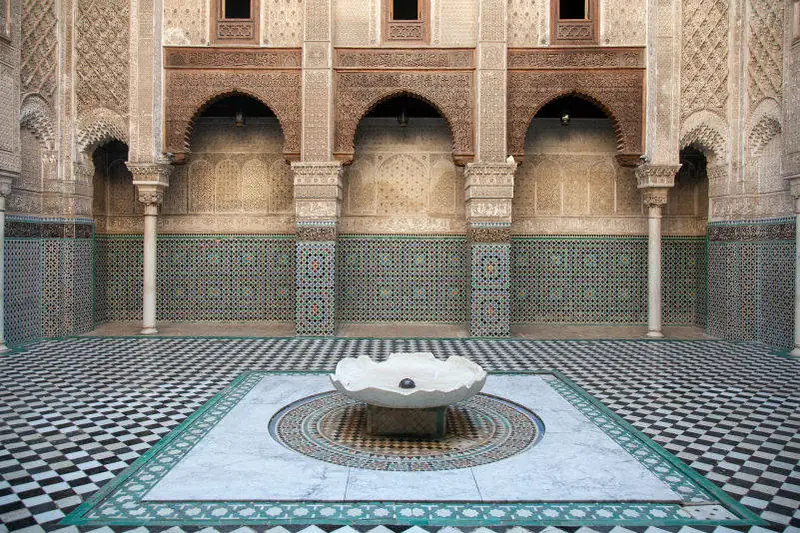
Zellige is assembled from shaped glazed tile pieces, not simply painted on a flat wall. Above it, carved plaster carries geometric, vegetal and calligraphic decoration; cedar adds warmer colour and depth. Avoid assigning a meaning to every inscription unless you have a reliable translation. It is better to recognise writing as part of the design than invent a quotation from a photograph.
Screens help explain the relationship between public court and more private circulation. Read them as functional elements as well as ornament. Do not touch carvings, lean bags against decorated surfaces or put belongings on a fountain edge for a photograph. Age, repair and ongoing conservation are also part of the building; do not assume every surface is untouched medieval work.
The Minaret, Prayer Hall and Water
The minaret makes sense once you understand the madrasa's congregational mosque function. It is not simply a decorative tower added to a school. You can appreciate its place in the ensemble without climbing it, and there is no reason to buy a promised tower view without clear confirmation of an authorised visitor arrangement.
The courtyard fountain and water arrangements belong to a religious and urban setting, not just a picturesque foreground. Water can help explain the relationship between ablution, prayer and the surrounding city. Do not assume it is drinking water, a play feature or something visitors should use. Keep access clear and photograph any permitted religious spaces without intruding on the people using them.
Dar al-Magana: The Water Clock Opposite
Look for the historic water-clock façade associated with the madrasa across the lane, known as Dar al-Magana. Its relationship with the institution is more important than treating it as a functioning clock demonstration. Historically, timekeeping helped organise prayer. Surviving architectural elements and restoration photographs do not mean the original mechanism is operating or that the building behind the façade is open to visitors.
Pause where you are not obstructing the narrow street and ask a knowledgeable guide to explain what can actually be identified. Avoid elaborate accounts of an operating mechanism presented as something you can watch today. The exterior can be a short companion stop, not a second ticketed interior to expect automatically.
Bou Inania or Al Attarine: Which Should You Choose?
Both offer Marinid craftsmanship, but they fit different parts of a medina day. Bou Inania is convenient for an approach from Bab Boujloud and helps explain the college-and-mosque combination. Al Attarine is nearer Al Quaraouiyine and offers a compact, richly decorated court.
| Choice | Useful for | Planning tradeoff |
|---|---|---|
| Bou Inania | Gate-side start and mosque context | Check worship and open areas |
| Al Attarine | A focused court near Al Quaraouiyine | A separate stop deeper in the medina |
| Both | Comparing layout and decorative scale | Allow walking, admission and rest |
| One only | Limited time or energy | Choose by route, not a universal ranking |
Read our Al Attarine Madrasa guide before deciding. If you visit both, compare one or two things deliberately, such as the screens or the transition from tilework to plaster. Skip the second admission if the family or group has already had enough architectural detail.
Getting There from Bab Boujloud
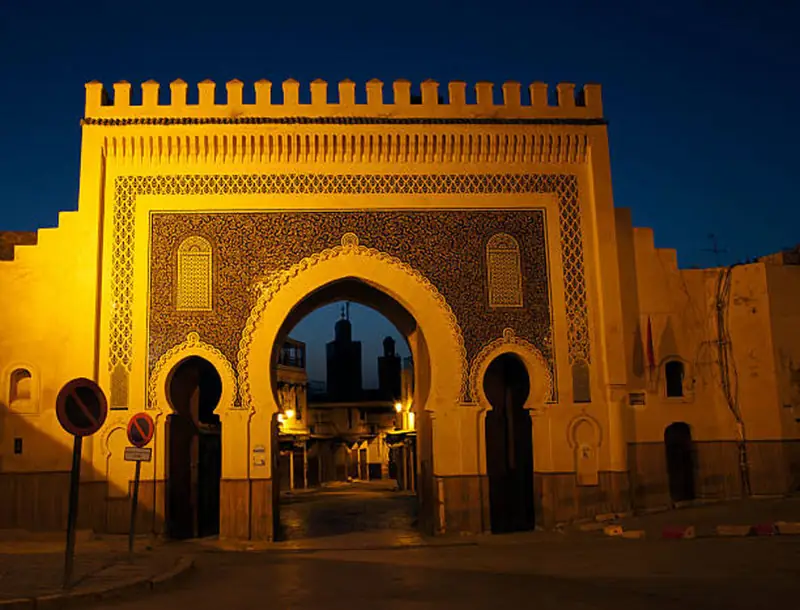
Bab Boujloud is a useful orientation point for reaching Bou Inania on foot. Save the landmark pin and your accommodation offline, and check which entrance staff are using. Street labels and transliterations vary, and map routes through the medina can be imperfect. Do not assume a door on a map is the public visitor entrance just because it touches the same building.
The approach is relatively convenient for a first medina stop, but that is not a promise of a level or step-free route. Ask about thresholds, stairs, busy passages and any particular mobility requirement. A stroller and a wheelchair have different needs. Limited car access does not mean no deliveries or other moving traffic; allow room for working street life rather than stopping across a passage.
Build a Medina Walk without Rushing
Start with the madrasa while your attention is fresh, then take a break before deciding how far to continue. Our Fes el-Bali guide explains the wider setting, and the Fes city guide helps with arrival and neighbourhood choices. Leave time to walk back to a reachable taxi point instead of counting only time spent inside monuments.
If continuing toward Chouara Tannery, treat it as a separate experience with its own viewing and shopping questions, not the inevitable end of every cultural walk. Agree costs and expectations before accepting help. A licensed guide can add historical context, but should be clear about duration, language, admissions and commercial stops. You can also choose a shorter route and a meal.
Etiquette, Photography and a Backup Plan
Wear modest clothing, keep voices low and follow instructions for any area you enter. Ask before photographing identifiable people, especially worshippers. A courtyard ticket does not confer permission to use flash, set up equipment or photograph every room. Check any specific restrictions and avoid blocking others while waiting for a clear composition.
Plan water, suitable shoes and rest for the wider walk, with extra flexibility in heat or rain. If the madrasa is closed, do not buy an unofficial promise of entry: confirm locally, continue with a permitted nearby stop or return later if arrangements allow. The aim is to understand a living historic building, not to force a fixed checklist through whatever conditions you find.
Frequently asked questions
Can non-Muslims visit Bou Inania Madrasa?
Normally yes, in the designated visitor areas. This does not mean unrestricted access to the prayer hall, upper rooms or minaret. Confirm today's open areas and follow staff instructions.
Who built Bou Inania Madrasa in Fes?
The Marinid sultan Abu Inan Faris founded it in the mid-fourteenth century. It combined teaching and accommodation with a congregational mosque function; it is not the identically named madrasa in Meknes.
How much is admission, and when is it open?
Check the current fee and hours locally before planning a tight visit. Published prices and schedules conflict, and worship or other closures can affect access. Bring cash and ask what admission includes.
How long should I spend at Bou Inania?
Around thirty to forty-five minutes is a useful planning allowance for a focused visit, separate from walking and the water-clock exterior. It is not an official duration or a guarantee that upper floors are included.
Is Bou Inania better than Al Attarine?
Choose by route and interests. Bou Inania fits an approach from Bab Boujloud and has a congregational mosque context; Al Attarine offers another richly decorated court near Al Quaraouiyine. Visiting both is optional, with separate admissions.