El Badi Palace, Marrakech: Saadian Scale, Storks and the Kasbah Walk
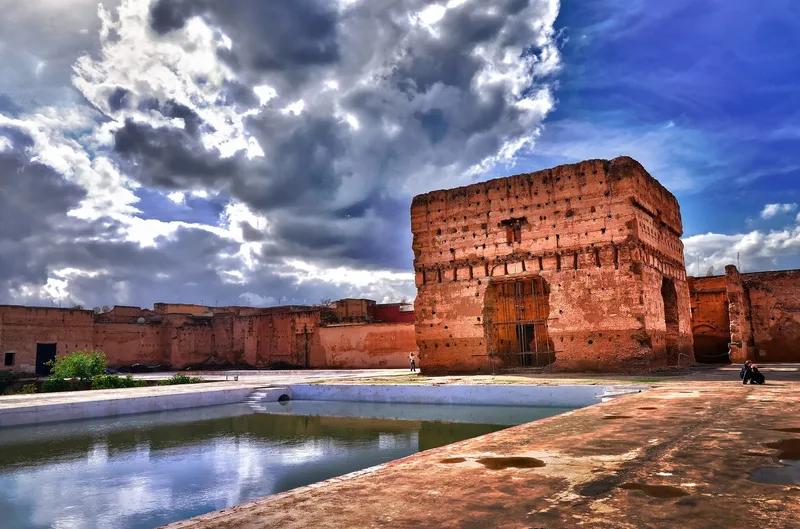
El Badi Palace in Marrakech is not a painted room-by-room mansion like nearby Bahia Palace. Commissioned after 1578 by Saadian Sultan Ahmad al-Mansur and stripped of its marble and gold a century later, it survives today as an immense sunken courtyard framed by rammed-earth ramparts, reflecting basins, sunken orange orchards and rooftop stork nests.
Visited with the right expectations and at the right hour, it is one of the calmest historic spaces in southern Marrakech. Plan 60 to 90 minutes, arrive early or late to avoid open-sky heat, check at the gate whether the Koutoubia minbar exhibition room is open, and pair it on foot with the Saadian Tombs and Mellah spice lanes.
Visit for scale, not intact tilework. Bring sun protection, water and cash in dirhams for the ticket booth, and confirm on arrival whether the Almoravid Koutoubia minbar pavilion requires a separate or combined ticket.
At a glance
- Location
- Ksibat Nhass in the Berrima and Kasbah quarter, southern medina
- Era
- Late 16th-century Saadian reception palace begun under Ahmad al-Mansur
- What you see
- Sunken grand courtyard, pools, subterranean passages, ramparts and storks
- Key exhibit
- 12th-century Almoravid Koutoubia minbar (check pavilion access at gate)
- Typical duration
- 60 to 90 minutes at an unhurried walking pace
- Easy pairing
- Bahia Palace, Mellah market and Saadian Tombs within 10 to 12 minutes
In this guide
How to read the palace ruins
El Badi was a ceremonial reception palace commissioned by Saadian Sultan Ahmad al-Mansur after his accession in 1578. Its name means the Incomparable. The scale of the courtyard and the remains of pools and sunken gardens reveal how architecture, water and imported materials projected royal power to visitors. Much of the decoration was later removed, so the bare walls should not be mistaken for the original finish.
The Koutoubia minbar displayed here is much older than El Badi: it was made in twelfth-century Córdoba for the Almoravid mosque and later used at the Koutoubia. Examine its intricate woodwork as a separate object with its own history. Check whether its exhibition is open and whether it needs a separate ticket; leave time for the open courtyard and protect yourself from the sun.
Why El Badi Looks Like a Ruin and Why It Matters
Sultan Ahmad al-Mansur began building El Badi ('The Incomparable') shortly after the 1578 Battle of the Three Kings, funding a vast ceremonial showcase with trans-Saharan trade revenues and diplomatic tribute. Contemporary chroniclers described Italian marble columns, onyx paving, gilded cedar ceilings and water channels designed to impress foreign ambassadors.
Late in the 17th century, Alaouite Sultan Moulay Ismail systematically dismantled the palace over more than a decade, transporting columns, marble and carved woodwork north to build his new imperial capital at Meknes. What remains is the architectural skeleton: a sunken rectangular esplanade over 130 metres long that reveals Saadian engineering, water storage and symmetry far more clearly than crowded smaller interiors.
| Kasbah-side stop | Main character | Shade level | Suggested time |
|---|---|---|---|
| El Badi Palace | Monumental open Saadian courtyard, pools, dungeons and storks | Mostly open sky | 60 to 90 min |
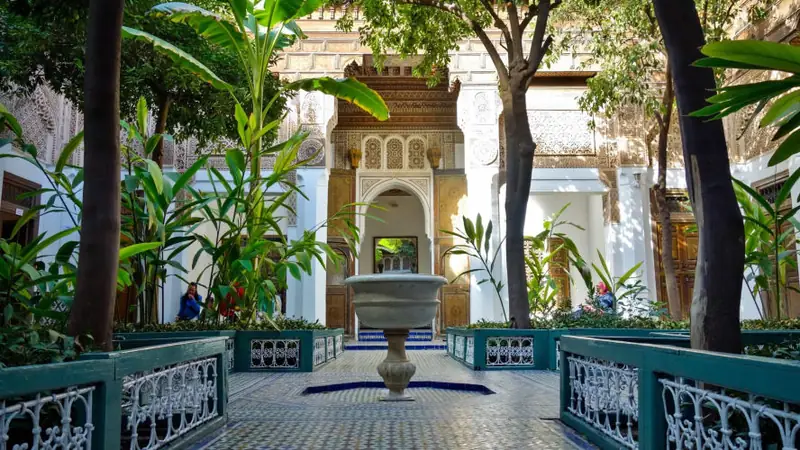
| Bahia Palace | 19th-century painted cedar ceilings, stucco and shaded courtyards | Mostly shaded | 60 to 90 min |
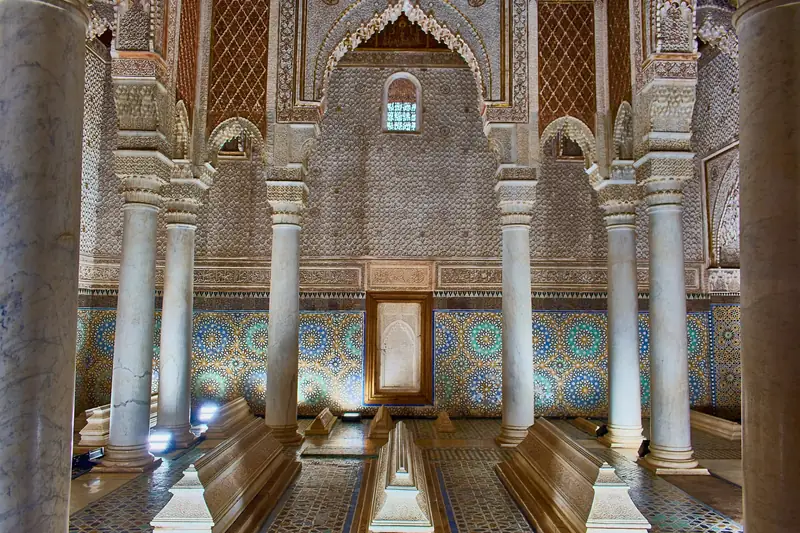
| Saadian Tombs | Compact royal mausoleum with carved Carrara marble and zellige | Partly shaded queues | 45 to 60 min |
What to See Inside the Complex
Once through the corner entrance gate, step onto the terrace overlooking the central reflection pool before descending into the sunken gardens. Four planted quadrants of citrus and olive trees sit below walkway level so foliage once appeared like a carpet alongside the water basins.
Around the perimeter, explore the vaulted subterranean chambers (often called dungeons or service galleries, formerly used for storage and palace logistics), perimeter pavilions with fragmentary zellige floors, and designated rampart viewpoints where white storks nest on nearly every crenellated tower.
The 12th-Century Koutoubia Minbar
When open, the dedicated climate-controlled exhibition hall at El Badi displays one of the masterpieces of western Islamic woodworking: the Almoravid minbar (stepped pulpit) commissioned in Cordoba around 1137 for the Koutoubia Mosque. Assembled from hundreds of finely inlaid panels of cedar, African blackwood and bone marquetry, it stood in Koutoubia for centuries before conservation.
Access rules and supplementary ticket pricing for the minbar room can change during conservation work or cultural events. Ask at the main ticket window before paying so you know whether the pavilion is open during your visit.
Best Time of Day and Event Closures
Because the central esplanade has very little overhead shade, midday sun between May and September reflects strongly off the pale paving and ochre walls. Aim for opening hour in the morning or the final two hours before closing, when low light warms the rammed-earth walls and storks return to their nests.
El Badi's courtyard also hosts major stages such as the Marrakech Popular Arts Festival and comedy festivals. During stage assembly or performances, sections of the central basin or terraces may be cordoned off or hours adjusted; check notices at the Ksibat Nhass entrance before buying a ticket.
Getting There and Combining the Southern Medina
From Jemaa el-Fna, walk south past Koutoubia or down Rue Riad Zitoun el-Jdid toward Place des Ferblantiers (Tinsmiths' Square) in about 15 to 20 minutes. Taxis can drop you right at Place des Ferblantiers, leaving only a short flat walk through the archway into Ksibat Nhass.
- Morning triangle: Start at Saadian Tombs at opening to beat Chamber of Twelve Columns queues, walk 10 minutes east to El Badi Palace while temperatures are still mild, then finish in the shaded rooms of Bahia Palace.
- Footwear and surfaces: Expect uneven brick thresholds, gravel edges and dark stone steps inside the underground passages; wear closed flat shoes and use your phone torch on stairs.
- Unofficial guides at the arch: The lane between Place des Ferblantiers and the palace gate is straightforward and well signed; politely decline anyone claiming the entrance is closed or moved. See our Morocco safety and scams guide.
Photography, Accessibility and Practical Etiquette
Personal handheld photography is straightforward across the open courtyard, while tripods or commercial shoots require formal authorization. Inside the Koutoubia minbar room, avoid flash to protect the 900-year-old wood inlay.
Visitors with limited mobility can view the entire sunken courtyard from the upper perimeter walkways near the entrance level, though reaching the sunken garden beds, rooftop terrace and underground passages involves steps without lifts. Pair your afternoon with a wider city plan using our best time to visit Morocco guide.
Frequently asked questions
How long does it take to visit El Badi Palace?
Allow 60 to 90 minutes to walk the central courtyard, underground passages, rampart viewpoints and, when open, the Koutoubia minbar pavilion.
Should I visit El Badi Palace or Bahia Palace if short on time?
Choose Bahia Palace for intact painted wood ceilings and shaded rooms; choose El Badi Palace for monumental scale, open views, storks and 16th-century Saadian history. Because they are 10 minutes apart on foot, most travellers visit both.
Is the Koutoubia minbar included in the standard ticket?
Admission structure can vary between combined and supplementary tickets or temporary conservation closures; ask at the official ticket window before purchasing.
Are storks visible at El Badi Palace all year?
Many resident white storks perch on the palace walls throughout the year, with nesting and chick activity peaking from late winter through spring.
Is El Badi Palace shaded in summer?
Very little of the central courtyard is shaded. Visit right at morning opening or late afternoon, wear a hat and carry drinking water.