Koutoubia Mosque, Marrakech: Minaret, Gardens and an Exterior Walk
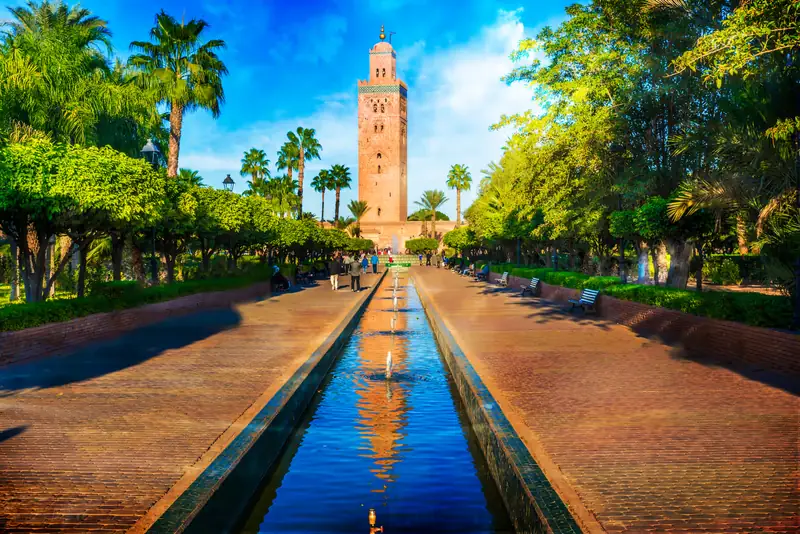
Koutoubia Mosque is Marrakech’s great Almohad landmark, just west of Jemaa el-Fna, with a minaret about 77 metres high. Non-Muslim visitors should plan to see the exterior and permitted public spaces, not enter the prayer hall or climb the tower. Allow roughly 20 to 40 minutes for a first look, with extra time for a garden pause or a longer city walk.
This is an active mosque rather than a ticketed interior attraction. The public approach, planted areas and worship entrances are not interchangeable: follow current barriers and signs, leave room for people attending prayer and adjust your route if an area is closed. A short, respectful visit can be worthwhile without access to every side.
Plan the outside, not a promised interior tour. An open prayer door or a description of the minaret’s internal ramp is not visitor permission. Follow local instructions and do not pay someone for an unsupported promise of entry.
At a glance
- Location
- West of Jemaa el-Fna in central Marrakech
- Period
- Twelfth-century Almohad complex
- Landmark
- Minaret about 77 metres high
- Visit style
- Exterior and permitted public paths
- Allow
- About 20 to 40 minutes, longer with rest
- Access
- Active mosque; no non-Muslim interior or tower visit
In this guide
- Start with the Right Expectations
- What the Almohad History Explains
- Read the Minaret from Ground Level
- A Simple Exterior Walk, Not a Guaranteed Loop
- Gardens and Earlier Remains Are Different Spaces
- Prayer Access and Non-Muslim Visitors
- Dress, Photos and a Quiet Presence
- Choose Light and Weather, Not a Fixed Sunset Promise
- Children, Mobility and Resting Places
- Walk from Jemaa el-Fna with Real Street Awareness
- Transport, Costs and Offers of Entry
- Build a Manageable Marrakech Combination
Start with the Right Expectations
Koutoubia, Koutoubiya and Kutubiyya are spellings of the same mosque. Its tower is useful for orientation near the medina, but a visible minaret does not tell you which public path reaches it. Approach by the actual streets and crossings rather than trying to take a straight line through a block or a mosque entrance.
The main reward is seeing the tower’s proportions, changing decorated faces and relationship to the surrounding city. You do not need an interior ticket to appreciate that. The Marrakech guide helps place the stop within a day, while a flexible exterior plan avoids arriving with expectations borrowed from a palace or museum that operates differently.
| Space | What to expect | Do not assume |
|---|---|---|
| Public exterior | Ground-level tower views | Every path stays open |
| Prayer hall | Active worship | Non-Muslim sightseeing |
| Minaret | View from outside | Public ascent |
What the Almohad History Explains
The complex belongs to the twelfth-century Almohad transformation of Marrakech, following the city’s earlier Almoravid foundation. The name is associated with booksellers who traded nearby. These are distinct historical points: the city’s founding date is not the mosque’s construction date, and a name connected to books does not make today’s surrounding area a surviving medieval book market.
There were two successive sanctuaries at the site, with remains of the earlier layout near the standing mosque. Sources present the precise building sequence and explanations differently, so a broad period is more dependable than a single confident completion day. The Koutoubia forms part of the wider UNESCO-listed Medina of Marrakesh; that status does not create an admission system or override religious access rules.
Read the Minaret from Ground Level
The square stone tower rises to approximately 77 metres, with carved arch patterns and tile details higher up. Look from more than one permitted angle rather than treating a single front view as the whole design. The smaller upper stage and finial complete the silhouette; there is no need to turn decorative stories into measurements or claims about the purity of its metal.
Koutoubia belongs to the architectural conversation that includes Seville’s Giralda and Hassan Tower in Rabat. That comparison helps explain Almohad traditions, not identical dimensions or visitor arrangements. Historical descriptions of an internal ramp do not establish public ascent. Do not expect a tower climb, test a door or follow a worshipper into a restricted passage.
A Simple Exterior Walk, Not a Guaranteed Loop
Begin at an open public approach, take a broad view of the minaret and move along permitted paths to another angle. Watch for crossings and for people arriving at the mosque. Pause away from doors and narrow passages rather than letting a photograph or a guide’s explanation block circulation. A closed section is a reason to adapt, not find a gap in a barrier.
Then decide whether a planted public area is open and comfortable for a rest. Allow about 20 to 40 minutes for a first exterior visit. Heat, walking needs and a quiet pause can all change how long the visit takes.
| Plan | Useful for | Allow for |
|---|---|---|
| Short stop | Exterior from open paths | Crossings and photos |
| Garden pause | Rest if available | Shade and path checks |
| Longer walk | Square or another monument | Separate access and travel |
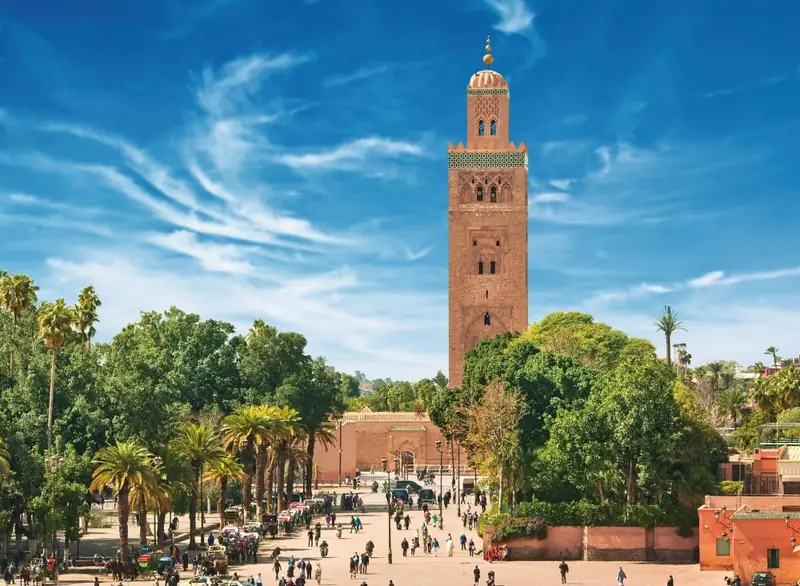
Gardens and Earlier Remains Are Different Spaces
The planted areas around Koutoubia offer a welcome contrast to dense medina lanes, and the garden commonly called Lalla Hasna is associated with the mosque setting. Use open public paths without assuming every gate, lawn, fountain or seat is available. Shade changes with the sun, and maintenance or local restrictions can alter the route you saw in a photograph.
The remains of the earlier mosque also deserve a careful look from authorised viewpoints where accessible. They are not picnic platforms or stepping stones for children. Do not climb foundations, move fragments or enter excavated areas because another visitor did.
Prayer Access and Non-Muslim Visitors
Non-Muslims cannot visit the Koutoubia prayer hall or minaret as a sightseeing interior. An open door during prayer is not an invitation to cross the threshold or photograph through worshippers. If you are Muslim and wish to pray, ask about the appropriate current entrance and arrangements; religious attendance is not the same thing as an interior architectural tour.
Casablanca’s Hassan II Mosque has separate visitor arrangements, which should not be transferred to Koutoubia. Equally, public paths outside a mosque should not be confused with its prayer areas. There is no reason to disguise your purpose or religion, accept a supposed exception from an unofficial guide, or treat a staff request to move as a negotiation.
Dress, Photos and a Quiet Presence
Choose modest clothing and keep voices low near worship entrances. Covering shoulders and knees is a respectful practical choice, not a paid dress-code service or a promise of interior admission. Do not interrupt prayer, sit in an active doorway or stage repeated poses where people need to pass. Follow any current instructions about particular areas rather than assuming a photo online establishes permission.
Ask before photographing identifiable people, especially children, and avoid turning worshippers into scenery. Keep camera equipment and bags out of circulation routes. A guide can help explain architectural details, but agree the language, scope and total fee before starting. Decline unwanted offers politely with “La, shukran”; an unsolicited explanation does not mean you ordered a paid visit.
Choose Light and Weather, Not a Fixed Sunset Promise
Morning or later light can make the stone easier to read, while midday heat may make a short walk tiring. There is no guaranteed perfect photo time: season, cloud, shade and crowds all matter. Take water, sun protection and shoes with grip, and consult the packing guide for broader preparation rather than relying on an interior cooling break.
Rain can make paving slippery and evening temperatures can feel different after a hot day. If you stay until dusk, choose an open, comfortable public route back and check your meeting point before light fades. Lighting effects shown in pictures are not a promise of current illumination. Shorten the visit if conditions are uncomfortable; seeing a landmark does not require waiting for one particular sky.
- Before arriving: choose a public approach and meeting point.
- Before taking a photo: leave worship entrances clear.
- Before adding a stop: check its separate access.
- Before leaving: allow the real connection to your next destination.
Children, Mobility and Resting Places
Broad open spaces can hide kerbs, uneven paving, steps and difficult road approaches. Ask about the exact route from your drop-off to the viewing point or garden you want, not simply whether “the mosque is accessible”.
With a wheelchair, walking aid or pushchair, seek current path and crossing information and choose a shorter out-and-back route if useful. Do not depend on strangers lifting a person over steps. Keep children close near traffic, foundations and fountains, and plan water and rest before fatigue. A seat in a photograph does not guarantee space, shade or toilets at the moment you arrive.
Walk from Jemaa el-Fna with Real Street Awareness
Jemaa el-Fna is nearby to the east, but the square and mosque are separate places with roads and pedestrian movements between them. A short connection can still take longer with traffic, heat or a group. Use appropriate crossings, look for motorcycles and do not step into the roadway while looking up at the tower or checking a phone.
Keep a map or saved accommodation location for the return: a visible tower helps orientation but cannot tell you the entrance to your riad. Do not use a prayer entrance as a shortcut towards the square. Agree a precise public meeting place with companions or a driver, especially if “by Koutoubia” could refer to different sides of a large complex.
Transport, Costs and Offers of Entry
From a hotel outside the medina, the railway station or the airport, allow a separate city transfer. Confirm the destination, fare arrangement and permitted drop-off before using a taxi; do not assume a vehicle can deliver you to every path. Check current public-transport stops and routes directly. Compare options in the transport guide.
Keep transport, optional guiding, water and meals separate in your budget. Agree the total before accepting a service, and do not treat a seller’s ticket offer as permission to enter a restricted area. The money guide helps with payment planning.
Build a Manageable Marrakech Combination
For a compact outing, pair the exterior and a permitted garden pause with the square. For a longer plan, Bahia Palace or the Saadian Tombs are separate visits requiring their own access checks, ticket budget and connecting walk. They are not rooms in the Koutoubia complex, and a nearby map marker does not remove medina navigation time.
A workable sequence is an exterior look, a rest, then one additional destination if conditions suit. Do not build a train or airport departure around the most optimistic finish. If paths are restricted or the heat is stronger than expected, keep the shorter version and let the mosque remain an appreciated exterior landmark.
Frequently asked questions
Can non-Muslims go inside Koutoubia Mosque?
No. Plan an exterior visit using open public paths, not a prayer-hall or minaret tour. An open door during worship is not sightseeing permission.
How tall is the Koutoubia minaret?
About 77 metres. Appreciate its decorated faces from ground level; that height is not an invitation to climb it.
How long should I allow?
Roughly 20 to 40 minutes for a first exterior look, longer for a garden pause or walking needs. This is a planning suggestion, not an official circuit.
Is there a ticket for the exterior?
An open public-street view is not an interior ticket product. Check particular areas locally and do not pay for an unsupported promise of mosque access.
Can I combine it with Jemaa el-Fna?
Yes, the square is nearby to the east. Allow for roads and crossings, and treat other monuments as separate visits with their own arrangements.