Saadian Tombs, Marrakech: Royal History, Tickets and a Realistic Visit
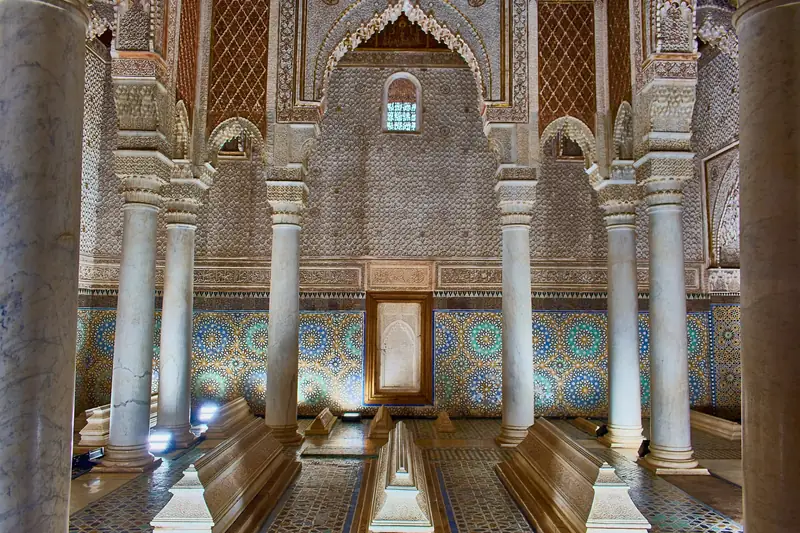
The Saadian Tombs are a royal burial complex beside the Kasbah Mosque in Marrakech’s southern medina, known for marble columns, carved plaster, cedar and tiled graves. Plan a compact heritage visit, not a walk through every burial chamber. The celebrated Hall of Twelve Columns is normally viewed from a controlled opening, where a queue can take longer than the view itself.
Allow roughly 30 to 60 minutes plus any waiting, and confirm the current entrance and hours before making a special journey. The ministry ticket portal publishes different prices by visitor category; a reseller package is not the same as admission alone. Keep voices low, stay behind barriers and leave time for the walk through the Kasbah quarter.
A ticket and a chamber queue are different things. Check the official admission category and current opening arrangements. An advance ticket does not establish priority at the viewing point or permission to enter a protected chamber.
At a glance
- Location
- Kasbah quarter beside the Kasbah Mosque
- Period
- Mainly sixteenth- and seventeenth-century Saadian burials
- Highlight
- Hall of Twelve Columns and garden graves
- Allow
- About 30 to 60 minutes plus queues
- Visit style
- Ticketed burial monument, controlled viewing
- Access
- Confirm entrance, narrow passages and steps
In this guide
- Know Which Site You Are Visiting
- The Saadian Royal Story
- What “Rediscovered in 1917” Means
- The Hall of Twelve Columns and Controlled Viewing
- Garden Graves and Other Rooms
- Published Tickets: Use the Ministry Categories
- Hours and Tickets: When to Arrive
- Queue Strategy Without a Guarantee
- Dress, Photography and Burial-Site Etiquette
- Heat, Steps and Mobility Questions
- Reach the Kasbah Entrance with Time to Spare
- Combine the Tombs with One Manageable Next Stop
Know Which Site You Are Visiting
The Saadian Tombs, or Tombeaux Saadiens, occupy a compact necropolis beside the Kasbah Mosque. They are not the mosque’s general visitor entrance, not a palace and not a cemetery you can cross as a public shortcut. Save the actual monument entrance rather than following a map pin into a prayer doorway or a private lane.
The Marrakech guide helps locate the Kasbah quarter within a wider day. The attraction suits visitors interested in decoration and dynastic history, but its small scale matters: the best-known room is a controlled view, not a large museum floor. Arriving with that expectation makes it easier to judge whether the wait fits your interests and time.
| Part | Main interest | Access expectation |
|---|---|---|
| Twelve Columns | Royal chamber and marble | Controlled viewing |
| Other rooms | Decoration and dynastic layers | Follow open route |
| Courtyard | Outdoor graves and setting | Stay on paths |
The Saadian Royal Story
The principal mausoleums developed in the sixteenth century around the burial of Muhammad al-Shaykh and the work of his son Abdallah al-Ghalib. Ahmad al-Mansur later expanded and embellished the complex; his mother Lalla Messaouda and other members of the ruling family are part of its story. This is not one ruler’s single tomb constructed at one moment.
The ministry also identifies the later Alaouite ruler Moulay al-Yazid among those buried here, so not every burial belongs to the same dynasty. The Saadian monuments form part of Marrakech’s wider historic fabric, alongside but distinct from earlier Almohad sites. There is no need to memorise an exact grave count to see how different rooms and outdoor burial areas express status and commemoration.
What “Rediscovered in 1917” Means
The heritage service recorded the monument’s discovery in 1917, during the French Protectorate. The burial ground’s modern conservation history is another layer of the visit, alongside the much older Saadian tombs.
Use 1917 as a point in the history of documentation, restoration and public presentation, not proof that every surface is original or unchanged. Preservation work and visitor arrangements shape the place you see today. A compelling visit can focus on the surviving workmanship without repeating a later ruler’s supposed motives for sealing the tombs as a verified psychological fact.
The Hall of Twelve Columns and Controlled Viewing
The best-known chamber is associated with Ahmad al-Mansur and is named for its marble columns. Look at the relationship between supports, carved decoration, ceiling and tomb markers rather than just trying to fit the whole room into a phone frame. The visual density rewards a brief attentive look even when the permitted viewing time is limited.
Expect to see this room from a managed threshold or opening rather than walk freely among its tombs. Follow the actual route and staff directions, let the line move and do not lean beyond a barrier to improve a photograph. A photograph taken from inside does not establish present public access. No guide’s promise or premium ticket should be treated as permission to cross conservation limits.
| Visitor category | Adult | Child aged 7 to 13 |
|---|---|---|
| Foreigner | 100 DH | 50 DH |
| Moroccan or resident | 30 DH | 10 DH |
Garden Graves and Other Rooms
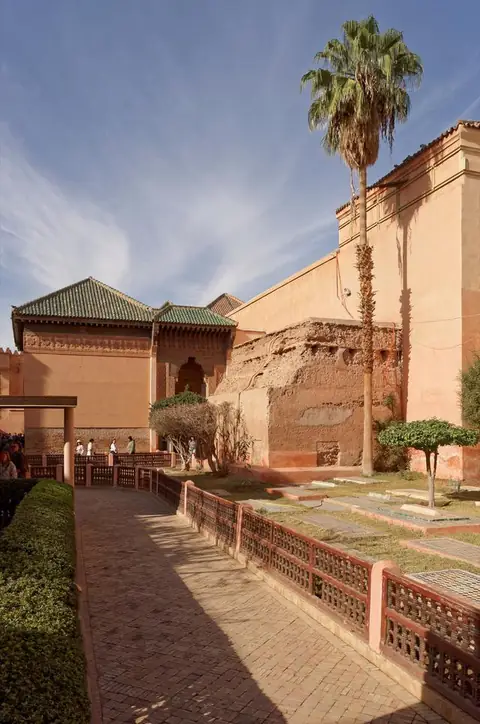
Outdoor burial areas and other decorated spaces are part of the monument, not just somewhere to stand while waiting for the famous chamber. Notice the different scale and treatment of grave markers, tile patterns and architectural transitions. Read available interpretation instead of assigning an identity to each grave from a photograph or a guidebook image.
Keep to permitted paths and never step over graves, sit on tombs or touch carved plaster and fragile tilework. The planted courtyard is also a burial setting, not a picnic lawn or children’s play area. If part of the complex is closed, respect that boundary rather than assume a ticket includes every chamber. A shorter route can still give a useful sense of the whole.
Published Tickets: Use the Ministry Categories
The official Ministry of Culture ticket portal lists 100 DH for a foreign adult and 50 DH for a foreign child aged 7 to 13. It lists 30 DH for a Moroccan or resident adult and 10 DH for a Moroccan or resident child aged 7 to 13. Recheck your category and required documents before paying.
The portal also states free entry for people with reduced mobility and for Moroccan nationals on Fridays and the first day of national and religious holidays. Ask what proof or procedure applies; eligibility does not establish a step-free route. Do not replace these published categories with an old flat 70 DH price or assume a foreign resident qualifies for every nationality-based exemption.
Hours and Tickets: When to Arrive
The tombs are usually visited between about 9am and 5pm. Arrive near opening if you can: the main chamber is viewed through a small opening, so its queue can take longer than the rest of the visit. Leave extra time even early in the day. Check the day’s closing time before joining the queue, especially during Ramadan and on holidays.
Book through the ministry ticket portal or check the options at the entrance. Before paying, check the valid date, delivery instructions, cancellation terms and any service charge. Admission, an audio or digital guide and a guided tour are different products. A prepaid ticket does not remove the queue at the main chamber’s viewing opening.
Queue Strategy Without a Guarantee
At a compact site, one narrow viewing opening can slow everyone down. Earlier or later visits may suit your wider plan, but neither guarantees an empty line. Ask about the current wait before committing to a fixed next appointment and distinguish a ticket-counter queue from a queue inside for a chamber. The latter can remain even if you bought ahead.
If waiting in sun or standing is difficult, ask about current assistance and decide whether the available visit suits you. Do not rely on an unverified fast-track product or crowd forecast. Allow about 30 to 60 minutes, plus the viewing queue. Leave room to shorten the visit or omit one view rather than rush other people.
- Before paying: verify category and conditions.
- Before queuing: ask which line and expected wait.
- Before a photograph: respect the viewing boundary.
- Before adding a palace: leave travel and rest time.
Dress, Photography and Burial-Site Etiquette
Dress respectfully and speak quietly. The tomb monument’s tourist access is separate from the neighbouring mosque’s religious rules; a necropolis ticket does not admit you to prayer spaces. Keep bags and camera equipment away from decorated surfaces and passages. Ask staff about flash or other photography limits and accept a no-photography direction without treating an online picture as permission.
Ask before photographing identifiable visitors or staff, especially children. Do not block the viewing opening with repeated poses, touch inscriptions for a close-up or climb for a higher angle. An optional guide can explain the context, but agree language, content, duration and total price first. Politely decline unsolicited services; an explanation offered without agreement is not a tour you ordered.
Heat, Steps and Mobility Questions
Bring water, sun protection and shoes with grip; the packing guide helps with broader preparation. Outdoor waiting and a narrow approach may feel more demanding than the monument’s size suggests. Rain can make paving slippery, and a beautiful courtyard photograph does not tell you how much shade or seating will be available.
Ask about the precise entrance, passage width, thresholds, steps and route to each viewing point if using a wheelchair, walking aid or pushchair. Do not depend on strangers lifting someone over obstacles. With children, plan a short explanation and rest breaks, keep them on paths and ask about toilets rather than assuming facilities in every area.
Reach the Kasbah Entrance with Time to Spare
The monument is in the southern medina near Rue de la Kasbah and the Kasbah Mosque. From Jemaa el-Fna, allow for real streets, junctions, pedestrians and possible motorcycles rather than a straight-line estimate. Save the route offline and ask your accommodation about the current public entrance; the neighbouring mosque’s door is not an alternative tourist entrance.
From the station, airport or a hotel farther out, add a separate city connection. Confirm a taxi’s fare arrangement and permitted drop-off, then the final walk. The transport guide compares options without promising a current bus number or exact transfer time. The money guide helps prepare dirhams for transport and optional services; do not assume every counter accepts the same payment method.
Combine the Tombs with One Manageable Next Stop
Koutoubia Mosque and Bahia Palace are possible separate stops; El Badi Palace is another distinct monument, not an extension of the necropolis. Each needs its own connecting route and access check, and a tomb ticket should not be assumed to cover a palace. Leave time for heat breaks and finding the next entrance.
A realistic outline is the tombs, including the wait you are willing to accept, a rest, then one additional destination. Do not chain a tight train or airport departure to the most optimistic queue estimate. If opening arrangements or mobility needs change the day, a smaller plan is better than paying for a sequence you cannot comfortably finish.
Frequently asked questions
How much is a ticket to the Saadian Tombs?
The ministry portal lists 100 DH for a foreign adult and 50 DH for a foreign child aged 7 to 13; Moroccan/resident categories are 30 and 10 DH. Recheck eligibility and conditions directly.
Can visitors walk inside the Hall of Twelve Columns?
Plan to view it from the managed opening, not walk among the tombs. Follow staff and barriers; advance purchase does not grant unrestricted access.
How long should I allow?
About 30 to 60 minutes plus any queue is a useful planning allowance. Waiting at the chamber can be separate from ticket purchase and is not guaranteed to be short.
What are the current opening hours?
Usually around 9am to 5pm. Aim for opening and check the day’s last entry and closing time, especially during Ramadan or holidays.
Does admission include the Kasbah Mosque or a palace?
No such combined access should be assumed. The neighbouring mosque has religious rules, and Bahia or El Badi are separate monument visits.