Moroccan Arabic Phrases: A Practical Darija Travel Guide
Learn a small set of Moroccan Arabic phrases for greeting, thanking, asking a price and admitting you do not understand. Darija is everyday Moroccan Arabic, not simply a different pronunciation of a standard Arabic phrasebook. Start with Salam alaykum, Shukran and Afak, then practise recognising a reply rather than memorising a long speech.
In a souk, a greeting before the price question gives the conversation a clear beginning. At a taxi, a written destination can be more useful than an ambitious sentence. This guide combines short phrases, Arabic script and practical situations for first-time visitors. Spellings and speech vary, so use the tables as a starting point, not a promise that one version will suit every person or region.
Learn a way to pause. Ma fhemtsh means I did not understand. If a price, destination, ingredient or instruction matters, stop and confirm it with writing, a map or a capable interpreter rather than pretending the reply was clear.
At a glance
- Language
- Darija, Moroccan Arabic
- Please
- Afak
- Thank you
- Shukran
- No, thanks
- La, shukran
- Not understood
- Ma fhemtsh
- Backup
- Offline notes and written address
In this guide
- Darija, Arabic and Amazigh: know what you are learning
- Read the spelling as a guide, not an exact recording
- Greetings and politeness: learn the reply too
- When you do not understand: stop the conversation safely
- Shopping: ask the total, not just a friendly question
- Directions and taxis: combine speech with an address
- Food and drink: a few words are not an allergy protocol
- Numbers one to ten: practise hearing as well as saying
- Respectful conversation and words you may hear
- Save an offline phrase card and practise a short exchange
Darija, Arabic and Amazigh: know what you are learning
Arabic and Amazigh are Morocco’s official languages. Darija is the Moroccan Arabic used in much everyday conversation; Modern Standard Arabic has important formal and written uses. Amazigh languages are not dialects of Arabic. French, English and Spanish may help depending on person and place, but none is a universal fallback.
A traveller can manage many routine situations without fluency, especially with preparation and patient assistance. That does not justify assuming every guide, driver or shopkeeper speaks your preferred language. Ask which language works and be willing to change method. A clear address or picture can succeed where several louder repetitions of the same sentence fail.
The short forms here are selected for common travel tasks, not a complete grammar course. Some wording changes with the person addressed, grammatical gender, number or region. Keep the examples modest and ask a local teacher or speaker to help you adapt them.
Read the spelling as a guide, not an exact recording
Darija is written in Arabic script and in several Latin transcription systems. It is not an unwritten language, but there is no single Latin spelling used by every speaker and textbook. Shukran can appear as choukran; short vowels may be represented differently or omitted. These tables use a simple consistent travel notation, not the International Phonetic Alphabet.
The combination sh represents a sound like the start of ship; kh resembles the rough sound in Scottish loch, and gh is a different voiced sound, not an English g plus h. In some informal writing, 3 represents the Arabic letter ع and 7 represents ح. In the numbers table, rb3a is one word for four, not a mathematical formula.
Listen to a willing speaker, repeat slowly and ask for correction without turning their workday into a lesson. There is no reliable rule that every word is stressed on the last syllable. Avoid forcing difficult throat sounds. If someone does not understand, switch to writing or another language rather than assuming a smile guarantees comprehension.
Greetings and politeness: learn the reply too
| Meaning | Darija | Arabic |
|---|---|---|
| Hello | Salam alaykum | السلام عليكم |
| Reply | Wa alaykum salam | وعليكم السلام |
| How are you? | Labas? | لاباس؟ |
| Thank you | Shukran | شكرا |
| Please | Afak | عفاك |
| You’re welcome | Bla jmil | بلا جميل |
| Yes | Iyeh | إيه |
| No | La | لا |
| No, thanks | La, shukran | لا شكرا |
| Goodbye | Bslama | بسلامة |
Salam alaykum is a common greeting, with Wa alaykum salam as the reply. A shorter Salam also works as a greeting. Labas? asks how someone is; you may hear Labas, l-hamdullah in response, roughly fine, thanks be to God.
Afak means please in a request, not you’re welcome. Bla jmil is one possible response to thanks. Iyeh means yes, while Wakha is often an acknowledgement such as okay; do not make every acknowledgement stand in for a confirmed agreement. A friendly exchange is welcome, but it does not establish a price, booking or promise of free help.
When you do not understand: stop the conversation safely
| Meaning | Darija | Arabic |
|---|---|---|
| Not understood | Ma fhemtsh | ما فهمتش |
| Slowly, please | Bshwiya, afak | بشوية عفاك |
| How much? | Bshhal? | بشحال؟ |
| Where...? | Fin...? | فين...؟ |
| I’d like... | Bghit... | بغيت... |
| Stop here, please | Wqef hna, afak | وقف هنا عفاك |
Ma fhemtsh is useful because asking a polished question can produce a fluent reply you cannot follow. Bshwiya, afak asks for a slower pace; it does not automatically turn unfamiliar vocabulary into something you recognise. Try one short question, wait, then confirm the answer.
For complex information, write one idea at a time and let the other person correct it. A translation application may offer standard Arabic rather than Darija or handle local speech unevenly; check its current language options. Save useful material offline and test it before travelling. Machine output is not independent proof that a medical, legal or payment message is accurate.
Shopping: ask the total, not just a friendly question
Bshhal? asks how much. Use it with the item clearly identified, then confirm the amount in Moroccan dirhams and whether it is for one item, a set or a weight. Write numerals if you cannot follow the spoken figure. Knowing one to ten does not mean you can safely infer a large price from a few familiar sounds.
La, shukran politely declines an offer. Say it calmly and move on if you do not want to buy; you do not owe a long explanation of your hotel or budget. Safi can mean enough or that is it depending on context, and Mzyan means good. Neither is a magic bargaining formula or a substitute for a definite final total.
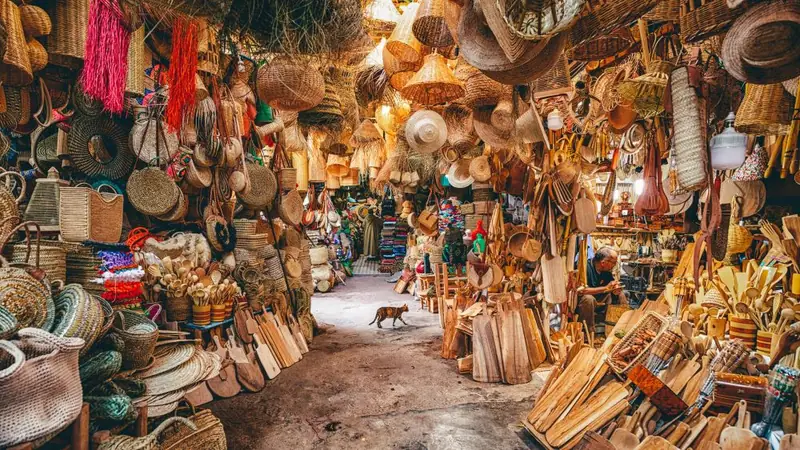
Ask before a photo, demonstration, terrace visit or bag-carrying service whether payment is expected. Greeting somebody does not make a service free, and a tip is different from an agreed fee. Compare quality and terms rather than assuming every first price should be halved. The souk shopping guide explains the decisions beyond vocabulary.
Directions and taxis: combine speech with an address
Fin...? introduces a where question; the exact complete form depends on what follows. Show the place name and map rather than trying to build a complex sentence from one fragment. Similar-sounding hotel names and different medina gates make a street address or host’s meeting point valuable. Confirm the vehicle-accessible destination and the remaining walk separately.
Wqef hna, afak means stop here, please. Use it only where a safe, lawful stop is possible; it is not an instruction for a driver to brake in moving traffic. Bshwiya can also request a slower pace, but a phrase is no guarantee of safe driving. If you are uncomfortable, prioritise getting help or ending the journey safely.
Before boarding, confirm the destination and fare basis with a meter or clear agreement as appropriate. A nod or Wakha does not prove every part of your request was understood. For stations, platforms and last departures, use the ticket and current operator information. Our getting-around guide covers the transport planning a phrase list cannot replace.
Food and drink: a few words are not an allergy protocol
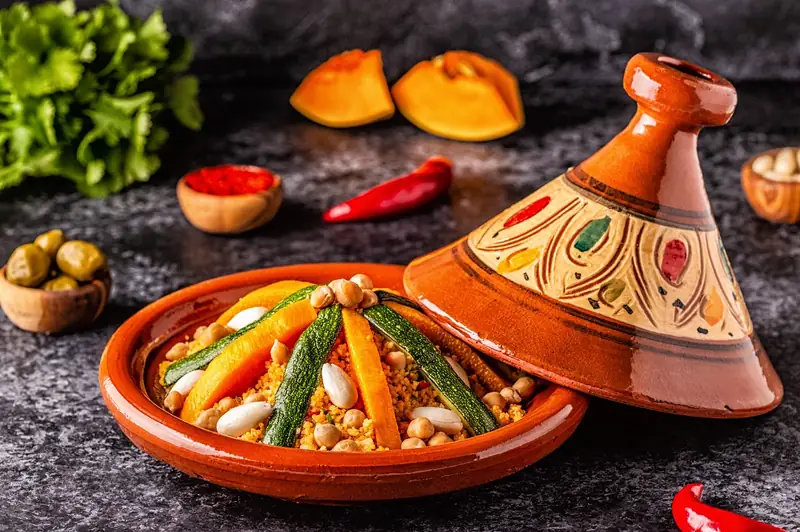
Atay means tea, l-ma water and khobz bread. Bghit... is a useful I would like opening when the item is clear. L-hisab, afak asks for the bill. A menu, pointing politely and confirming quantity can be easier than improvising a full order. Ask about the complete price before agreeing to extras or a dish sold by weight.
Bla lham means without meat, but that alone does not reliably communicate vegetarian, vegan, stock-free or allergy requirements. A vegetable-looking dish may have ingredients you cannot see. For a serious allergy, obtain a carefully checked written explanation naming ingredients and cross-contact, show it before ordering and discuss whether the kitchen can actually meet the need.
Do not rely on pronunciation alone or a stranger’s unverified translation for a potentially life-threatening message. Bring prescribed emergency treatment and a clinician-agreed plan if relevant; seek urgent local help for a reaction rather than trying to perfect a sentence. The Moroccan food guide explains dishes, not a guarantee that any particular meal is suitable.
Numbers one to ten: practise hearing as well as saying
| Number | Darija | Arabic |
|---|---|---|
| 1 | wahed | واحد |
| 2 | juj | جوج |
| 3 | tlata | تلاتة |
| 4 | rb3a | ربعة |
| 5 | khmsa | خمسة |
| 6 | setta | ستة |
| 7 | sb3a | سبعة |
| 8 | tmnya | تمنية |
| 9 | ts3ud | تسعود |
| 10 | 3shra | عشرة |
These are standalone counting forms. Forms can change when a number is used with a noun or inside a larger number, so do not construct prices by simply joining rows. Practise recognising a small quantity, then ask for the numeral in writing when money or a departure time matters.
Distinguish quantity, price, date and time explicitly. A handwritten figure without its unit can still be misunderstood. For tickets and bookings, use the printed date and a clear clock time; for payments, ask for MAD and the total. Check a returned banknote and receipt before leaving, without displaying the rest of your cash.
Respectful conversation and words you may hear
Inshallah means God willing and is used in many contexts about future events; it is not automatically a cancellation or a binding schedule. Bismillah is commonly heard before beginning something, including eating. Learn meanings without turning religious expressions into a performance or using them to pressure someone into an agreement.
Azul is an Amazigh greeting, not a Darija word or proof that every Amazigh-speaking community uses exactly the same forms. Follow how your host identifies their language. French Bonjour, merci and s’il vous plaît may help when shared, just as another language may; do not assume language from someone’s clothing, age or occupation.
Ask permission before recording speech or photographing people. Avoid practising personal questions with staff who are busy, or treating a refusal as an invitation to bargain harder. For behaviour beyond words, read Moroccan culture. Courtesy is useful, but it does not replace consent, access rules or a clear service agreement.
Save an offline phrase card and practise a short exchange
Before departure, save greetings, Ma fhemtsh, your accommodation’s written address, the vehicle meeting point and the host’s contact number. Keep an offline map and enough phone power.
Practise a simple sequence: greet, ask one question, listen, admit uncertainty, confirm in writing and thank. At a café, identify the drink and quantity rather than reciting all the food words you know. In a shop, a written total is a successful conversation, not a failure to speak like a local.
If something serious happens, seek nearby staffed assistance and local emergency help. Point to your location and explain the immediate need using a language or interpreter that works. Do not delay help while searching this page for a perfect phrase. The aim is useful communication and respectful listening, not an exam in accent or a promise of effortless travel.
Frequently asked questions
Do I need fluent Arabic to travel in Morocco?
No, but do not assume everyone speaks your language. Learn a greeting and a way to say you do not understand, then use written addresses, maps and assistance for important details.
Does Afak mean please or you’re welcome?
Afak means please in a request. Bla jmil is one possible reply to thanks; do not use the two as interchangeable translations.
Is Darija the same as standard Arabic?
No. Darija is Moroccan Arabic used in everyday speech; Modern Standard Arabic has formal uses. An Arabic translation app may not reproduce the exact local wording you hear.
What do 3 and 7 mean in Darija spelling?
They represent Arabic sounds in some Latin-based writing, not numbers to pronounce within the word. Here 3 represents ع; 7 is commonly used for ح. Learn through a competent speaker rather than forcing a throat sound.
Can I use these phrases for allergies or emergencies?
Not as your only safeguard. Arrange checked written information for serious dietary needs and a medical plan where relevant; in an emergency seek local help promptly rather than depending on memorised pronunciation.